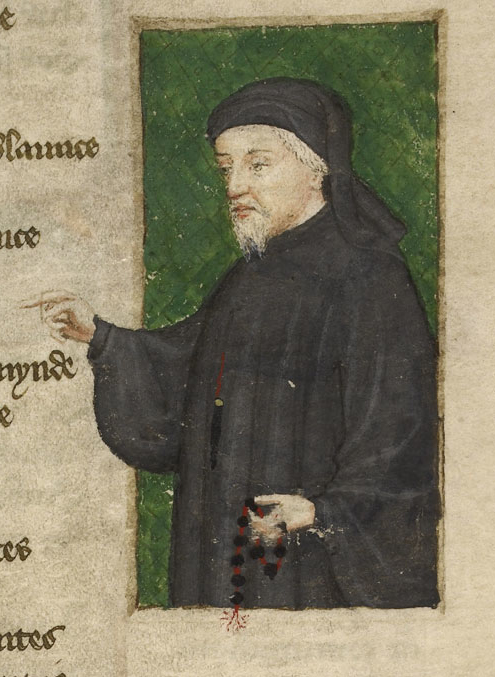
via Wikipedia · CC-BY-SA
76
Ideas
36
Passages
366
Citations
Works cited (2)
Ideas this author touches 76 Ideas · click an Idea to read in context
God24Man18Sin17Love16Happiness15Religion13Virtue And Vice10Family9Justice9Good And Evil8Immortality8Pleasure And Pain8Poetry8Slavery8Punishment7Angel6Cause6Change6Honor6Liberty6Medicine6Wealth6Desire5Education5Knowledge5Law5Life And Death5Memory And Imagination5Animal4Art4Astronomy4Courage4Custom And Convention4Emotion4Nature4Prophecy4Prudence4Relation4Temperance4Truth4War And Peace4Will4Experience3Labor3Language3Necessity And Contingency3Opinion3Rhetoric3Sign And Symbol3Wisdom3World3Beauty2Being2Chance2Eternity2Fate2Quality2State2Tyranny2Aristocracy1Duty1Element1Evolution1Government1Habit1History1Infinity1Matter1Mind1Opposition1Philosophy1Reasoning1Science1Sense1Soul1Time1
This MindMap is generated using weights to determine which ideas this thinker debates with others.
Passages by work
The Canterbury Tales24 passages
Knight's Tale [1902-2482] 191a- 200b✓ correct
Whylom, as olde stories tellen us,
Ther was a duk that highte Theseus;
Of Athenes he was lord and governour,
And in his tyme swich a conquerour,
That gretter was ther noon under the sonne.
Ful many a riche contree hadde he wonne;
What with his wisdom and his chivalrye,
He conquered al the regne of Femenye,
That whylom was y-cleped Scithia;
And weddede the quene Ipolita,
And broghte hir… Read the rest of this passage →
Monies Tale [14,005-012] 434a✓ correct
Aprille with his shoures sote
The droghte of Marche hath perced to the rote,
And bathed every veyne in swich licour,
Of which vertu engendred is the flour;
Whan Zephirus eek with his swete breeth
Inspired hath in every holt and heeth
The tendre croppes, and the yonge sonne
Hath in the Ram his halfe cours y-ronne,
And smale fowles maken melodye,
That slepen al the night with open yë,
(So…
Friar's Tale [6957-7220] 279a-283b / Summons's Prologue 284b-285a✓ correct
Whilom ther was dwellinge in my contree
An erchedeken, a man of heigh degree,
That boldely dide execucioun
In punisshinge of fornicacioun,
Of wicchecraft, and eek of bauderye,
Of diffamacioun, and avoutrye,
Of chirche-reves, and of testaments,
Of contractes, and of lakke of sacraments,
And eek of many another maner cryme
Which nedeth nat rehercen at this tyme;
Of usure, and of symonye… Read the rest of this passage →
Manciple's Tale [17,104-135] 490a-b ] 23 HOBBES* Leviathan, PART i, 61a-d; 64a-c✓ correct
Phebus dwelled here in this erthe adoun,
As olde bokes maken mencioun,
He was the moste lusty bachiler
In al this world, and eek the beste archer;
He slow Phitoun, the serpent, as he lay
Slepinge agayn the sonne upon a day;
And many another noble worthy dede
He with his bowe wroghte, as men may rede.
Pleyen he coude on every minstralcye,
And singen, that it was a melodye,
To heren of… Read the rest of this passage →
Nun's Priest's Tale [15,282-287] 457b / Manciple's Tale [17,104-144] 490a-b✓ correct
A povre widwe, somdel stope in age,
Was whylom dwelling in a narwe cotage,
Bisyde a grove, stonding in a dale.
This widwe, of which I telle yow my tale,
Sin thilke day that she was last a wyf,
In pacience ladde a ful simple lyf,
For litel was hir catel and hir rente;
By housbondrye, of such as God hir sente,
She fond hir-self, and eek hir doghtren two.
Three large sowes hadde she, and… Read the rest of this passage →
Tale of Wife of Bath [6701-6758] 274b-275b✓ correct
In tholde dayes of the king Arthour,
Of which that Britons speken greet honour,
All was this land fulfild of fayerye.
The elf-queen, with hir Ioly companye,
Daunced ful ofte in many a grene mede;
This was the olde opinion, as I rede,
I speke of manye hundred yeres ago;
But now can no man see none elves mo.
For now the grete charitee and prayeres
Of limitours and othere holy freres,
That… Read the rest of this passage →
Physician's Tale [11,941-972] 366b- 367a✓ correct
A knight that called was Virginius,
Fulfild of honour and of worthinesse,
And strong of freendes and of greet richesse.
This knight a doghter hadde by his wyf,
No children hadde he mo in al his lyf.
Fair was this mayde in excellent beautee
Aboven every wight that man may see;
For nature hath with sovereyn diligence
Y-formed hir in so greet excellence,
As though she wolde seyn, ‘lo! I,… Read the rest of this passage →
Intro, to Man of Law's Prologue [4465-4510] 234b-235b / Prologue to Mehbeus 400b-401a / U Envoi 550a-b✓ correct
With thurst, with cold, with hunger so confounded!
To asken help thee shameth in thyn herte;
If thou noon aske, with nede artow so wounded,
That verray nede unwrappeth al thy wounde hid!
Maugree thyn heed, thou most for indigence
Or stele, or begge, or borwe thy despence!
Thou blamest Crist, and seyst ful bitterly,
He misdeparteth richesse temporal;
Thy neighebour thou wytest… Read the rest of this passage →
Franklin's Tale [11,582-605] 360b 23 HOBBES; Leviathan, PART iv, 267a-b✓ correct
Ther was a knight that loved and dide his payne
To serve a lady in his beste wyse;
And many a labour, many a greet empryse
He for his lady wroghte, er she were wonne.
For she was oon, the faireste under sonne,
And eek therto come of so heigh kinrede,
That wel unnethes dorste this knight, for drede,
Telle hir his wo, his peyne, and his distresse.
But atte laste, she, for his… Read the rest of this passage →
Tale ofMelibeus, par 37 417b✓ correct
Melibeus, mighty and riche, bigat up-on his wyf that called was Prudence, a doghter which that called was Sophie. /
§ 2. Upon a day bifel, that he for his desport is went in-to the feeldes him to pleye. / His wyf and eek his doghter hath he left inwith his hous, of which the dores weren fast y-shette. / Thre of his olde foos han it espyed, and setten laddres to the walles of his hous, and by the… Read the rest of this passage →
Tale of Man of Law 236b-255b✓ correct
Surrie whylom dwelte a companye
Of chapmen riche, and therto sadde and trewe,
That wyde-wher senten her spycerye,
Clothes of gold, and satins riche of hewe;
Her chaffar was so thrifty and so newe,
That every wight hath deyntee to chaffare
With hem, and eek to sellen hem hir ware.
Now fel it, that the maistres of that sort
Han shapen hem to Rome for to wende;
Were it for chapmanhode or… Read the rest of this passage →
Canon's Yeoman's Prologue 471b- b 474a / Canon's Yeoman's Tale 474b-487a✓ correct
I dwelt have seven yeer,
And of his science am I never the neer.
Al that I hadde, I have y-lost ther-by;
And god wot, so hath many mo than I.
Ther I was wont to be right fresh and gay
Of clothing and of other good array,
Now may I were an hose upon myn heed;
And wher my colour was bothe fresh and reed,
Now is it wan and of a leden hewe;
Who-so it useth, sore shal he rewe.
And of my… Read the rest of this passage →
Wife of Bath's Prologue [5583-6410] 256a-269b✓ correct
Were in this world, were right y-nough to me
To speke of wo that is in mariage;
For, lordinges, sith I twelf yeer was of age,
Thonked be god that is eterne on lyve,
Housbondes at chirche-dore I have had fyve;
For I so ofte have y-wedded be;
And alle were worthy men in hir degree.
But me was told certeyn, nat longe agon is,
That sith that Crist ne wente never but onis
To wedding in the… Read the rest of this passage →
Parson's Tale, par 60-6 1 529b-530a✓ correct
State super vias et videte et interrogate de viis antiquis, que sit via bona; et ambulate in ea, et inuenietis refrigerium animabus vestris, &c.
§ 1. Our swete lord god of hevene, that no man wole perisse, but wole that we comen alle to the knoweleche of him, and to the blisful lyf that is perdurable, /75 amonesteth us by the prophete Ieremie, that seith in this wyse: / ‘stondeth upon the weyes,… Read the rest of this passage →
Miller's Tale [3448-3464] 217a✓ correct
Whylom ther was dwellinge at Oxenford
A riche gnof, that gestes heeld to bord,
And of his craft he was a Carpenter.
With him ther was dwellinge a povre scoler,
Had lerned art, but al his fantasye
Was turned for to lerne astrologye,
And coude a certeyn of conclusiouns
To demen by interrogaciouns,
If that men axed him in certein houres,
Whan that men sholde have droghte or elles… Read the rest of this passage →
Prioress's Tale [13,418-620] 392a- 395b✓ correct
Lord our lord, thy name how merveillous
Is in this large worlde y-sprad — quod she:—
For noght only thy laude precious
Parfourned is by men of dignitee,
But by the mouth of children thy bountee
Parfourned is, for on the brest soukinge
Som tyme shewen they thyn heryinge.
Wherfor in laude, as I best can or may,
Of thee, and of the whyte lily flour
Which that thee bar, and is a mayde… Read the rest of this passage →
Miller's Prologue [3150-3166] 21 2a / Miller's Tale 212b-223b✓ correct
Here folwen the wordes bitwene the Host and the Millere.
Whan that the Knight had thus his tale y-told,
In al the route nas ther yong ne old
That he ne seyde it was a noble storie,
And worthy for to drawen to memorie;
And namely the gentils everichoon.
Our Hoste lough and swoor, ‘so moot I goon,
This gooth aright; unbokeled is the male;
Lat see now who shal telle another tale:
For… Read the rest of this passage →
Second Nun's Tale [15,787-816] 467a-b 23HoBBEs: Leviathan, PART i, 83a-b; PART n, 137b-138b; 160b; PART m, 165a-167b; 176d- 177c; 181a-186c; 205 b-d; CONCLUSION, 281d- 282a✓ correct
The ministre and the norice un-to vyces,
Which that men clepe in English ydelnesse,
That porter of the gate is of delyces,
To eschue, and by hir contrarie hir oppresse,
That is to seyn, by leveful bisinesse,
Wel oghten we to doon al our entente,
Lest that the feend thurgh ydelnesse us hente.
For he, that with his thousand cordes slye
Continuelly us waiteth to biclappe,
Whan he may man in… Read the rest of this passage →
Pardoner's Tale [12,829-849] 381b / Parson's Tale, par 12-22, 504b-510b✓ correct
Numbered in continuation of the preceding.)
Here biginneth the Pardoners Tale.
In Flaundres whylom was a companye
Of yonge folk, that haunteden folye,
As ryot, hasard, stewes, and tavernes,
Wher-as, with harpes, lutes, and giternes,
They daunce and pleye at dees bothe day and night,
And ete also and drinken over hir might,
Thurgh which they doon the devel sacrifyse
With-in that develes… Read the rest of this passage →
Merchant's Tale [10,160-164] 336a✓ correct
Whylom ther was dwellinge in Lumbardye
A worthy knight, that born was of Pavye,
In which he lived in greet prosperitee;
And sixty yeer a wyflees man was he,
And folwed ay his bodily delyt
On wommen, ther-as was his appetyt,
As doon thise foles that ben seculeer.
And whan that he was passed sixty yeer,
Were it for holinesse or for dotage,
I can nat seye, but swich a greet corage
Hadde… Read the rest of this passage →
Reeve's Prologue [3862-3896] 224a-b / Wife of Bath's Prologue (6051^6062] 2$3b- 264a 25 MONTAIGNE: 33b-c; 156d-158a,c; Essays, 339a-d; 394a-395b; 406c-408b; 429d-430a 26 SHAKESPEARE: 1st Henry VI, ACT n, sc v [i- 16] 12d-13a / 2nd Henry IV, ACT i, sc n [201- 208) 472a-b / Henry V, ACT v, sc n [167-174] J 565a / As You Like It, ACT n, sc vn [137-166] 608d-609a✓ correct
Whan folk had laughen at this nyce cas
Of Absolon and hende Nicholas,
Diverse folk diversely they seyde;
But, for the more part, they loughe and pleyde,
Ne at this tale I saugh no man him greve,
But it were only Osewold the Reve,
By-cause he was of carpenteres craft.
A litel ire is in his herte y-laft,
He gan to grucche and blamed it a lyte.
‘So theek,’ quod he, ‘ful wel coude I yow… Read the rest of this passage →
Reeve's Tale 225a-232a✓ correct
Ther goth a brook and over that a brigge,
Up-on the whiche brook ther stant a melle;
And this is verray soth that I yow telle.
A Miller was ther dwelling many a day;
As eny pecok he was proud and gay.
Pypen he coude and fisshe, and nettes bete,
And turne coppes, and wel wrastle and shete;
And by his belt he baar a long panade,
And of a swerd ful trenchant was the blade.
A Ioly popper… Read the rest of this passage →
Clerks Prologue 295a-296a✓ correct
Ye ryde as coy and stille as dooth a mayde,
Were newe spoused, sitting at the bord;
This day ne herde I of your tonge a word.
I trowe ye studie aboute som sophyme,
But Salomon seith, “every thing hath tyme.”
For goddes sake, as beth of bettre chere,
It is no tyme for to studien here.
Telle us som mery tale, by your fey;
For what man that is entred in a pley,
He nedes moot unto the pley… Read the rest of this passage →
Clerks Tale [8031-8037] 298a xxx-xxxi 99b-102b, PARADISE, in 109d-110b, xxvi [1-69] 145d-146c✓ correct
Ther is, at the west syde of Itaille,
Doun at the rote of Vesulus the colde,
A lusty playne, habundant of vitaille,
60
Wher many a tour and toun thou mayst biholde,
That founded were in tyme of fadres olde,
And many another delitable sighte,
And Saluces this noble contree highte.
A markis whylom lord was of that londe,
65
As were his worthy eldres him bifore;
And obeisant and redy to… Read the rest of this passage →
Cited under: Angel · Animal · Aristocracy · Art · Astronomy · Beauty · Being · Cause · Change · Courage · Custom And Convention · Desire · Duty · Education · Element · Emotion · Eternity · Evolution · Experience · Family · God · Good And Evil · Government · Habit · Happiness · History · Honor · Immortality · Justice · Knowledge · Labor · Law · Liberty · Life And Death · Love · Man · Matter · Medicine · Memory And Imagination · Nature · Necessity And Contingency · Opinion · Opposition · Philosophy · Pleasure And Pain · Poetry · Prophecy · Prudence · Punishment · Reasoning · Relation · Religion · Rhetoric · Science · Sense · Sign And Symbol · Sin · Slavery · Soul · State · Temperance · Truth · Tyranny · Virtue And Vice · War And Peace · Wealth · Will · Wisdom · World
Troilus and Criseyde4 passages
Troilus and Cressida, BK n, STANZA 149 41a / Physician's Tale [11,941-972] 366b- 367a✓ correct
In lovinge, how his aventures fellen Fro wo to wele, and after out of Ioye, My purpos is, er that I parte fro ye. 5 Thesiphone, thou help me for tendyte Thise woful vers, that wepen as I wryte!
To thee clepe I, thou goddesse of torment, Thou cruel Furie, sorwing ever in peyne; Help me, that am the sorwful instrument 10 That helpeth lovers, as I can, to pleyne! For wel sit it, the sothe for to… Read the rest of this passage →
TroilusandCressida, BK iv, STANZA 154 108b✓ correct
But al to litel, weylaway the whyle, Lasteth swich Ioye, y-thonked be Fortune! That semeth trewest, whan she wol bygyle, And can to foles so hir song entune, That she hem hent and blent, traytour comune; 5 And whan a wight is from hir wheel y-throwe, Than laugheth she, and maketh him the mowe.
From Troilus she gan hir brighte face Awey to wrythe, and took of him non hede, But caste him clene out… Read the rest of this passage →
Troilus and Cressida, BK v, STANZA 263-267 154b-155a / Second Nun's Tale 463b- 471 b / Parson's Tale, par 6, 497a; par 21 509a-b; par 31 517b-518b✓ correct
Aprochen gan the fatal destinee That Ioves hath in disposicioun, And to yow, angry Parcas, sustren three, Committeth, to don execucioun; For which Criseyde moste out of the toun, 5 And Troilus shal dwelle forth in pyne Til Lachesis his threed no lenger twyne. —
The golden-tressed Phebus heighe on-lofte Thryes hadde alle with his bemes shene The snowes molte, and Zephirus as ofte 10 Y-brought… Read the rest of this passage →
Troilus and Cressida, BK H, STANZA 53-59 28b-29a; STANZA 100-115 34b-36b; 100-115 34b~36b; STANZA 162-163 42b-43a; BK III, STANZA 22 25 57b; ST\NZA 36-50 59a- 61a / Knight's Tale [3041-3056] 210a✓ correct
O blisful light of whiche the bemes clere 1 Adorneth al the thridde hevene faire! O sonnes lief, O Ioves doughter dere, Plesaunce of love, O goodly debonaire, In gentil hertes ay redy to repaire! 5 O verray cause of hele and of gladnesse, Y-heried be thy might and thy goodnesse!
In hevene and helle, in erthe and salte see Is felt thy might, if that I wel descerne; As man, brid, best, fish, herbe… Read the rest of this passage →
Cited under: Art · Beauty · Being · Cause · Chance · Change · Courage · Custom And Convention · Desire · Emotion · Experience · Family · Fate · God · Good And Evil · Happiness · Honor · Infinity · Justice · Knowledge · Language · Liberty · Life And Death · Love · Man · Memory And Imagination · Mind · Necessity And Contingency · Opinion · Pleasure And Pain · Poetry · Prophecy · Prudence · Quality · Relation · Religion · Rhetoric · Sign And Symbol · Temperance · Time · Truth · Virtue And Vice · Will · Wisdom · World