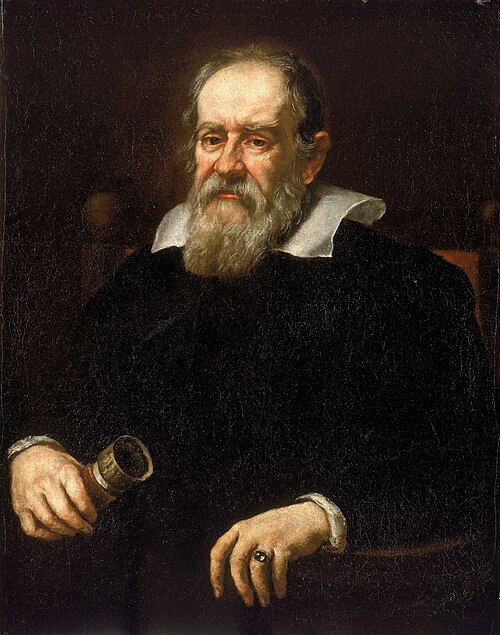
via Wikipedia · CC-BY-SA
34
Ideas
4
Passages
141
Citations
Works cited (1)
Ideas this author touches 34 Ideas · click an Idea to read in context
This MindMap is generated using weights to determine which ideas this thinker debates with others.
Passages by work
Dialogues Concerning Two New Sciences4 passages
Two New Sciences, FIRST DAY, 132c; SECOND DAY, 187b-188c, 195c-d✓ correct
The constant activity which you Venetians display in your famous arsenal suggests to the studious mind a large field for investigation, especially that part of the work which involves mechanics; for in this department all types of instruments and machines are constantly being constructed by many artisans, among whom there must be some who, partly by inherited experience and partly by their own… Read the rest of this passage →
Two New Sciences, SECOND DAY, 187b-188c✓ correct
I were awaiting your arrival we were trying to recall that last consideration which you advanced as a principle and basis for the results you intended to obtain; this consideration dealt with the resistance which all solids offer to fracture and depended upon a certain cement which held the parts glued together so that they would yield and separate only under considerable pull [potente… Read the rest of this passage →
Two New Sciences, FOURTH DAY, 245b-d 8<r(3) to 9a CHAPTER 5: ASTRONOMY 105✓ correct
Simplicio is here on time; so let us without delay take up the question of motion. The text of our Author is as follows:
The Motion of Projectiles
In the preceding pages we have discussed the properties of uniform motion and of motion naturally accelerated along planes of all inclinations. I now propose to set forth those properties which belong to a body whose motion is compounded of two other… Read the rest of this passage →
Two New Sciences, THIRD DAY, 214d✓ correct
This discussion is divided into three parts; the first part deals with motion which is steady or uniform; the second treats of motion as we find it accelerated in nature; the third deals with the so-called violent motions and with projectiles.
Uniform Motion
In dealing with steady or uniform motion, we need a single definition which I give as follows:
Definition
By steady or uniform motion, I… Read the rest of this passage →
Cited under: Animal · Astronomy · Being · Cause · Change · Definition · Element · Experience · God · Hypothesis · Induction · Infinity · Knowledge · Language · Life And Death · Logic · Mathematics · Matter · Mechanics · Nature · One And Many · Opposition · Physics · Progress · Quality · Quantity · Reasoning · Relation · Science · Sense · Space · Time · Truth · World