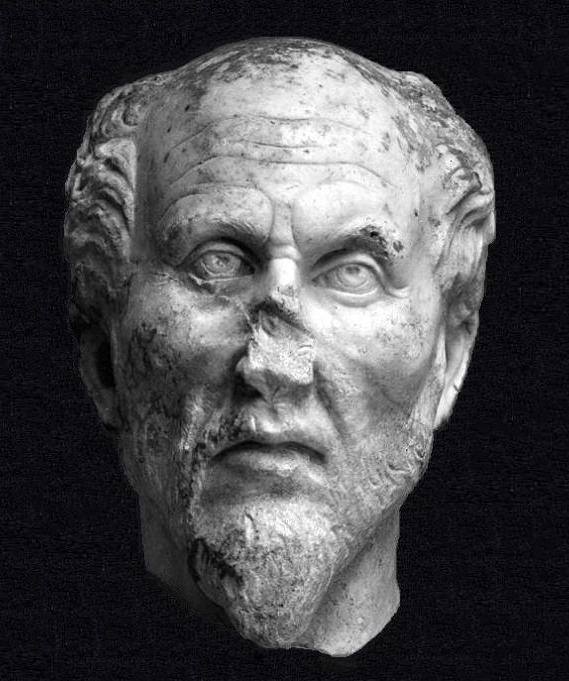
via Wikipedia · CC-BY-SA
77
Ideas
39
Passages
525
Citations
Works cited (1)
Ideas this author touches 77 Ideas · click an Idea to read in context
Being25One And Many22Change19Good And Evil18God17Knowledge17Soul17Man14Sense14Beauty13Mind13Quantity12Art11Element11Memory And Imagination11Astronomy10Nature10Pleasure And Pain10Quality10Will10Education9Opposition9Time9World9Cause8Form8Infinity8Love8Matter8Chance7Happiness7Immortality7Relation7Same And Other7Space7Eternity6Liberty6Virtue And Vice6Emotion5Idea5Life And Death5Medicine5Necessity And Contingency5Universal And Particular5Animal4Definition4Desire4Habit4Language4Philosophy4Poetry4Wisdom4Angel3Courage3Dialectic3Logic3Temperance3Truth3Fate2Mathematics2Mechanics2Metaphysics2Opinion2Sign And Symbol2Experience1Family1Judgment1Justice1Principle1Prophecy1Punishment1Reasoning1Religion1Rhetoric1Science1Sin1Tyranny1
This MindMap is generated using weights to determine which ideas this thinker debates with others.
Passages by work
The Six Enneads37 passages
Second Ennead, TR ix, CH 9 70d-72a passim / Third Ennead, TR v 100c-106b / Fourth Ennead, TR HI, CH 14 149d-150a / Fifth Enncad, TR vin, CH 3, 241a …✓ correct
We have seen elsewhere that the Good, the Principle, is simplex, and, correspondingly, primal — for the secondary can never be simplex — that it contains nothing: that it is an integral Unity.
Now the same Nature belongs to the Principle we know as The One. just as the goodness of The Good is essential and not the outgrowth of some prior substance so the Unity of The One is its… Read the rest of this passage →
Second Ennead, TR 11, CH j 40a-41a; CH 3 41c-42a; TR in, CH 2 42c-d / Third Ennead, TR 11, CH 3, 84b; TR iv, CH 6, 99d …✓ correct
We hold that the ordered universe, in its material mass, has existed for ever and will for ever endure: but simply to refer this perdurance to the Will of God, however true an explanation, is utterly inadequate.
The elements of this sphere change; the living beings of earth pass away; only the Ideal-form [the species] persists: possibly a similar process obtains in the All.
The Will of God is… Read the rest of this passage →
First Ennead, TR i, CH n 5b-c / Fourth Ennead, TR in, CH 23 153d-154b✓ correct
Pleasure and distress, fear and courage, desire and aversion, where have these affections and experiences their seat?
Clearly, either in the Soul alone, or in the Soul as employing the body, or in some third entity deriving from both. And for this third entity, again, there are two possible modes: it might be either a blend or a distinct form due to the blending.
And what applies to the… Read the rest of this passage →
Fourth Ennead, TR in, CH 23, 154b✓ correct
On what subject can we more reasonably expend the time required by minute discussion and investigation? Apart from much else, it is enough that such an enquiry illuminates two grave questions: of what sphere the soul is the principle, and whence the soul itself springs. Moreover, we will be only obeying the ordinance of the God who bade us know ourselves.
Our general instinct to seek and learn,… Read the rest of this passage →
Fourth Ennead, TR HI, CH 23, 154b✓ correct
The Six Enneads, by Plotinus : part4.1
The Six Enneads, by Plotinus
First Tractate.
On the Essence of the Soul (1).
1. In the Intellectual Kosmos dwells Authentic Essence, with the Intellectual-Principle [Divine Mind] as the noblest of its content, but containing also souls, since every soul in this lower sphere has come thence: that is the world of unembodied spirits while to our world…
Third Ennead, TR iv, CH 2, 98a✓ correct
Idea, come into being; but, in our view, the Soul generates by its motion, to which is due the sensitive faculty — that in any of its expression-forms — Nature and all forms of life down to the vegetable order. Even as it is present in human beings the Soul carries its Expression-form [Hypostasis] with it, but is not the dominant since it is not the whole man (humanity including the Intellectual… Read the rest of this passage →
Fifth Ennead, TR vui, CH i 239b- 240a '✓ correct
Principle, the veritably and essentially intellective, can this be conceived as ever falling into error, ever failing to think reality?
Assuredly no: it would no longer be intelligent and therefore no longer Intellectual-Principle: it must know unceasingly — and never forget; and its knowledge can be no guesswork, no hesitating assent, no acceptance of an alien report. Nor can it call on… Read the rest of this passage →
Third Ennead, TR vin, CH 3-4 130a-131a / Fourth Ennead, TR in, CH 10 147c- 148b; TR iv, CH 31, 174d-175a / Fifth Ennead, TR viii, CH 1-2 239b-240c; CH 5, 242a; TR ix, CH 2, 247a / Sixth Ennead, TR n, CH ii, 275c✓ correct
In our theory, feelings are not states; they are action upon experience, action accompanied by judgement: the states, we hold, are seated elsewhere; they may be referred to the vitalized body; the judgement resides in the Soul, and is distinct from the state — for, if it is not distinct, another judgement is demanded, one that is distinct, and, so, we may be sent back for ever.
Still, this… Read the rest of this passage →
First Ennead, TR vi, CH 2-3 21d- 23a / Fifth Ennead, TR vin, CH 1-2 239b-240c; TR ix, CH 2, 247a✓ correct
Beauty addresses itself chiefly to sight; but there is a beauty for the hearing too, as in certain combinations of words and in all kinds of music, for melodies and cadences are beautiful; and minds that lift themselves above the realm of sense to a higher order are aware of beauty in the conduct of life, in actions, in character, in the pursuits of the intellect; and there is the beauty of the… Read the rest of this passage →
Fourth Ennead, TR iv, CH 31, 174d- 175a / Fifth Ennead, TR vin, CH 5, 242a✓ correct
What, then, will be the Soul’s discourse, what its memories in the Intellectual Realm, when at last it has won its way to that Essence?
Obviously from what we have been saying, it will be in contemplation of that order, and have its Act upon the things among which it now is; failing such Contemplation and Act, its being is not there. Of things of earth it will know nothing; it will not, for… Read the rest of this passage →
Fifth Ennead, TR vin, CH i 239b- i3] 270c-271a / BK i, CH i Metaphysics, 240a b
There is a principle having intellection of the external and another having self-intellection and thus further removed from duality.
Even the first mentioned is not without an effort towards the pure unity of which it is not so capable: it does actually contain its object, though as something other than itself.
In the self-intellective, there is not even this distinction of being:… Read the rest of this passage →
First Ennead, TR in 10a-12b✓ correct
What art is there, what method, what discipline to bring us there where we must go?
The Term at which we must arrive we may take as agreed: we have established elsewhere, by many considerations, that our journey is to the Good, to the Primal-Principle; and, indeed, the very reasoning which discovered the Term was itself something like an initiation.
But what order of beings will attain the… Read the rest of this passage →
Third Ennead, TR VH, CH 7-8 122d- 124c; CH 11-13 126a-129a✓ correct
Spirit, a state of mind? Or is it, perhaps, sometimes to be thought of as a God or Spirit and sometimes merely as an experience? And what is it essentially in each of these respects?
These important questions make it desirable to review prevailing opinions on the matter, the philosophical treatment it has received and, especially, the theories of the great Plato who has many passages dealing… Read the rest of this passage →
Second Ennead, TR in, CH 5, 43d- 44a✓ correct
That the circuit of the stars indicates definite events to come but without being the cause direct of all that happens, has been elsewhere affirmed, and proved by some modicum of argument: but the subject demands more precise and detailed investigation for to take the one view rather than the other is of no small moment.
The belief is that the planets in their courses actually produce not merely… Read the rest of this passage →
Fifth Ennead, TR vm, CH 1-3 239b- : par 20 24b-c; par 24-27 25b-26a; BK vn, par 23 241a✓ correct
What can it be that has brought the souls to forget the father, God, and, though members of the Divine and entirely of that world, to ignore at once themselves and It?
The evil that has overtaken them has its source in self-will, in the entry into the sphere of process, and in the primal differentiation with the desire for self ownership. They conceived a pleasure in this freedom and largely…
Third Ennead, TR i, CH 4 79d-80a; TR ii, CH 1-2 82c-83d; TR vui, en 8-10 132d- 136a; TR ix, CH 3 137b-138a,c / Fifth Ennead,✓ correct
In the two orders of things — those whose existence is that of process and those in whom it is Authentic Being — there is a variety of possible relation to Cause.
Cause might conceivably underly all the entities in both orders or none in either. It might underly some, only, in each order, the others being causeless. It might, again, underly the Realm of Process universally while in the Realm of… Read the rest of this passage →
Sixth Ennead, TR i, CH 2-3 252c- 253b; CH 10 257b-258b; CH 25 265b-d; TR in, CH 2-10 281c-286d✓ correct
Philosophy at a very early stage investigated the number and character of the Existents. Various theories resulted: some declared for one Existent, others for a finite number, others again for an infinite number, while as regards the nature of the Existents — one, numerically finite, or numerically infinite — there was a similar disagreement. These theories, in so far as they have been adequately… Read the rest of this passage →
Second Ennead, TR vi 60c-62d / Sixth Ennead, TR i, CH 4-24 253b-265b; CH 30 268b-c✓ correct
Being as the substance stripped of all else, while Reality is this same thing, Being, accompanied by the others — Movement, Rest, Identity, Difference — so that these are the specific constituents of Reality?
The universal fabric, then, is Reality in which Being, Movement, and so on are separate constituents.
Now Movement has Being as an accident and therefore should have Reality as an… Read the rest of this passage →
Second Ennead, TR v 57d-60c / Third Ennead, TR vi, CH 7, llla-b; CH 1 1, 113b- c; CH 14-15 115b-116c …✓ correct
A distinction is made between things existing actually and things existing potentially; a certain Actuality, also, is spoken of as a really existent entity. We must consider what content there is in these terms.
Can we distinguish between Actuality [an absolute, abstract Principle] and the state of being-in-act? And if there is such an Actuality, is this itself in Act, or are the two quite… Read the rest of this passage →
Fourth Ennead, TR vin, CH 6 203d- 204b / Sixth Ennead, TR i, CH 3 253a-b; CH 5, 254c-d; CH 15 260c-d; CH 25 265b-d; TR n, CH 14-15 276c-277b; TR in, CH 3 282a-c; CH 6 284a-c; CH 8, 285b-c✓ correct
Perceptions are no imprints, we have said, are not to be thought of as seal-impressions on soul or mind: accepting this statement, there is one theory of memory which must be definitely rejected.
Memory is not to be explained as the retaining of information in virtue of the lingering of an impression which in fact was never made; the two things stand or fall together; either an impression is… Read the rest of this passage →
Second Ennead, TR iv, CH 2-4 50b-51a; CH 6 51d-52a …✓ correct
By common agreement of all that have arrived at the conception of such a Kind, what is known as Matter is understood to be a certain base, a recipient of Form-Ideas. Thus far all go the same way. But departure begins with the attempt to establish what this basic Kind is in itself, and how it is a recipient and of what.
To a certain school, body-forms exclusively are the Real Beings; existence is… Read the rest of this passage →
Sixth Ennead, TR vin, CH n 348b-c 3c. The nature and sources of our knowledge of causes✓ correct
It is suggested that multiplicity is a falling away from The Unity, infinity being the complete departure, an innumerable multiplicity, and that this is why unlimit is an evil and we evil at the stage of multiplicity.
A thing, in fact, becomes a manifold when, unable to remain self-centred, it flows outward and by that dissipation takes extension: utterly losing unity it becomes a manifold since… Read the rest of this passage →
Sixth Ennead, TR in, CH 24 295b-c; CH 27 296b-297a✓ correct
We have now explained our conception of Reality [True Being] and considered how far it agrees with the teaching of Plato. We have still to investigate the opposed principle [the principle of Becoming].
There is the possibility that the genera posited for the Intellectual sphere will suffice for the lower also; possibly with these genera others will be required; again, the two series may differ… Read the rest of this passage →
Third Ennead, TR vii, CH 8-9 123b-✓ correct
Kind, the other in the realm of Process, in our own Universe”; and, by continually using the words and assigning every phenomenon to the one or the other category, we come to think that, both by instinct and by the more detailed attack of thought, we hold an adequate experience of them in our minds without more ado.
When, perhaps, we make the effort to clarify our ideas and close into the heart… Read the rest of this passage →
Sixth Ennead, TR v, CH 2 306a-b 19 AQUINAS: Summa Theologica, PART i, Q i, A 7, REP I 7a-C; Q 2, A I, REP 2 lOd-lld,' A 2, REP 2 lld-12c; Q 3, A 5, ANS 17c-18b; Q 17, A 3, REP i-2 102d-103c; Q 58, A 5 303c<304c; Q 85, A 6 4S8d-459c✓ correct
The integral omnipresence of a unity numerically identical is in fact universally received; for all men instinctively affirm the god in each of us to be one, the same in all. It would be taken as certain if no one asked How or sought to bring the conviction to the test of reasoning; with this effective in their thought, men would be at rest, finding their stay in that oneness and identity, so… Read the rest of this passage →
First Enncad, TR in, CH 1-3 lOa- lla / Fifth Ennead, TR ix, CH 1-2 246c- 247b 19 AQUINAS* Summa Theologtca, PART I-H, Q 46, A 5, ANS and REP i 815d-816d✓ correct
All human beings from birth onward live to the realm of sense more than to the Intellectual.
Forced of necessity to attend first to the material, some of them elect to abide by that order and, their life throughout, make its concerns their first and their last; the sweet and the bitter of sense are their good and evil; they feel they have done all if they live along pursuing the one and barring… Read the rest of this passage →
First Ennead, TR v, CH 7 20a-c / : Third Ennead, TR vn 119b-129a / Fourth Ennead, TR iv, CH 6-8 161b-162d …✓ correct
Is it possible to think that Happiness increases with Time, Happiness which is always taken as a present thing?
The memory of former felicity may surely be ruled out of count, for Happiness is not a thing of words, but a definite condition which must be actually present like the very fact and act of life.
2. It may be objected that our will towards living and towards expressive activity is… Read the rest of this passage →
Sixth Ennead, TR ix 353d-360d✓ correct
It is in virtue of unity that beings are beings.
This is equally true of things whose existence is primal and of all that are in any degree to be numbered among beings. What could exist at all except as one thing? Deprived of unity, a thing ceases to be what it is called: no army unless as a unity: a chorus, a flock, must be one thing. Even house and ship demand unity, one house, one ship; unity… Read the rest of this passage →
Third Ennead, TR ix 136a-138a,c / Fifth Ennead, TR i, CH 4 209d-210c; CH 6-7 211a-212c; TR in, CH 8-13 219d-224b; TR iv, CH 2-TR ix, CH 14 227b-251d✓ correct
Creator judged that all the content of that essentially living Being must find place in this lower universe also.”
Are we meant to gather that the Ideas came into being before the Intellectual-Principle so that it “sees them” as previously existent?
The first step is to make sure whether the “Living Being” of the text is to be distinguished from the Intellectual-Principle as another thing than… Read the rest of this passage →
First Ennead, TR iv, CH 12 17d / Second Ennead, TR ix, CH 15, 74d-75a / Sixth Ennead, TR vn, CH 26 334c-d; CH 29-30 335d- 336d✓ correct
Happiness one and the same thing with Welfare or Prosperity and therefore within the reach of the other living beings as well as ourselves?
There is certainly no reason to deny well-being to any of them as long as their lot allows them to flourish unhindered after their kind.
Whether we make Welfare consist in pleasant conditions of life, or in the accomplishment of some appropriate task, by… Read the rest of this passage →
Fourth Ennead, TR vn, CH 15 200c BK in, CH 4 [429*19- b 4] 661c-d; CH 5 662c-d; CH 7 [431*15] 663d; CH 8 [432*5-10] 664c✓ correct
We undertook to discuss the question whether sight is possible in the absence of any intervening medium, such as air or some other form of what is known as transparent body: this is the time and place.
It has been explained that seeing and all sense-perception can occur only through the medium of some bodily substance, since in the absence of body the soul is utterly absorbed in the Intellectual… Read the rest of this passage →
Third Ennead, TR n, CH 13 88d- 89b; TR in, CH 4 94c-95c / Fourth Ennead, TR HI, CH 24 154b-d✓ correct
All events and things, good and evil alike, are included under the Universal Reason-Principle of which they are parts — strictly “included” for this Universal Idea does not engender them but encompasses them.
The Reason-Principles are acts or expressions of a Universal Soul; its parts [i.e., events good and evil] are expressions of these Soulparts.
This unity, Soul, has different parts; the… Read the rest of this passage →
Fifth Ennead, TR in, CH 2-4 216b- 217d✓ correct
Are we to think that a being knowing itself must contain diversity, that self-knowledge can be affirmed only when some one phase of the self perceives other phases, and that therefore an absolutely simplex entity would be equally incapable of introversion and of self-awareness?
No: a being that has no parts or phases may have this consciousness; in fact there would be no real self-knowing in an… Read the rest of this passage →
First Ennead, TR ix 34b-d / Third Ennead, TR n, CH 8, 87b✓ correct
You will not dismiss your Soul lest it go forth . . . ” [taking something with it].
For wheresoever it go, it will be in some definite condition, and its going forth is to some new place. The Soul will wait for the body to be completely severed from it; then it makes no departure; it simply finds itself free.
But how does the body come to be separated?
The separation takes place when nothing… Read the rest of this passage →
Fourth Ennead, TR ix, CH 5 206d- b 207a,c B b b✓ correct
Soul of every individual is one thing we deduce from the fact that it is present entire at every point of the body — the sign of veritable unity — not some part of it here and another part there. In all sensitive beings the sensitive soul is an omnipresent unity, and so in the forms of vegetal life the vegetal soul is entire at each several point throughout the organism.
Now are we to hold… Read the rest of this passage →
Third Ennead, TR ii, CH 17 91c-92c 37 FIELDING: Tom Jones, 49a-50c; 152a-155b; 204b,d-205c✓ correct
To make the existence and coherent structure of this Universe depend upon automatic activity and upon chance is against all good sense.
Such a notion could be entertained only where there is neither intelligence nor even ordinary perception; and reason enough has been urged against it, though none is really necessary.
But there is still the question as to the process by which the individual… Read the rest of this passage →
Sixth Ennead, TR iv, CH 15, 304c-d; TR vin, CH i, 343a~b✓ correct
How are we to explain the omnipresence of the soul? Does it depend upon the definite magnitude of the material universe coupled with some native tendency in soul to distribute itself over material mass, or is it a characteristic of soul apart from body?
In the latter case, soul will not appear just where body may bring it; body will meet soul awaiting it everywhere; wheresoever body finds place,… Read the rest of this passage →
Cited under: Angel · Animal · Art · Astronomy · Beauty · Being · Cause · Chance · Change · Courage · Definition · Desire · Dialectic · Education · Element · Emotion · Eternity · Experience · Family · Fate · Form · God · Good And Evil · Habit · Happiness · Idea · Immortality · Infinity · Judgment · Justice · Knowledge · Language · Liberty · Life And Death · Logic · Love · Man · Mathematics · Matter · Mechanics · Medicine · Memory And Imagination · Metaphysics · Mind · Nature · Necessity And Contingency · One And Many · Opinion · Opposition · Philosophy · Pleasure And Pain · Poetry · Principle · Prophecy · Punishment · Quality · Quantity · Reasoning · Relation · Religion · Rhetoric · Same And Other · Science · Sense · Sign And Symbol · Sin · Soul · Space · Temperance · Time · Truth · Tyranny · Universal And Particular · Virtue And Vice · Will · Wisdom · World