Can We Know Anything?
Descartes vs Hume
Descartes, alone by a fire, decides to doubt everything. It is a theatrical move, and Descartes knows it — the Meditations are staged, deliberately, so the reader will doubt alongside him and feel the ground give way. The point is not to end in doubt. It is to find the single thing doubt cannot touch and rebuild knowledge from there.
A century later, David Hume takes up the same question from a quieter room. He does not announce his skepticism; he simply examines what we actually do when we think we know something — how we move from one event to another, how we imagine the future will resemble the past — and shows, politely, that the foundations Descartes hoped to rebuild were never there to begin with. The prose is plain. The conclusion is vertiginous.
In the passages that follow you will read Descartes's opening doubt first, then Hume's dissolution of what we thought doubt was for. Both men are skeptics. They arrive at skepticism from opposite directions. The question to press, passage by passage: if Hume is right, what does Descartes's project even try to do?
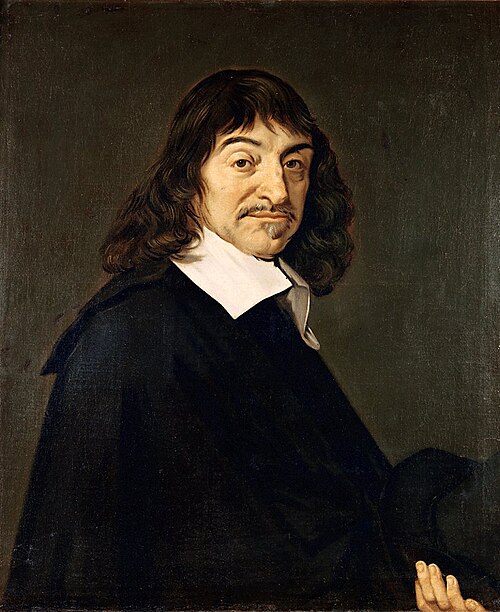 1Descartes1596 – 1650Meditations on First Philosophy · Haldane & Ross / Elwes (GBWW) translation
MEDITATION I Of the things which may be brought within the sphere of the doubtful. It is now some years since I detected how many were the false beliefs that I had from my earliest youth admitted as true, and how doubtful was everything I had since constructed on this basis; and from that time I was convinced that I must once for all seriously undertake to rid myself of all the opinions which I had formerly accepted, and commence to build anew from the foundation, if I wanted to establish any firm and permanent structure in the sciences. But as this enterprise appeared to be a very great one, I waited until I had attained an age so mature that I could not hope that at any later date I should be better fitted to execute my design. This reason caused me to delay so long that I should feel that I was doing wrong were I to occupy in deliberation the time that yet remains to me for action. To-day, then, since very opportunely for the plan I have in view I have delivered my mind from every care [and am happily agitated by no passions] and since I have procured for myself an assured leisure in a peaceable retirement, I shall at last seriously and freely address myself to the general upheaval of all my former opinions. Now for this object it is not necessary that I should show that all of these are false—I shall perhaps never arrive at this end. But inasmuch as reason already persuades me that I ought no less carefully to withhold my assent from matters which are not entirely certain and indubitable than from those which appear to me manifestly to be false, if I am able to find in each one some reason to doubt, this will suflice to justify my rejecting the whole. And for that end it will not be requisite that I should examine each in particular, which would be an endless undertaJdng; for owing to the fact that the destruction of the foundations of necessity brings with it the downfall of the rest of the edifice, I shall only in the first place attack those principles upon which all my former opinions rested. All that up to the present time I have accepted as most true and certain I have learned either from the senses or through the senses; but it is sometimes proved to me that these senses are deceptive, and it is wiser not to trust entirely to any tiling by which we have once been deceived. But it may be that although the senses sometimes deceive us concerning things which are hardly perceptible, or very far away, there are yet many others to be met with as to which we cannot reasonably have any doubt, although we recognise them by their means. For example, there is the fact that I am here, seated by the fire, attired in a dressing gown, having this paper in my hands and other similar matters. And how could I deny that these hands and this body are mine, were it not perhaps that I compare myself to certain persons, devoid of sense, whose cerebella are so troubled and clouded by the violent vapours of black bile, that they constantly assure us that they think they are kings when they are really quite poor, or that they are clothed in purple when they are really without covering, or who imagine that they have an earthenware head or are nothing but pumpkins or are made of glass. But they are mad, and I should not be any the less insane were I to follow examples so extravagant. At the same time I must remember that I am a man, and that consequently I am in the habit of sleeping, and in my dreams representing to myself the same things or sometimes even less probable things, than do those who are insane in their waking moments. How often has it happened to me that in the night I dreamt that I found myself ia this particular
place, that I was dressed and seated near the fire, whilst in reality I was lying undressed in bed! At this moment it does indeed seem to me that it is with eyes awake that I am looking at this paper; that this head which I move is not asleep, that it is deliberately and of set purpose that I extend my hand and perceive it; what happens in sleep does not appear so clear nor so distinct as does all this. But in thinking over this I remind myself that on many occasions I have in sleep been deceived by similar illusions, and in dwelling carefully on this reflection I see so manifestly that there are no certain indications by which we may clearly distinguish wakefulness from sleep that I am lost in astonishment. And my astonishment is such that it is almost capable of persuading me that I now dream. Now let us assume that we are asleep and that all these particulars, e.g. that we open our eyes, shake our head, extend our hands, and so on, are but false delusions; and let us reflect that possibly neither our hands nor our whole body are such as they appear to us to be. At the same time we must at least confess that the things wliich are represented to us in sleep are like painted representations which can only have been formed as the counterparts of something real and true, and that in this way those general things at least, i.e. eyes, a head, hands, and a whole body, are not imaginary things, but things really existent. For, as a matter of fact, painters, even when they study with the greatest skill to represent sirens and satyrs by forms the most strange and extraordinary, cannot give them natures which are entirely new, but merely make a certain medley of the members of different animals; or if their imagination is extravagant enough to invent something so novel that nothing similar has ever before been seen, and that then their work represents a thing purely fictitious and absolutely false, it is certain all the same that the colours of which this is composed are necessarily real. And for the same reason, although these general things, to wit, [a body], eyes, a head, hands, and such like, may be imaginary, w’e are bound at the same time to confess that there are at least some other objects yet more simple and more universal, which are real and true; and of these just in the same way as with certain real colours, aU these images of things which dwell in our thoughts, whether true and real or false and fantastic, are formed. To such a class of things pertains corporeal nature in general, and its extension, the figure of extended things, their quantity or uiagiii. tude and number, as also the place in which they are, the time wliicli measures their duration, and so on. That is possibly wliy our reasoning is uot unjust when wn cnncludo from this that Phy^ ics. Astronomy, Medicine ami all other sci. ences which have as tlndr end the considera. tion of composite things, arc very dubious and uncertain; but that Ariiihmctic,, Geometry and other sciences of that kind which only treat of things that arc very simple and very general without taking great 1, rouble to ascertaia whether they arc actually existent or not, contain some measure of certainty and an element of the indubitable, h’or whether I am awake or asleep, two and three together always form five, and the square can never have more than four sides, and it docs not seem possible that truths 80 clear and apparent can be suspected of any falsity [or umiertaintyj. Nevertheless I have long luul fixed in my mind the belief that an all-powerful Clod existed by whom I have be(m (a-eated siic.li as I am. But how do I know tliat I le has not brought it to pass that there is no earth, no heaven, no extended body, no magnitmUi, no [)lace, and that nevertheless [I possess the ]iorc.eption8 of all these things and that] they seem to me to exist just exactly as I now sec thorn? And, besides, as I sometimes imagine that others deceive themselves in the things which they think they know best, how do I know that I am not deceived every time that I add two and tluree, or count the sides of a srjuaro, or judge of things yet simpler, if anything simpler can be imagined? But possibly God has not desired that I should be thus deceived, for lie is said to be supremely good. If, however, it is contrary to His goodness to have maile me such that I constantly deceive myself, it would also appear to be contrary to His goodness to permit mo to be sometime.? deceived, and nevertheless I cannot doubt that Ho does permit tliis. There may indeed be those who would prefer to deny the existence of a God so powerful, rather than believe that all other things are uncertain. But let us not oppose them for the present, and grant that all that is here said of a God is a fable; nevertheless in whatever way they suppose that I have arrived at the state of being that I have reached—^whether they attribute it to fate or to accident, or make out that it is by a continual succession of antecedents, or by some other method—since to
err and deceive oneself is a defect, it is clear that the greater will be the probabilitj’’ of my being so imperfect as to deceive myself ever, as is the Author to whom they assign my origin the less powerful. To these reasons I have certainly nothing to reply, but at the end I feel constrained to confess that there is nothing in all that I formerly believed to be true, of which I cannot in some measure doubt, and that not merely through want of thought or through lenity, but for reasons which are very powerful and maturely considered; so that henceforth I ought not the less carefully to refrain from giving credence to these opinions than to that w^hich is manifestly false, if I desire to arrive at any certainty [in the sciences]. But it is not sufficient to have made these remarks, we must also be careful to keep them in mind. For these ancient and commonly held opinions still revert frequently to my mind, long and familiar custom having given them the right to occupy my mind against my inclination and rendered them almost masters of my belief; nor will I ever lose the habit of deferring to them or of placing my confidence in them, so long as I consider them as they really are, i.e. opinions in some measure doubtful, as I have just shown, and at the same time highly probable, so that there is much more reason to believe in than to deny them. That is why I consider that I shall not be acting amiss, if, taking of set purpose a contrary belief, I allow myself to be deceived, and for a certain time pretend that all these opinions are entirely false and imaginary, until at last, having thus balanced my former prejudices with my latter [so that they cannot divert my opinions more to one side than to the other], my judgment will no longer be dominated by bad usage or turned away from the right knowledge of the truth. For I am assured that there can be neither peril nor error in this course, and that I cannot at present yield too much to distrust, since I am not considering the question of action, but only of knowledge. I shall then suppose, not that God who is supremely good and the fountain of truth, but some evil genius not less powerful than deceitful, has employed his whole energies in deceiving me; I shall consider that the heavens, the earth, colours, figures, sound, and all other external things are nought but the illusions and dreams of which this genius has availed himself in order to lay traps for my credulity; I shall consider myself as having no hands, no eyes, no flesh, no blood, nor any senses, yet 77 falsely belie^dng myself to possess all these tilings; I shall remain obstinately attached to this idea, and if by this means it is not in my powder to arrive at the knowledge of any truth, I may at least do what is in my power [i.e. suspend my judgment], and with firm purpose avoid giving credence to any false thing, or being imposed upon by this arch deceiver, how^ever powerful and deceptive he may be. But this task is a laborious one, and insensibly a certain lassitude leads me into the course of my ordinary life. And just as a captive who in sleep enjoys an imaginary liberty, when he begins to suspect that his liberty is but a dream, fears to awaken, and conspires wdth these agreeable illusions that the deception may be prolonged, so insensibly of my owm accord I fall back into my former opinions, and I dread awmkening from this slumber, lest the laborious wakefulness which would foUow the tranquillity of this repose should have to be spent not in daylight, but in the excessive darkness of the difficulties w'hich have just been discussed. MEDITATION II Of the Nature of the Human Mind; and that it is more easily known than the Body. The Meditation of yesterday filled my mind with so many doubts that it is no longer in my power to forget them. And yet I do not see in what manner I can resolve them; and, just as if I had all of a sudden fallen into very deep water, I am so disconcerted that I can neither make certain of setting my feet on the bottom, nor can I swim and so support myself on the surface. I shall nevertheless make an effort and follow anew the same path as that on which I yesterday entered, i.e. I shall proceed by setting aside all that in which the least doubt could be supposed to exist, just as if I had discovered that it was absolutely false; and I shall ever follow in this road imtil I have met wdth something which is certain, or at least, if I can do nothing else, until I have learned for certain that there is nothing in the world that is certain. Archimedes, in order that he might draw the terrestrial globe out of its place, and transport it elsewhere, demanded only that one point should be fixed and immoveable; in the same way I shall have the right to conceive high hopes if I am happy enough to discover one thing only which is certain and indubitable.
— Descartes, Meditations on First Philosophy
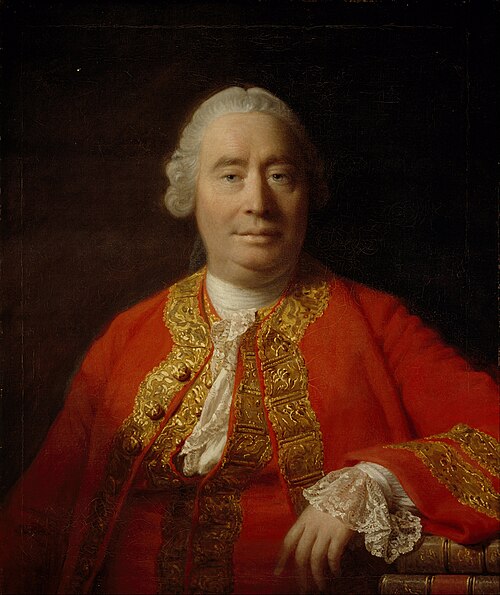 2Hume1711 – 1776An Enquiry Concerning Human Understanding · Section 10
THERE is, in Dr. Tillotson's writings, an argument against the real presence, which is as concise, and elegant, and strong as any argument can possibly be supposed against a doctrine, so little worthy of a serious refutation. It is acknowledged on all hands, says that learned prelate, that the authority, either of the scripture or of tradition, is founded merely in the testimony of the Apostles, who were eye-witnesses to those miracles of our Saviour, by which he proved his divine mission. Our evidence, then, for, the truth of the Christian religion is less than the evidence for the truth of our senses; because, even in the first authors of our religion, it was no greater; and it is evident it must diminish in passing from them to their disciples; nor can any one rest such confidence in their testimony, as in the immediate object of his senses. But a weaker evidence can never destroy a stronger; and therefore, were the doctrine of the real presence ever so clearly revealed in scripture, it were directly contrary to the rules of just reasoning to give our assent to it. It contradicts sense, though both the scripture and tradition, on which it is supposed to be built, carry not such evidence with them as sense; when they are considered merely as external evidences, and are not brought home to every one's breast, by the immediate operation of the Holy Spirit.
Nothing is so convenient as a decisive argument of this kind, which must at least silence the most arrogant bigotry and superstition, and free us from their impertinent solicitations. I flatter myself, that I have discovered an argument of a like nature, which, if just, will, with the wise and learned, be an everlasting check to all kinds of superstitious delusion, and consequently, will be useful as long as the world endures. For so long, I presume, will the accounts of miracles and prodigies be found in all history, sacred and profane.
Though experience be our only guide in reasoning concerning matters of fact; it must be acknowledged, that this guide is not altogether infallible, but in some cases is apt to lead us into errors. One, who in our climate, should expect better weather in any week of June than in one of December, would reason justly, and conformably to experience; but it is certain, that he may happen, in the event, to find himself mistaken. However, we may observe, that, in such a case, he would have no cause to complain of experience; because it commonly informs us beforehand of the uncertainty, by that contrariety of events, which we may learn from a diligent observation. All effects follow not with like certainty from their supposed causes. Some events are found, in all countries and all ages, to have been constantly conjoined together: Others are found to have been more variable, and sometimes to disappoint our expectations; so that, in our reasonings concerning matter of fact, there are all imaginable degrees of assurance, from the highest certainty to the lowest species of moral evidence.
A wise man, therefore, proportions his belief to the evidence. In such conclusions as are founded on an infallible experience, he expects the event with the last degree of assurance, and regards his past experience as a full proof of the future existence of that event. In other cases, he proceeds with more caution: he weighs the opposite experiments: he considers which side is supported by the greater number of experiments: to that side he inclines, with doubt and hesitation; and when at last he fixes his judgement, the evidence exceeds not what we properly call probability. All probability, then, supposes an opposition of experiments and observations, where the one side is found to overbalance the other, and to produce a degree of evidence, proportioned to the superiority. A hundred instances or experiments on one side, and fifty on another, afford a doubtful expectation of any event; though a hundred uniform experiments, with only one that is contradictory, reasonably beget a pretty strong degree of assurance. In all cases, we must balance the opposite experiments, where they are opposite, and deduct the smaller number from the greater, in order to know the exact force of the superior evidence.
To apply these principles to a particular instance; we may observe, that there is no species of reasoning more common, more useful, and even necessary to human life, than that which is derived from the testimony of men, and the reports of eye-witnesses and spectators. This species of reasoning, perhaps, one may deny to be founded on the relation of cause and effect. I shall not dispute about a word. It will be sufficient to observe that our assurance in any argument of this kind is derived from no other principle than our observation of the veracity of human testimony, and of the usual conformity of facts to the reports of witnesses. It being a general maxim, that no objects have any discoverable connexion together, and that all the inferences, which we can draw from one to another, are founded merely on our experience of their constant and regular conjunction; it is evident, that we ought not to make an exception to this maxim in favour of human testimony, whose connexion with any event seems, in itself, as little necessary as any other. Were not the memory tenacious to a certain degree; had not men commonly an inclination to truth and a principle of probity; were they not sensible to shame, when detected in a falsehood: were not these, I say, discovered by experience to be qualities, inherent in human nature, we should never repose the least confidence in human testimony. A man delirious, or noted for falsehood and villainy, has no manner of authority with us.
And as the evidence, derived from witnesses and human testimony, is founded on past experience, so it varies with the experience, and is regarded either as a proof or a probability, according as the conjunction between any particular kind of report and any kind of object has been found to be constant or variable. There are a number of circumstances to be taken into consideration in all judgements of this kind; and the ultimate standard, by which we determine all disputes, that may arise concerning them, is always derived from experience and observation. Where this experience is not entirely uniform on any side, it is attended with an unavoidable contrariety in our judgements, and with the same opposition and mutual destruction of argument as in every other kind of evidence. We frequently hesitate concerning the reports of others. We balance the opposite circumstances, which cause any doubt or uncertainty; and when we discover a superiority on any side, we incline to it; but still with a diminution of assurance, in proportion to the force of its antagonist.
This contrariety of evidence, in the present case, may be derived from several different causes; from the opposition of contrary testimony; from the character or number of the witnesses; from the manner of their delivering their testimony; or from the union of all these circumstances. We entertain a suspicion concerning any matter of fact, when the witnesses contradict each other; when they are but few, or of a doubtful character; when they have an interest in what they affirm; when they deliver their testimony with hesitation, or on the contrary, with too violent asseverations. There are many other particulars of the same kind, which may diminish or destroy the force of any argument, derived from human testimony.
Suppose, for instance, that the fact, which the testimony endeavours to establish, partakes of the extraordinary and the marvellous; in that case, the evidence, resulting from the testimony, admits of a diminution, greater or less, in proportion as the fact is more or less unusual. The reason why we place any credit in witnesses and historians, is not derived from any connexion, which we perceive a priori, between testimony and reality, but because we are accustomed to find a conformity between them. But when the fact attested is such a one as has seldom fallen under our observation, here is a contest of two opposite experiences; of which the one destroys the other, as far as its force goes, and the superior can only operate on the mind by the force, which remains. The very same principle of experience, which gives us a certain degree of assurance in the testimony of witnesses, gives us also, in this case, another degree of assurance against the fact, which they endeavour to establish; from which contradiction there necessarily arises a counterpoize, and mutual destruction of belief and authority.
I should not believe such a story were it told me by Cato, was a proverbial saying in Rome, even during the lifetime of that philosophical patriot.20 The incredibility of a fact, it was allowed, might invalidate so great an authority.
The Indian prince, who refused to believe the first relations concerning the effects of frost, reasoned justly; and it naturally required very strong testimony to engage his assent to facts, that arose from a state of nature, with which he was unacquainted, and which bore so little analogy to those events, of which he had had constant and uniform experience. Though they were not contrary to his experience, they were not conformable to it.21
But in order to encrease the probability against the testimony of witnesses, let us suppose, that the fact, which they affirm, instead of being only marvellous, is really miraculous; and suppose also, that the testimony considered apart and in itself, amounts to an entire proof; in that case, there is proof against proof, of which the strongest must prevail, but still with a diminution of its force, in proportion to that of its antagonist.
A miracle is a violation of the laws of nature; and as a firm and unalterable experience has established these laws, the proof against a miracle, from the very nature of the fact, is as entire as any argument from experience can possibly be imagined. Why is it more than probable, that all men must die; that lead cannot, of itself, remain suspended in the air; that fire consumes wood, and is extinguished by water; unless it be, that these events are found agreeable to the laws of nature, and there is required a violation of these laws, or in other words, a miracle to prevent them? Nothing is esteemed a miracle, if it ever happen in the common course of nature. It is no miracle that a man, seemingly in good health, should die on a sudden: because such a kind of death, though more unusual than any other, has yet been frequently observed to happen. But it is a miracle, that a dead man should come to life; because that has never been observed in any age or country. There must, therefore, be a uniform experience against every miraculous event, otherwise the event would not merit that appellation. And as a uniform experience amounts to a proof, there is here a direct and full proof, from the nature of the fact, against the existence of any miracle; nor can such a proof be destroyed, or the miracle rendered credible, but by an opposite proof, which is superior.22
The plain consequence is (and it is a general maxim worthy of our attention), 'that no testimony is sufficient to establish a miracle, unless the testimony be of such a kind, that its falsehood would be more miraculous, than the fact, which it endeavors to establish; and even in that case there is a mutual destruction of arguments, and the superior only gives us an assurance suitable to that degree of force, which remains, after deducting the inferior.' When anyone tells me, that he saw a dead man restored to life, I immediately consider with myself, whether it be more probable, that this person should either deceive or be deceived, or that the fact, which he relates, should really have happened. I weigh the one miracle against the other; and according to the superiority, which I discover, I pronounce my decision, and always reject the greater miracle. If the falsehood of his testimony would be more miraculous, than the event which he relates; then, and not till then, can he pretend to command my belief or opinion.
— Hume, An Enquiry Concerning Human Understanding, Section 10
3Descartes1596 – 1650Objections Against the Meditations and Replies · Haldane & Ross / Elwes (GBWW) translation
OBJECTIONS URGED BY CERTAIN MEN OF LEARNING AGAINST THE PRECEDING MEDITATIONS; WITH THE AUTHOR’S REPLIES THE FIRST SET OF OBJECTIONS^ Gentlemen, As soon as I recognized that you loere so anxious that I should make a thorough examination of the writings of M. Descartes^ it seemed impossible for me, in duty, to disoblige in this 7natier friends so dear to me. My reason in complying was both that you might witness the extent of my esteem for you, and also that I might reveal my lack of power and intellectual endowment; hence, I hoped, you might in future allow me the more indulgence, if 1 require it, or, if I came short, be less exacting. In my estimation M. Descartes is in truth a man who combines the highest intellectual endowments with an extreme modesty—one of whom even Momus, had he come to life, would approve. think," he says, ‘^hence I exist; nay, I am that very thinking, or the mind" True. ‘'However, in thinking I have within me ideas of things, and firstly an idea of a being of extreme perfection and infinite.” I grant this. “Moreover, I, not equalling the objective reality of this idea, am not its cause; hence it has some cause more perfect than I, and this immediately shows that there is something else besides me in existence, something more perfect than I am. This is a being who is an entity not in any indeterminate sense, but orw which absolutely and without limitations embraces its whole reality wholly in itself, and is, as it were, an anticipatory cause, as Dionysiud^ says {de divin. nom. cap, 8).” But here 1 am forced to stop a little, to avoid excessive exhaustion; for already my mind fluctuates like the Euripus with its changing tides. ^The author of these objections of the first ^up is Caterus, a priest of Allonaar, who sent them to Bannius and Bloemaert, two friends of Descartes. ®The reference is to the writings attributed in mediaeval times to Dionysius—^Dionysius the Areopagite. Now I consent, now I deny; I approve and once more disapprove. To disagree with the cluunpiim of this theory I do not rare, agree with him 1 cannot. But, pray, what sort of vause must an idea have? or, tell me, what is an idea? It is the thing thought of itself in so far a.s that is “ohjextivdy" in the understanding. But e,vpla,in what “to be objectively in the midvrsUmdimf’ is. As I was taught, it is the determination of an net of mind by a modification due to an object, bat this is a merely external altributc of the thing and nothing belonging to its reMUy, For, as “being seen” is merely the direction of the act of vision towards the percipient so “being thought” or “being objectively in the 'imlcrstanding” is merely a standing still of our thought within itself and ending ihtre, which cun occur whether the thing is active or passive, indeed though it is even nonexistent. Hence, why should I a,sk for a cause oj that which is nothing actual, which is a mere name, a nonentity? Nevertheless, says our great philosopher,— “because a certain idea has such iind such an objective reality rather than another, it must owe this to some cause.”” Nay it needs no cause, for its “objective reality” is a nitre name and nothing actual. Further, a cause exerts some real and actual influence; hit the objective existence which is nothing actual can he the recipient of nothing, and heme cannot be passively ojfected by the real activity of a cause, so far is it from requiring a cause. My conclusion is that, though 1 have ideas, there is no cause for their existence, so far from their being a cause for them greatir than me and infinite. “But, if you do not assign some cause fm ideas, you must, at least, give some reason why this particular idea contains Oiis particular objective reality rather than that.” Quite right; it is ®Cf. Med. in, p. 84. 104
not my way to he niggardly xoith my friends but to he open-handed. 1 affirm universally of all ideas what M. Descartes says at other times of the triangle. He says:—“Though possibly no such figure exists anywhere outside my thought or has at any time existed, yet is its nature something unconditionally determinate, an essence, or form, that is immutable and eternal."'^ It is hence an eternal verity which requires no cause. A boat is a boat, as Davus is Dams and not (Edipus. If, however, you drive me to assign a reason, I shall say it is the imperfection of the mind, which is not infinite; for, not clasping in a single embrace the whole which exists simultaneously and all together, it parcels out and divides the omni-preseni good. Thus, because it cannot bring forth the whole, it conceives it in a series of acts, or, in technical language “inadequately.” M. Descartes further asserts, “Yet, however imperfect be the manner of the existence in which a thing is, by means of an idea, objectively in the understanding, nevertheless it is not merely nothing, nor consequently, can it proceed from nothing.” But this is equivocation; for, if ‘^nothing" is the same as “an entity not actually existing,” it is entirely non-existent, because it does not actually exist, and hence it proceeds from nothing, i.e. from no cause. But if by “nothing” something imaginary is meant, something vulgarly styled an “ens rationis,” it is not “nothing” but something real which is distinctly conceived. But since it is merely conceived and is nothing actual, though it may be conceived, yet it cannot be caused [or banished from the mind]. But he proceeds, “Further, I should like to ask, whether “I” who have this idea could exist, if no such being existed,”® i.e. if none existed, “from which the idea of a being more perfect than I proceeds,” os he says immediately before. “For,” says he, “from what should I proceed? From myself, from my parents, or from some other beings? .,. But, if I were selforiginated, neither should I doubt, nor should I wish for anything, nor should I suffer lack of anything whatsoever, for I should have given mj^-self all the perfections of which I have any idea, and should thus myself be God.”® “But, if I am derived from something else, the end of the series of beings from which I come will ultimately be one which is self-originated, and hence what would have held good for myself {if self ^Cf. Med. V, p. 93. 2Cf. Med. Ill, p. 87. sCf. Med. Ill, p. 87. 105 originated) mil be true of this.”^ This is an argument that pursues the same path as that taken by St. Thomas,^ and which he calls the proof fr^' “the causality of an efficient cause.” It is derived from Aristotle. But Aristotle and St. Thomas are not concerned with the causes of ideas. Perhaps they had no need to be, for might not the argument take a more direct and less devious course?—I think, hence I exist; nay I am that very thinking mind, that thinking. But that mind, that thought, springs either from itself or from something else. On the latter alternative, from what does that something else come? If it is selfderived, it must be God? for that which is selforiginated will have no trouble in conferring all things on itself. An entreaty I would press upon our author, is that he would not hide his meaning from this Reader, one eager to comprehend him, albeit perhaps lacking in acuteness. “Self-originated” has two senses, firstly a positive meaning equivalent to—derived from its own self as from a cause. Hence anything which was self-originated and conferred, its own existence on itself, would, if giving itself what it desired by an act of choice involving premeditation, certainly give itself everything and would thus he God. Secondly, “self-originated” has a negative usage which equates it with “by itself” or “not derived from anything else”; so far as my memory serves me, it is universally employed in this sense. But now, if anything is self-derived, i.e. not due to something else, how can I prove that it embraces all things and is infinite? I shall pay no heed to the reply that, if it is self-derived, it will have given itself everything, for it does not depend on itself as on a cause, noi' did it anticipate its existence and so at a prior time choose what it should afterwards he. It is true I have heard this doctrine of Suarez “All limitations proceed from a cause, and the reason why anything is finite and limited is, either that its cause could not, or that it would not give it more being and perfection. Hence, if anything is self-derived and does not issue from a cause, it is necessarily unlimited and infinite.” But I do not wholly agree. For ijbe the thing ever so much self-originated, i.e. not due to something else), if the limitation be due to the thing's iniernal constitutional principles, i.e. to its very form and essence, which, however, you have not *Cf. Med. Ill, p. 87. ®Thomas Aquinas, Summa Theologica, Part I, Q 2, A 3 (“Whether God exists?”) Serunda via est ex raiione causae efficients. “The second way,” etc.
UliJJlUTiOJNS yet proved to he infinite, what is your answer? It is certain that the hot, if yoti will concede that there is such a thing, is hot and not cold in virtue of its own internal constitutional principles, though you conceive that hot thing to derive its existence from nothing else. I doubt not that M. Descartes has no lack of reasons for substantialing that which others perhaps have not demonstrated with sufficient clearness. At last I find a point of agreement with my adversary. He has erected as a general rule, “Wliatever I know clearly and distinctly is something z'eally true.”^ Nay “whatever I think is true; for almost from boyhood 1 have banished chimaeras and ‘entities of reason’ from my mind. No faculty can be deflected from its proper object: the will if it moves at all tends towards good: indeed not even the senses Ihemselvcs err; sight sees what it sees, the ears hear what they hear: though what you see be tinsel there is nothing wrong with the vision; the error comes in when your judgment decides that it is gold you are beholding.” Hence M. Descartes most properly assigns all error to the account of the will and judgment. But now, from this cause infer what you wanted. “I apprehend clearly and distinctly an infinite being; hence it is something true and real.”But will not someone ask, “Do you apprehend clearly and distinctly an infinite being?” But what then is the meaning of that well-worn maxim known to all?—^The infinite quit infinite is unknown. For if, when I think of a chiliagon and have a confused representation of some figure, 1 do not have a distinct image of the chiliagon or know it, because I do not have its thousand sides evident and distinct before my mind, shall I not be asked,—how can the infinite be thought of distinctly and not confusedly, if the infinite perfections of which it is composed cannot be perceived clearly, and, as it were, with true distinctness of vision? Perhaps this is what St Thomas meant when he denied that the proposition “God is” is known “per se.”^ In objection to this he considers an argumeni drawn from Damascenus—“God exists; the knowledge of this truth nature has implanted in all; hence the truth that God exists is known “per se.” His reply is the knowledge of the existence of God is, in a general sense, and, as he says, in a confused manner, to wit, in so far as He is man’s highest existence, implanted by nature in all. But this is not an unqualified apprehension of the existence of ^Cf. Med. Ill, p. 86. ^Summa Theologica, Part I, Q 2, A1, AND REPLIES God, just as to know that someone is coming jj not tlie same as to know Peter, tliough Peter be the man who is c.omiug,-* etc. This is tardamount to saying that God is known in so far He falls urulcr some gemral Urm or as jinai cause, or even as first and most perfect of beings or jirudly as something which contains all things in a confused and generic manner, hut not in respect of the precise notion which expresses Ili^ nature. I believe that M. Descartes will have no difficulty in replying to anyone who raises a question here. Yet I am sure that owing to wJud I here bring forward, merely for discussim’s salce, he nnll end to mind the. doelrine of Boethm: Tliat there iirc cm-tain eoinmon mental conceptions wliieh ar(i only known “]>er so” by the wisc.^ lienee no one slintihl marvel if those who desire to know marc (Hum otiurs) ask niang questions, and for a long time linger over ihoss topics which they know to have been laid dam as the first prinnples of the whole subject, and in spite of this do not master it ‘without strenuous intellectual effort. Let us then eonee.de that someotw has a clear and distinct iilea of a highest and most perfect being; what further vonclimon do you draio? That this infinite being exists, and that so certainly that tire existence of God should have certitude, at least, for my iniuil, as grind, astliat which mathematical truths have lnt.ljerto enjoyed.^ Hence there is no loss eontradiction in thinking of a God (that is of a being of the highest perfection) wlio lacks o-xisteuce (a particular perfection) tliaii in thinking of a hill which is not relative to a valley.® The whole dispute hinges on this; ho 'who gives way hm must admit defeat. Bince my opponent is the stronger combatant I sho'uld like for n little to avoid engaging him at close q'uartns in imkr that, fated as I am to lose, 1 may yet ‘postpom what I cannot avoid. Firstly then, though reason only and not avr thority is the arbiter in our dise^mian, yet, lestl he judged impertinent in gainsaying the coni&vUons of such an illustrious phUoso'pher, let me quote you what Ht Thomas swys; it is an objection he urges against his own doctrine:—As soon us the intellect grasps the signification of the name God, it knows that Goil exists; for the meaning of His name is an object nothing greater than which can bo conceived. Now that which exists in fact as well as in the mind is ^Summa Theologwa, loc, cit. ‘Quotation in Thomas Aquinas, he. cit. ®Med. V, pp. 93-94. ‘Cf. p.
— Descartes, Objections Against the Meditations and Replies
4Hume1711 – 1776An Enquiry Concerning Human Understanding · Section 4
ALL the objects of human reason or enquiry may naturally be divided into two kinds, to wit, Relations of Ideas, and Matters of Fact. Of the first kind are the sciences of Geometry, Algebra, and Arithmetic; and in short, every affirmation which is either intuitively or demonstratively certain. That the square of the hypothenuse is equal to the square of the two sides, is a proposition which expresses a relation between these figures. That three times five is equal to the half of thirty, expresses a relation between these numbers. Propositions of this kind are discoverable by the mere operation of thought, without dependence on what is anywhere existent in the universe. Though there never were a circle or triangle in nature, the truths demonstrated by Euclid would for ever retain their certainty and evidence.
Matters of fact, which are the second objects of human reason, are not ascertained in the same manner; nor is our evidence of their truth, however great, of a like nature with the foregoing. The contrary of every matter of fact is still possible; because it can never imply a contradiction, and is conceived by the mind with the same facility and distinctness, as if ever so conformable to reality. That the sun will not rise to-morrow is no less intelligible a proposition, and implies no more contradiction than the affirmation, that it will rise. We should in vain, therefore, attempt to demonstrate its falsehood. Were it demonstratively false, it would imply a contradiction, and could never be distinctly conceived by the mind.
It may, therefore, be a subject worthy of curiosity, to enquire what is the nature of that evidence which assures us of any real existence and matter of fact, beyond the present testimony of our senses, or the records of our memory. This part of philosophy, it is observable, has been little cultivated, either by the ancients or moderns; and therefore our doubts and errors, in the prosecution of so important an enquiry, may be the more excusable; while we march through such difficult paths without any guide or direction. They may even prove useful, by exciting curiosity, and destroying that implicit faith and security, which is the bane of all reasoning and free enquiry. The discovery of defects in the common philosophy, if any such there be, will not, I presume, be a discouragement, but rather an incitement, as is usual, to attempt something more full and satisfactory than has yet been proposed to the public.
All reasonings concerning matter of fact seem to be founded on the relation of Cause and Effect. By means of that relation alone we can go beyond the evidence of our memory and senses. If you were to ask a man, why he believes any matter of fact, which is absent; for instance, that his friend is in the country, or in France; he would give you a reason; and this reason would be some other fact; as a letter received from him, or the knowledge of his former resolutions and promises. A man finding a watch or any other machine in a desert island, would conclude that there had once been men in that island. All our reasonings concerning fact are of the same nature. And here it is constantly supposed that there is a connexion between the present fact and that which is inferred from it. Were there nothing to bind them together, the inference would be entirely precarious. The hearing of an articulate voice and rational discourse in the dark assures us of the presence of some person: Why? because these are the effects of the human make and fabric, and closely connected with it. If we anatomize all the other reasonings of this nature, we shall find that they are founded on the relation of cause and effect, and that this relation is either near or remote, direct or collateral. Heat and light are collateral effects of fire, and the one effect may justly be inferred from the other.
If we would satisfy ourselves, therefore, concerning the nature of that evidence, which assures us of matters of fact, we must enquire how we arrive at the knowledge of cause and effect.
I shall venture to affirm, as a general proposition, which admits of no exception, that the knowledge of this relation is not, in any instance, attained by reasonings a priori; but arises entirely from experience, when we find that any particular objects are constantly conjoined with each other. Let an object be presented to a man of ever so strong natural reason and abilities; if that object be entirely new to him, he will not be able, by the most accurate examination of its sensible qualities, to discover any of its causes or effects. Adam, though his rational faculties be supposed, at the very first, entirely perfect, could not have inferred from the fluidity and transparency of water that it would suffocate him, or from the light and warmth of fire that it would consume him. No object ever discovers, by the qualities which appear to the senses, either the causes which produced it, or the effects which will arise from it; nor can our reason, unassisted by experience, ever draw any inference concerning real existence and matter of fact.
This proposition, that causes and effects are discoverable, not by reason but by experience, will readily be admitted with regard to such objects, as we remember to have once been altogether unknown to us; since we must be conscious of the utter inability, which we then lay under, of foretelling what would arise from them. Present two smooth pieces of marble to a man who has no tincture of natural philosophy; he will never discover that they will adhere together in such a manner as to require great force to separate them in a direct line, while they make so small a resistance to a lateral pressure. Such events, as bear little analogy to the common course of nature, are also readily confessed to be known only by experience; nor does any man imagine that the explosion of gunpowder, or the attraction of a loadstone, could ever be discovered by arguments a priori. In like manner, when an effect is supposed to depend upon an intricate machinery or secret structure of parts, we make no difficulty in attributing all our knowledge of it to experience. Who will assert that he can give the ultimate reason, why milk or bread is proper nourishment for a man, not for a lion or a tiger?
But the same truth may not appear, at first sight, to have the same evidence with regard to events, which have become familiar to us from our first appearance in the world, which bear a close analogy to the whole course of nature, and which are supposed to depend on the simple qualities of objects, without any secret structure of parts. We are apt to imagine that we could discover these effects by the mere operation of our reason, without experience. We fancy, that were we brought on a sudden into this world, we could at first have inferred that one Billiard-ball would communicate motion to another upon impulse; and that we needed not to have waited for the event, in order to pronounce with certainty concerning it. Such is the influence of custom, that, where it is strongest, it not only covers our natural ignorance, but even conceals itself, and seems not to take place, merely because it is found in the highest degree.
But to convince us that all the laws of nature, and all the operations of bodies without exception, are known only by experience, the following reflections may, perhaps, suffice. Were any object presented to us, and were we required to pronounce concerning the effect, which will result from it, without consulting past observation; after what manner, I beseech you, must the mind proceed in this operation? It must invent or imagine some event, which it ascribes to the object as its effect; and it is plain that this invention must be entirely arbitrary. The mind can never possibly find the effect in the supposed cause, by the most accurate scrutiny and examination. For the effect is totally different from the cause, and consequently can never be discovered in it. Motion in the second Billiard-ball is a quite distinct event from motion in the first; nor is there anything in the one to suggest the smallest hint of the other. A stone or piece of metal raised into the air, and left without any support, immediately falls: but to consider the matter a priori, is there anything we discover in this situation which can beget the idea of a downward, rather than an upward, or any other motion, in the stone or metal?
And as the first imagination or invention of a particular effect, in all natural operations, is arbitrary, where we consult not experience; so must we also esteem the supposed tie or connexion between the cause and effect, which binds them together, and renders it impossible that any other effect could result from the operation of that cause. When I see, for instance, a Billiard-ball moving in a straight line towards another; even suppose motion in the second ball should by accident be suggested to me, as the result of their contact or impulse; may I not conceive, that a hundred different events might as well follow from that cause? May not both these balls remain at absolute rest? May not the first ball return in a straight line, or leap off from the second in any line or direction? All these suppositions are consistent and conceivable. Why then should we give the preference to one, which is no more consistent or conceivable than the rest? All our reasonings a priori will never be able to show us any foundation for this preference.
In a word, then, every effect is a distinct event from its cause. It could not, therefore, be discovered in the cause, and the first invention or conception of it, a priori, must be entirely arbitrary. And even after it is suggested, the conjunction of it with the cause must appear equally arbitrary; since there are always many other effects, which, to reason, must seem fully as consistent and natural. In vain, therefore, should we pretend to determine any single event, or infer any cause or effect, without the assistance of observation and experience.
Hence we may discover the reason why no philosopher, who is rational and modest, has ever pretended to assign the ultimate cause of any natural operation, or to show distinctly the action of that power, which produces any single effect in the universe. It is confessed, that the utmost effort of human reason is to reduce the principles, productive of natural phenomena, to a greater simplicity, and to resolve the many particular effects into a few general causes, by means of reasonings from analogy, experience, and observation. But as to the causes of these general causes, we should in vain attempt their discovery; nor shall we ever be able to satisfy ourselves, by any particular explication of them. These ultimate springs and principles are totally shut up from human curiosity and enquiry. Elasticity, gravity, cohesion of parts, communication of motion by impulse; these are probably the ultimate causes and principles which we shall ever discover in nature; and we may esteem ourselves sufficiently happy, if, by accurate enquiry and reasoning, we can trace up the particular phenomena to, or near to, these general principles. The most perfect philosophy of the natural kind only staves off our ignorance a little longer: as perhaps the most perfect philosophy of the moral or metaphysical kind serves only to discover larger portions of it. Thus the observation of human blindness and weakness is the result of all philosophy, and meets us at every turn, in spite of our endeavours to elude or avoid it.
— Hume, An Enquiry Concerning Human Understanding, Section 4
5Descartes1596 – 1650Discourse on Method · Haldane & Ross / Elwes (GBWW) translation
OOD SENSE is of all things in the world the lost equally distributed, for everybody thinks imself so abundantly provided with it, that /en those most difficult to please in all other latters do not commonly desire more of it lan they already possess. It is unlikely that lis is an error on their part; it seems rather to s evidence in support of the view that the ower of forming a good judgment and of disnguishing the true from the false, which is roperly speaking what is called Good Sense or Leason, is by nature equal in all men. Hence, DO, it will show that the diversity of our opin)ns does not proceed from some men being lore rational than others, but solely from the ict that our thoughts pass through diverse dannels and the same objects are not considred by all. For to be possessed of good mental owers is not sufficient; the principal matter is D apply them well. The greatest minds are apable of the greatest vices as well as of the reatest virtues, and those who proceed very owly may, provided they always follow the :raight road, really advance much faster than lose who, though they run, forsake it. For myself I have never venture sume that my mind was in any way feet than that of the ordinary ma even longed to possess thought as qi imagination as accurate and disti memory as comprehensive or readj others. And besides these I do not other qualities that make for the pei the human mind. For as to reason oi asmuch as it is the only thing that c us men and distinguishes us from th would fain believe that it is to be fc plete in each individual, and in thi the common opinion of the philosop say that the question of more or I only in the sphere of the accidents an affect the forms or natures of the ind the same species. But I shall not hesitate to say tl had great good fortune from my yo lighting upon and pursuing cert, ■which have conducted me to cons and maxims from which I have Method, by whose assistance it appi I have the means of gradually incr' knowledge and of little by little ra the highest possible point which th
rity of my talents and the brief duration of my life can permit me to reacli. For I have already reaped from it fruits of such a nature that, even though I ahvays try in the judgments I make on myself to lean to the side of self-depreciation rather than to that of arrogance, and though, looking with the eye of a philosopher on the diverse actions and enterprises of all mankind, I find scarcely any which do not seem to me vain and useless, I do not cease to receive extreme satisfaction in the progress which I seem to have already made in the search after truth, and to form such hopes for the future as to venture to believe that, if amongst the occupations of men, simply as men, there is some one in particular that is excellent and important, that is the one which I have selected. It must always be recollected, however, that possibly I deceive myself, and that what I take to be gold and diamonds is perhaps no more than copper and glass. I know how subject we are to delusion in whatever touches ourselves, and also how much the judgments of our friends ought to be suspected when they are in our favour. But in this Discourse I shall be very happy to show the paths I have followed, and to set forth my life as in a picture, so that everyone may judge of it for himself; and thus in learning from the common talk what are the opinions which are held of it, a new means of obtaining self-instruction will be reached, which I shall add to those which I have been in the habit of using. Thus my design is not here to teach the Method which everyone should follow in order to promote the good conduct of his Reason, but only to show in what manner I have endeavoured to conduct my own. Those who set about giving precepts must esteem themselves more skilful than those to whom they advance them, and if they fall short in the smallest matter they must of course take the blame for it. But regarding this Treatise simply as a history, or, if you prefer it, a fable in which, amongst certain things which may be imitated, there are possibly others also which it would not he right to follow, I hope that it will be of use to some without being hurtful to any, and that all will thank me for my frankness. I have been nourislied on letters since my childhood, and since I was given to believe that by their means a clear and certain knowledge could be obtained of all that is useful in life, I had an extreme desire to acquire instruction. But so soon as I had achieved the (an+iT'o course of study at the close of which one is usually received into the ranks of the learned, I entirely changed my opinion. For I found myself embarrassed with so many doubts and errors that it seemed t(j me that the effort to instruct myself had no effect other than the increasing tliscovcry of my own ignorance. And yet I was stiidyii\g at oiuj of the most celebrated Schools in Eiiroi)e, where I thought that there must be men of learning if they were to be found anywlicre in the world. I learned there all tluii others loarnc<l; and not being satisfied with the scieiKfos that we wore taught, I even read through all the books which fell into my hands, treating of what is cionsidered most curious and rare. Along with this I knew the judgments that otluu's liad formed of me, and I did not feel that I was (‘stccin(',d inferior to my fellow-stiuleuts, altliough there were amongst them some destined to fill the places of our masters. And finally our century seemed to me as flourishing, and as fertile in great minds, as any wliicli had preceded. Ami this made me take the liberty of jmlging all others by myself and of coming to the conclusion that there was no learning in the world siudi us I was foi-merly led to believe it to he. I did not omit, however, always to hold in esteem those exercises which arc the occupation of the Schools. I knew that the Languages which one learns there are essential for the understanding of all ancient literature j that fables with their charm stimulate the mind and histories of memorable deeds exalt it; and that, when read with discretion, these books assist in forming a sound judgment. I was aware that the reading of all good books is indeed like a conversation with the noblest men of past centuries who were the authors of them, nay a carefully studietl conversation, in which they reveal to us none but the best of their thoughts. I deemed Eloquence to have a power and beauty beyond compare; that Poesy has most ravishing delicacy and sweetness; that in Mathematics there are the subtlest discoveries and inventions which may accomplish much, both in satisfying the curious, and in furthering all the arts, and in diminishing man’s labour; that those writings that deal with Morals contain much that is instructive, and many e^xhortations to virtue which are most useful; that Theology points out the way to Heaven; that Philosophy teaches us to speak with an appearance of truth on all things, and camsesus to be admired by the less learned; that Juris
43 ON METHOD honour and riches to those who cultivate them; and finally that it is good to have examined all things, even those most full of superstition and falsehood, in order that we may know their just value, and avoid being deceived by them. But I considered that I had already given sufficient time to languages and like\\ise even to the reading of the literature of the ancients, both their histories and their fables. For to converse with those of other centuries is almost the same thing as to travel. It is good to know something of the customs of different peoples in order to judge more sanely of our own, and not to think that everything of a fashion not ours is absurd and contrary to reason, as do those who have seen nothing. But when one employs too much time in travelling, one becomes a stranger in one’s own country, and when one is too curious about things which were practised in past centuries, one is usually very ignorant about those which are practised in our own time. Besides, fables make one imagine many events possible which in reality are not so, and even the most accurate of histories, if they do not exactly misrepresent or exaggerate the value of things in order to render them more worthy of being read, at least omit in them all the circumstances which are basest and least notable; and from this fact it follows that what is retained is not portrayed as it really is, and that those who regulate their conduct by examples which they derive from such a source, are liable to fall into the extravagances of the knights-errant of Romance, and form projects beyond their power of performance. I esteemed Eloquence most highlj' and I was enamoured of Poesy, but I thought that both were gifts of the mind rather than fruits of study. Those who have the strongest power of reasoning, and who most skilfully arrange their thoughts in order to render them clear and intelligible, have the best power of persuasion even if they can but speak the language of Lower Brittany and have never learned Rhetoric. And those who have the most delightful original ideas and who know how to express them with the maximum of style and suavity, would not fail to be the best poets even if the art of Poetry were unknown to them. Most of all was I delighted with Mathematics because of the certainty of its demonstrations and the evidence of its reasoning; but I did not yet understand its true use, and, believing that it was of service only in the how firm and solid w’as its basis, no loftier edifice had been reared thereupon. On the other hand I compared the works of the ancient pagans which deal with Morals to palaces most superb and magnificent, which are yet built on sand and mud alone. They praise the \nrtues most highly and show them to be more worthy of being prized than anything else in the world, but they do not sufficiently teach us to become acquainted with them, and often that which is called by a fine name is nothing but insensibility, or pride, or despair, or parricide. I honoured our Theology and aspired as much as anyone to reach to heaven, but having learned to regard it as a most highly assured fact that the road is not less open to the most ignorant than to the most learned, and that the revealed truths which conduct thither are quite above our intelligence, I should not have dared to submit them to the feebleness of my reasonings; and I thought that, in order to undertake to examine them and succeed in so doing, it was necessary to have some extraordinary assi.stance from above and to be more than a mere man. I shall not say anything about Philosophy, but that, seeing that it has been cultivated for many centuries by the best minds that have ever lived, and that nevertheless no single thing is to be found in it which is not subject of dispute, and in consequence which is not dubious, I had not enough presumption to hope to fare better there than other men had done. And also, considering how many conflicting opinions there may be regarding the self-same matter, all supported by learned people, while there can never be more than one which is true, I esteemed as well-nigh false all that only w'ent as far as being probable. Then as to the other sciences, inasmuch as they derive their principles from Philosophy, I judged that one could have built nothing solid on foundations so far from firm. And neither the honour nor the promised gain w’as sufficient to persuade me to cultivate them, for, thanks be to God, I did not find myself in a condition w'hich obliged me to make a merchandise of science for the improvement of my fortune; and, although I did not pretend to scorn all glory like the Cynics, I yet had very small esteem for what I could not hope to acquire, e.xcepting through fictitious titles.
— Descartes, Discourse on Method
6Hume1711 – 1776An Enquiry Concerning Human Understanding · Section 1
MORAL philosophy, or the science of human nature, may be treated after two different manners; each of which has its peculiar merit, and may contribute to the entertainment, instruction, and reformation of mankind. The one considers man chiefly as born for action; and as influenced in his measures by taste and sentiment; pursuing one object, and avoiding another, according to the value which these objects seem to possess, and according to the light in which they present themselves. As virtue, of all objects, is allowed to be the most valuable, this species of philosophers paint her in the most amiable colours; borrowing all helps from poetry and eloquence, and treating their subject in an easy and obvious manner, and such as is best fitted to please the imagination, and engage the affections. They select the most striking observations and instances from common life; place opposite characters in a proper contrast; and alluring us into the paths of virtue by the views of glory and happiness, direct our steps in these paths by the soundest precepts and most illustrious examples. They make us feel the difference between vice and virtue; they excite and regulate our sentiments; and so they can but bend our hearts to the love of probity and true honour, they think, that they have fully attained the end of all their labours.
The other species of philosophers consider man in the light of a reasonable rather than an active being, and endeavour to form his understanding more than cultivate his manners. They regard human nature as a subject of speculation; and with a narrow scrutiny examine it, in order to find those principles, which regulate our understanding, excite our sentiments, and make us approve or blame any particular object, action, or behaviour. They think it a reproach to all literature, that philosophy should not yet have fixed, beyond controversy, the foundation of morals, reasoning, and criticism; and should for ever talk of truth and falsehood, vice and virtue, beauty and deformity, without being able to determine the source of these distinctions. While they attempt this arduous task, they are deterred by no difficulties; but proceeding from particular instances to general principles, they still push on their enquiries to principles more general, and rest not satisfied till they arrive at those original principles, by which, in every science, all human curiosity must be bounded. Though their speculations seem abstract, and even unintelligible to common readers, they aim at the approbation of the learned and the wise; and think themselves sufficiently compensated for the labour of their whole lives, if they can discover some hidden truths, which may contribute to the instruction of posterity.
It is certain that the easy and obvious philosophy will always, with the generality of mankind, have the preference above the accurate and abstruse; and by many will be recommended, not only as more agreeable, but more useful than the other. It enters more into common life; moulds the heart and affections; and, by touching those principles which actuate men, reforms their conduct, and brings them nearer to that model of perfection which it describes. On the contrary, the abstruse philosophy, being founded on a turn of mind, which cannot enter into business and action, vanishes when the philosopher leaves the shade, and comes into open day; nor can its principles easily retain any influence over our conduct and behaviour. The feelings of our heart, the agitation of our passions, the vehemence of our affections, dissipate all its conclusions, and reduce the profound philosopher to a mere plebeian.
This also must be confessed, that the most durable, as well as justest fame, has been acquired by the easy philosophy, and that abstract reasoners seem hitherto to have enjoyed only a momentary reputation, from the caprice or ignorance of their own age, but have not been able to support their renown with more equitable posterity. It is easy for a profound philosopher to commit a mistake in his subtile reasonings; and one mistake is the necessary parent of another, while he pushes on his consequences, and is not deterred from embracing any conclusion, by its unusual appearance, or its contradiction to popular opinion. But a philosopher, who purposes only to represent the common sense of mankind in more beautiful and more engaging colours, if by accident he falls into error, goes no farther; but renewing his appeal to common sense, and the natural sentiments of the mind, returns into the right path, and secures himself from any dangerous illusions. The fame of Cicero flourishes at present; but that of Aristotle is utterly decayed. La Bruyere passes the seas, and still maintains his reputation: but the glory of Malebranche is confined to his own nation, and to his own age. And Addison, perhaps, will be read with pleasure, when Locke shall be entirely forgotten.
The mere philosopher is a character, which is commonly but little acceptable in the world, as being supposed to contribute nothing either to the advantage or pleasure of society; while he lives remote from communication with mankind, and is wrapped up in principles and notions equally remote from their comprehension. On the other hand, the mere ignorant is still more despised; nor is any thing deemed a surer sign of an illiberal genius in an age and nation where the sciences flourish, than to be entirely destitute of all relish for those noble entertainments. The most perfect character is supposed to lie between those extremes; retaining an equal ability and taste for books, company, and business; preserving in conversation that discernment and delicacy which arise from polite letters; and in business, that probity and accuracy which are the natural result of a just philosophy. In order to diffuse and cultivate so accomplished a character, nothing can be more useful than compositions of the easy style and manner, which draw not too much from life, require no deep application or retreat to be comprehended, and send back the student among mankind full of noble sentiments and wise precepts, applicable to every exigence of human life. By means of such compositions, virtue becomes amiable, science agreeable, company instructive, and retirement entertaining.
Man is a reasonable being; and as such, receives from science his proper food and nourishment: But so narrow are the bounds of human understanding, that little satisfaction can be hoped for in this particular, either from the extent of security or his acquisitions. Man is a sociable, no less than a reasonable being: but neither can he always enjoy company agreeable and amusing, or preserve the proper relish for them. Man is also an active being; and from that disposition, as well as from the various necessities of human life, must submit to business and occupation: but the mind requires some relaxation, and cannot always support its bent to care and industry. It seems, then, that nature has pointed out a mixed kind of life as most suitable to the human race, and secretly admonished them to allow none of these biases to draw too much, so as to incapacitate them for other occupations and entertainments. Indulge your passion for science, says she, but let your science be human, and such as may have a direct reference to action and society. Abstruse thought and profound researches I prohibit, and will severely punish, by the pensive melancholy which they introduce, by the endless uncertainty in which they involve you, and by the cold reception which your pretended discoveries shall meet with, when communicated. Be a philosopher; but, amidst all your philosophy, be still a man.
Were the generality of mankind contented to prefer the easy philosophy to the abstract and profound, without throwing any blame or contempt on the latter, it might not be improper, perhaps, to comply with this general opinion, and allow every man to enjoy, without opposition, his own taste and sentiment. But as the matter is often carried farther, even to the absolute rejecting of all profound reasonings, or what is commonly called metaphysics, we shall now proceed to consider what can reasonably be pleaded in their behalf.
We may begin with observing, that one considerable advantage, which results from the accurate and abstract philosophy, is, its subserviency to the easy and humane; which, without the former, can never attain a sufficient degree of exactness in its sentiments, precepts, or reasonings. All polite letters are nothing but pictures of human life in various attitudes and situations; and inspire us with different sentiments, of praise or blame, admiration or ridicule, according to the qualities of the object, which they set before us. An artist must be better qualified to succeed in this undertaking, who, besides a delicate taste and a quick apprehension, possesses an accurate knowledge of the internal fabric, the operations of the understanding, the workings of the passions, and the various species of sentiment which discriminate vice and virtue. How painful soever this inward search or enquiry may appear, it becomes, in some measure, requisite to those, who would describe with success the obvious and outward appearances of life and manners. The anatomist presents to the eye the most hideous and disagreeable objects; but his science is useful to the painter in delineating even a Venus or an Helen. While the latter employs all the richest colours of his art, and gives his figures the most graceful and engaging airs; he must still carry his attention to the inward structure of the human body, the position of the muscles, the fabric of the bones, and the use and figure of every part or organ. Accuracy is, in every case, advantageous to beauty, and just reasoning to delicate sentiment. In vain would we exalt the one by depreciating the other.
Besides, we may observe, in every art or profession, even those which most concern life or action, that a spirit of accuracy, however acquired, carries all of them nearer their perfection, and renders them more subservient to the interests of society. And though a philosopher may live remote from business, the genius of philosophy, if carefully cultivated by several, must gradually diffuse itself throughout the whole society, and bestow a similar correctness on every art and calling. The politician will acquire greater foresight and subtility, in the subdividing and balancing of power; the lawyer more method and finer principles in his reasonings; and the general more regularity in his discipline, and more caution in his plans and operations. The stability of modern governments above the ancient, and the accuracy of modern philosophy, have improved, and probably will still improve, by similar gradations.
Were there no advantage to be reaped from these studies, beyond the gratification of an innocent curiosity, yet ought not even this to be despised; as being one accession to those few safe and harmless pleasures, which are bestowed on the human race. The sweetest and most inoffensive path of life leads through the avenues of science and learning; and whoever can either remove any obstructions in this way, or open up any new prospect, ought so far to be esteemed a benefactor to mankind. And though these researches may appear painful and fatiguing, it is with some minds as with some bodies, which being endowed with vigorous and florid health, require severe exercise, and reap a pleasure from what, to the generality of mankind, may seem burdensome and laborious. Obscurity, indeed, is painful to the mind as well as to the eye; but to bring light from obscurity, by whatever labour, must needs be delightful and rejoicing.
— Hume, An Enquiry Concerning Human Understanding, Section 1
7Descartes1596 – 1650Rules for the Direction of the Mind · Rule 4 · Haldane & Ross (1911) translation
There is need of a method for finding out the truth.
So blind is the curiosity by which mortals are possessed, that they often conduct their minds along unexplored routes, having no reason to hope for success, but merely being willing to risk the experiment of finding whether the truth they seek lies there. As well might a man burning with an unintelligent desire to find treasure, continuously roam the streets, seeking to find something that a passer by might have chanced to drop. This is the way in which most Chemists, many Geometricians, and Philosophers not a few prosecute their studies. I do not deny that sometimes in these wanderings they are lucky enough to find something true. But I do not allow that this argues greater industry on their part, but only better luck. But however that may be, it were far better^ never to think of investigating truth at all, than to do so without a method. For it is very certain that unregulated inquiries and confused reflections of this kind only confound the natural light and blind our mental powers. Those who so become accustomed to walk in darkness weaken their eye-sight so much that afterwards they cannot bear the light of day. This is confirmed by experience ; for how often do we not see that those who have never taken to letters, give a sounder and clearer decision about obvious matters than those who have spent all their time in the schools ? Moreover by a method I mean certain and simple rules, such that, if a man observe them accurately, he shall never assume what is false as true, and will never spend his mental efforts to no purpose, but will always gradually increase his knowledge and so arrive at a true understanding of all that does not surpass his powers.
These two points must be carefully noted, viz. never to assttrae what is false as true, and to arrive at a knowledge which takes in all things. For, if we are without the knowledge of any of the things which we are capable of understanding, that is only because we have never perceived any way to bring us to this knowledge, or because we have fallen into the contrary error. But if our method rightly explains how our mental vision should be used, so as not to fall into the contrary error, and how deduction should be discovered in order that we may arrive at the knowledge of all things, I do not see what else is needed to make it complete ; for I have already
L^
said that no science is acquired except by mental intuition or deduction. There is besides no question of extending it further in order to show how these said operations ought to be effected, because they are the most simple and primary of all. Consequently, unless our understanding were already able to employ them, it could comprehend none of the precepts of that very method, not even the simplest. But as for the other mental operations, which Dialectic does its best to direct by making use of these prior ones, they are quite useless here ; rather they are to be accounted impedi- ments, because nothing can be added to the pure light of reason which does not in some way obscure it.
Since then the usefulness of this method is so great that without it study seems to be harmful rather than profitable, I am quite ready to believe that the greater minds of former ages had some knowledge of it, nature even conducting them to it. For the human mind has in it something that we may call divine, wherein are scattered the first germs of useful modes of thought. Consequently it often happens that however much neglected and choked by interfering studies they bear fruit of their own accord. Arithmetic and Geometry, the simplest sciences, give us an instance of this ; for we have sufficient evidence that the ancient Geometricians made use of a certain analysis which they extended to the resolution of all problems, though they grudged the secret to posterity. At the present day also there flourishes a certain kind of Arithmetic, called Algebra, which designs to effect, when dealing with numbers, what the ancients achieved in the matter of figures. These two methods are nothing else than the spontaneous fruit sprung from the inborn principles of the discipline here in question ; and I do not wonder that these sciences with their very simple subject matter1 should have yielded results so much more satisfactory than others in which greater obstructions choke all growth. But even in the latter case, if only we take care to cultivate them assiduously, fruits will certainly be able to come to full maturity.
This is the chief result which I have had in view in writing this treatise. For I should not think much of these rules, if they had no utility save for the solution of the empty problems witli which Logicians and Geometers have been wont to beguile their leisure ; my only achievement thus would have seemed to be an ability to argue about trifles more subtly than others. Further, though much
1 objecta.
For Direction 11
mention is here made of numbers and figures, because no other sciences furnish us with illustrations of such self-evidence and cer- tainty, the reader who follows my drift with sufficient attention will easily see that nothing is less in my mind than ordinary Mathematics, and that I am expounding quite another science, of which these illustrations are rather the outer husk than the constituents. Such a science should contain the primary rudiments of human reason, and its province ought to extend to the eliciting of true results in every subject. To speak freely, I am convinced that it is a more power- ful instrument of knowledge than any other that has been bequeathed to us by human agency, as being the source of all others. But as for the outer covering I mentioned, I mean not to employ it to cover up and conceal my method for the purpose of warding off the vulgar ; rather I hope so to clothe and embellish it that I may make it more suitable for presentation to the human mind.
When first I applied my mind to Mathematics I read straight away most of what is usually given by the mathematical writers, and I paid special attention to Arithmetic and Geometry, because they were said to be the simplest and so to speak the way to all the rest. But in neither case did I then meet with authors who fully satisfied me. I did indeed learn in their works many propositions about numbers which I found on calculation to be true. As to figures, they in a sense exhibited to my eyes a great number of truths and drew conclusions from certain consequences. But they did not seem to make it sufficiently plain to the mind itself why those things are so, and how they discovered them. Consequently I was not surprised that many people, even of talent and scholarship, should, after glancing at these sciences, have either given them up as being empty and childish or, taking them to be very difficult and intricate, been deterred at the very outset from learning them. For really there is nothing more futile than to busy one's self with bare numbers and imaginary figures in such a way as to appear to rest content with such trifles, and so to resort to those superficial demon- strations, which are discovered more frequently by chance than by skill, and are a matter more of the eyes and the imagination than of the understanding, that in a sense one ceases to make use of one's reason. I might add that there is no more intricate task than that of solving by this method of proof new difficulties that arise, involved as they are with numerical confusions. But when I afterwards bethought myself how it could be that the earliest pioneers of Philosophy in bygone ages refused to admit to the study of wisdom any one who was not
versed in Mathematics, evidently believing that this was the easiest and most indispensable mental exercise and preparation for laying hold of other more important sciences, I was confirmed in my suspicion that they had knowledge of a species of Mathematics very different from that which passes current in our time. I do not indeed imagine that they had a perfect knowledge of it, for they plainly show how little advanced they were by the insensate rejoic- ings they display and the pompous thanksgivings1 they offer for the most trifling discoveries. I am not shaken in my opinion by the fact that historians make a great deal of certain machines of theirs. Possibly these machines were quite simple, and yet the ignorant and wonder-loving multitude might easily have landed them as miraculous. But I am convinced that certain primary germs of truth implanted by nature in human minds — though in our case the daily reading and hearing of innumerable diverse errors stifle them — had a very great vitality in that rude and unsophisticated age of the ancient world. Thus the same mental illumination which let them see that virtue was to be preferred to pleasure, and honour to utility, although they knew not why this was so, made them recog- nize true notions in Philosophy and Mathematics, although they were not yet able thoroughly to grasp these sciences. Indeed I seem to recognize certain traces of this true Mathematics in Pappus and Diophantus, who though not belonging to the earliest age, yet lived many centuries before our own times. But my opinion is that these writers then with a sort of low cunning, deplorable indeed, suppressed this knowledge. Possibly they acted just as many inventors are known to have done in the case of their discoveries, i.e. they feared that their method being so easy and simple would become cheapened on being divulged, and they preferred to exhibit in its place certain barren truths, deductively demonstrated with show enough of ingenuity, as the results of their art, in order to win from us our admiration for these achievements, rather than to disclose to us that method itself which would have wholly annulled the admiration accorded. Finally there have been certain men of talent who in the present age have tried to revive this same art. For it seems to be precisely that science known by the barbarous name Algebra, if only we could extricate it from that vast array of numbers and inexplicable figures by which it is overwhelmed, I j>o_ that it might display the clearness and simplicity which, we,
1 saciificia.
For Direction 13
— Descartes, Rules for the Direction of the Mind, Rule 4
8Hume1711 – 1776An Enquiry Concerning Human Understanding · Section 5
THE passion for philosophy, like that for religion, seems liable to this inconvenience, that, though it aims at the correction of our manners, and extirpation of our vices, it may only serve, by imprudent management, to foster a predominant inclination, and push the mind, with more determined resolution, towards that side which already draws too much, by the bias and propensity of the natural temper. It is certain that, while we aspire to the magnanimous firmness of the philosophic sage, and endeavour to confine our pleasures altogether within our own minds, we may, at last, render our philosophy like that of Epictetus, and other Stoics, only a more refined system of selfishness, and reason ourselves out of all virtue as well as social enjoyment. While we study with attention the vanity of human life, and turn all our thoughts towards the empty and transitory nature of riches and honours, we are, perhaps, all the while flattering our natural indolence, which, hating the bustle of the world, and drudgery of business, seeks a pretence of reason to give itself a full and uncontrolled indulgence. There is, however, one species of philosophy which seems little liable to this inconvenience, and that because it strikes in with no disorderly passion of the human mind, nor can mingle itself with any natural affection or propensity; and that is the Academic or Sceptical philosophy. The academics always talk of doubt and suspense of judgment, of danger in hasty determinations, of confining to very narrow bounds the enquiries of the understanding, and of renouncing all speculations which lie not within the limits of common life and practice. Nothing, therefore, can be more contrary than such a philosophy to the supine indolence of the mind, its rash arrogance, its lofty pretensions, and its superstitious credulity. Every passion is mortified by it, except the love of truth; and that passion never is, nor can be, carried to too high a degree. It is surprising, therefore, that this philosophy, which, in almost every instance, must be harmless and innocent, should be the subject of so much groundless reproach and obloquy. But, perhaps, the very circumstance which renders it so innocent is what chiefly exposes it to the public hatred and resentment. By flattering no irregular passion, it gains few partizans: By opposing so many vices and follies, it raises to itself abundance of enemies, who stigmatize it as libertine, profane, and irreligious.
Nor need we fear that this philosophy, while it endeavours to limit our enquiries to common life, should ever undermine the reasonings of common life, and carry its doubts so far as to destroy all action, as well as speculation. Nature will always maintain her rights, and prevail in the end over any abstract reasoning whatsoever. Though we should conclude, for instance, as in the foregoing section, that, in all reasonings from experience, there is a step taken by the mind which is not supported by any argument or process of the understanding; there is no danger that these reasonings, on which almost all knowledge depends, will ever be affected by such a discovery. If the mind be not engaged by argument to make this step, it must be induced by some other principle of equal weight and authority; and that principle will preserve its influence as long as human nature remains the same. What that principle is may well be worth the pains of enquiry.
Suppose a person, though endowed with the strongest faculties of reason and reflection, to be brought on a sudden into this world; he would, indeed, immediately observe a continual succession of objects, and one event following another; but he would not be able to discover anything farther. He would not, at first, by any reasoning, be able to reach the idea of cause and effect; since the particular powers, by which all natural operations are performed, never appear to the senses; nor is it reasonable to conclude, merely because one event, in one instance, precedes another, that therefore the one is the cause, the other the effect. Their conjunction may be arbitrary and casual. There may be no reason to infer the existence of one from the appearance of the other. And in a word, such a person, without more experience, could never employ his conjecture or reasoning concerning any matter of fact, or be assured of anything beyond what was immediately present to his memory and senses.
Suppose, again, that he has acquired more experience, and has lived so long in the world as to have observed familiar objects or events to be constantly conjoined together; what is the consequence of this experience? He immediately infers the existence of one object from the appearance of the other. Yet he has not, by all his experience, acquired any idea or knowledge of the secret power by which the one object produces the other; nor is it by any process of reasoning, he is engaged to draw this inference. But still he finds himself determined to draw it: and though he should be convinced that his understanding has no part in the operation, he would nevertheless continue in the same course of thinking. There is some other principle which determines him to form such a conclusion.
This principle is Custom or Habit. For wherever the repetition of any particular act or operation produces a propensity to renew the same act or operation, without being impelled by any reasoning or process of the understanding, we always say, that this propensity is the effect of Custom. By employing that word, we pretend not to have given the ultimate reason of such a propensity. We only point out a principle of human nature, which is universally acknowledged, and which is well known by its effects. Perhaps we can push our enquiries no farther, or pretend to give the cause of this cause; but must rest contented with it as the ultimate principle, which we can assign, of all our conclusions from experience. It is sufficient satisfaction, that we can go so far, without repining at the narrowness of our faculties because they will carry us no farther. And it is certain we here advance a very intelligible proposition at least, if not a true one, when we assert that, after the constant conjunction of two objects — heat and flame, for instance, weight and solidity — we are determined by custom alone to expect the one from the appearance of the other. This hypothesis seems even the only one which explains the difficulty, why we draw, from a thousand instances, an inference which we are not able to draw from one instance, that is, in no respect, different from them. Reason is incapable of any such variation. The conclusions which it draws from considering one circle are the same which it would form upon surveying all the circles in the universe. But no man, having seen only one body move after being impelled by another, could infer that every other body will move after a like impulse. All inferences from experience, therefore, are effects of custom, not of reasoning.7
Custom, then, is the great guide of human life. It is that principle alone which renders our experience useful to us, and makes us expect, for the future, a similar train of events with those which have appeared in the past. Without the influence of custom, we should be entirely ignorant of every matter of fact beyond what is immediately present to the memory and senses. We should never know how to adjust means to ends, or to employ our natural powers in the production of any effect. There would be an end at once of all action, as well as of the chief part of speculation.
But here it may be proper to remark, that though our conclusions from experience carry us beyond our memory and senses, and assure us of matters of fact which happened in the most distant places and most remote ages, yet some fact must always be present to the senses or memory, from which we may first proceed in drawing these conclusions. A man, who should find in a desert country the remains of pompous buildings, would conclude that the country had, in ancient times, been cultivated by civilized inhabitants; but did nothing of this nature occur to him, he could never form such an inference. We learn the events of former ages from history; but then we must peruse the volumes in which this instruction is contained, and thence carry up our inferences from one testimony to another, till we arrive at the eyewitnesses and spectators of these distant events. In a word, if we proceed not upon some fact, present to the memory or senses, our reasonings would be merely hypothetical; and however the particular links might be connected with each other, the whole chain of inferences would have nothing to support it, nor could we ever, by its means, arrive at the knowledge of any real existence. If I ask why you believe any particular matter of fact, which you relate, you must tell me some reason; and this reason will be some other fact, connected with it. But as you cannot proceed after this manner, in infinitum, you must at last terminate in some fact, which is present to your memory or senses; or must allow that your belief is entirely without foundation.
What, then, is the conclusion of the whole matter? A simple one; though, it must be confessed, pretty remote from the common theories of philosophy. All belief of matter of fact or real existence is derived merely from some object, present to the memory or senses, and a customary conjunction between that and some other object. Or in other words; having found, in many instances, that any two kinds of objects — flame and heat, snow and cold — have always been conjoined together; if flame or snow be presented anew to the senses, the mind is carried by custom to expect heat or cold, and to believe that such a quality does exist, and will discover itself upon a nearer approach. This belief is the necessary result of placing the mind in such circumstances. It is an operation of the soul, when we are so situated, as unavoidable as to feel the passion of love, when we receive benefits; or hatred, when we meet with injuries. All these operations are a species of natural instincts, which no reasoning or process of the thought and understanding is able either to produce or to prevent.
At this point, it would be very allowable for us to stop our philosophical researches. In most questions we can never make a single step farther; and in all questions we must terminate here at last, after our most restless and curious enquiries. But still our curiosity will be pardonable, perhaps commendable, if it carry us on to still farther researches, and make us examine more accurately the nature of this belief, and of the customary conjunction, whence it is derived. By this means we may meet with some explications and analogies that will give satisfaction; at least to such as love the abstract sciences, and can be entertained with speculations, which, however accurate, may still retain a degree of doubt and uncertainty. As to readers of a different taste; the remaining part of this section is not calculated for them, and the following enquiries may well be understood, though it be neglected.
— Hume, An Enquiry Concerning Human Understanding, Section 5
Join the Great Conversation
Add your reading notes, a question, or a response. Others in this lesson will see your contribution — and the editor will read every submission before it goes live.