What Is History?
Thucydides vs Hegel
Thucydides wrote his History of the Peloponnesian War so that his readers could see what the war had really been like. He thought that human beings, being what they are, would face the same situations again — the same speeches given under different banners, the same mistakes made by different cities — and he wanted his book to be something they could reach for when the time came. He called it a possession for all time. He meant: a mirror, not a path.
Hegel's Philosophy of History, written 2,300 years later, begins from an opposite premise. For Hegel the whole human story is the unfolding of Spirit — reason working itself out in time — toward the realization of freedom. History is not a mirror; it is a movement. Not everything in it is reasonable, but every part of it contributes to a reasonable outcome. Both philosophers believe history is intelligible. They believe radically different things about what its intelligibility consists in.
In the passages that follow you will read the Funeral Oration, the Melian Dialogue, and Thucydides' own methodological paragraph in Book I, then the Introduction to Hegel's Philosophy of History. Thucydides writes as a soldier and political observer whose sentences weigh more than they say. Hegel writes as a philosopher of world-spirit whose sentences often say more than they weigh. Each makes different demands on the reader. Modern readers, whether they know it or not, have been raised on Hegel. Thucydides is what is left when that way of reading is subtracted.
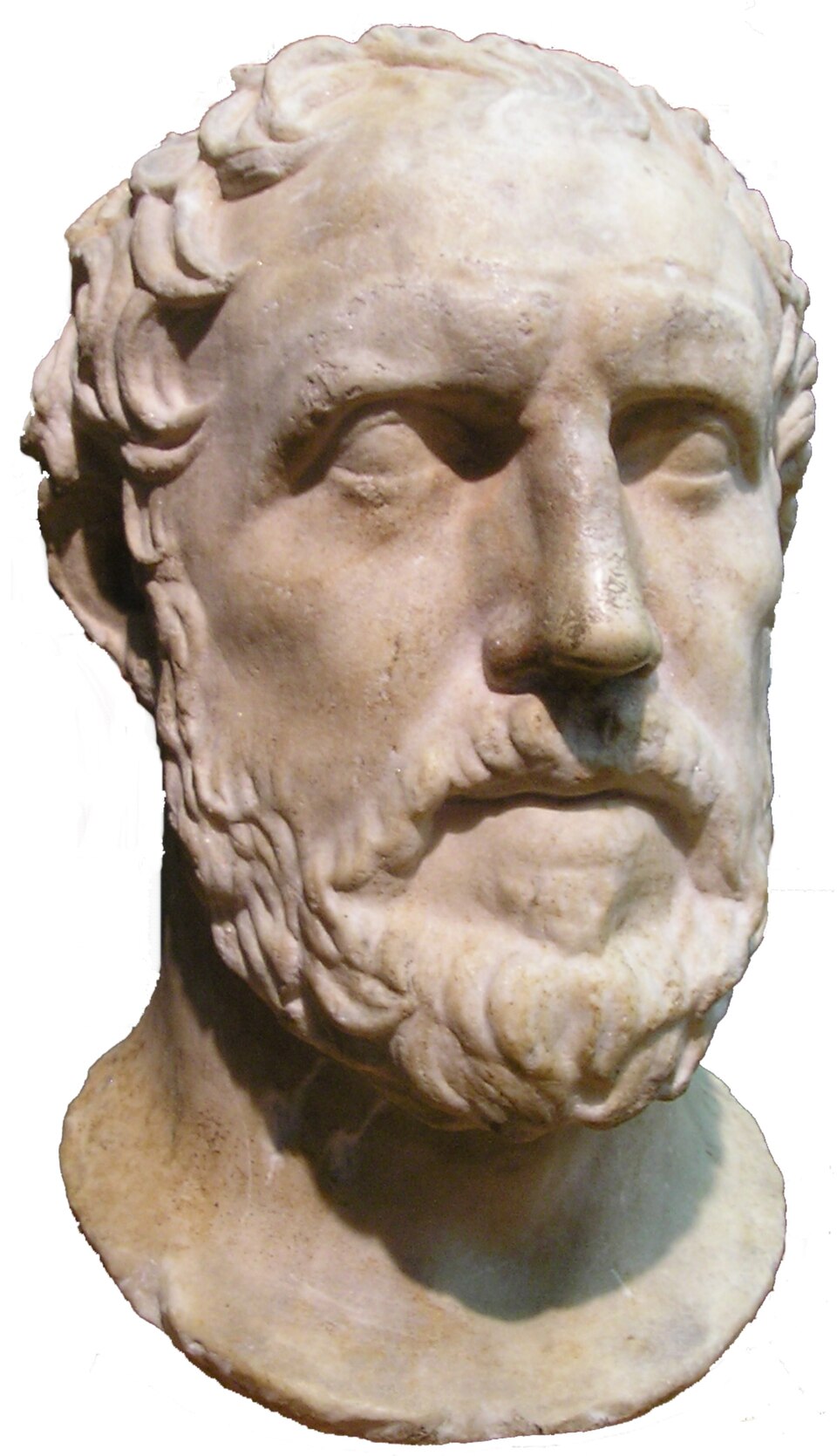 1Thucydidesc. 460 – c. 400 BCEHistory of the Peloponnesian War · Book 1 · Crawley (GBWW) translation
THUCYDIDES, an Athenian, wrote the history of the war in which the Peloponnesians and the Athenians fought against one another. He began to write when they first took up arms, believing that it would be great and memorable above any previous war. For he argued that both states were then at the full height of their military power, and he saw the rest of the Hellenes either siding or intending to side with one or other of them. No movement ever stirred Hellas more deeply than this; it was shared by many of the Barbarians, and might be said even to affect the world at large. The character of the events which preceded, whether immediately or in more remote antiquity, owing to the lapse of time cannot be made out with certainty. But, judging from the evidence which I am able to trust after most careful enquiry,1 I should imagine that former ages were not great either in their wars or in anything else.
The country which is now called Hellas was not regularly settled in ancient times.2 The people were migratory, and readily left their homes whenever they were overpowered by numbers. There was no commerce, and they could not safely hold intercourse with one another either by land or sea. The several tribes cultivated their own soil just enough to obtain a maintenance from it. But they had no accumulations of wealth and did not plant the ground; for, being without walls, they were never sure that an invader might not come and despoil them. Living in this manner and knowing that they could anywhere obtain a bare subsistence, they were always ready to migrate; so that they had neither great cities nor any considerable resources. The richest districts were most constantly changing their inhabitants; for example, the countries which are now called Thessaly and Boeotia, the greater part of the Peloponnesus with the exception of Arcadia, and all the best parts of Hellas. For the productiveness of the land increased the power of individuals; this in turn was a source of quarrels by which communities3 were ruined, while at the same time they were more exposed to attacks from without. Certainly Attica, of which the soil was poor and thin, enjoyed a long freedom from civil strife, and therefore retained its original inhabitants. And a striking confirmation of my argument is afforded by the fact that Attica through immigration increased in population more than any other region. For the leading men of Hellas,4 when driven out of their own country by war or revolution, sought an asylum at Athens; and from the very earliest times, being admitted to rights of citizenship, so greatly increased the number of inhabitants that Attica became incapable of containing them, and was at last obliged to send out colonies to Ionia.
The feebleness of antiquity is further proved to me by the circumstance that there appears to have been no common action in Hellas before the Trojan War. And I am inclined to think that the very name was not as yet given to the whole country, and in fact did not exist at all before the time of Hellen, the son of Deucalion; the different tribes, of which the Pelasgian was the most widely spread, gave their own names to different districts. But when Hellen and his sons became powerful in Phthiotis, their aid was invoked by other cities, and those who associated with them gradually began to be called Hellenes, though a long time elapsed before the name prevailed over the whole country. Of this Homer affords the best evidence; for he, although he lived long after the Trojan War, nowhere uses this name collectively, but confines it to the followers of Achilles from Phthiotis, who were the original Hellenes; when speaking of the entire host he calls them Danaäns, or Argives, or Achaeans. Neither is there any mention of Barbarians in his poems, clearly because there were as yet no Hellenes opposed to them by a common distinctive name. Thus the several Hellenic tribes (and I mean by the term Hellenes those who, while forming separate communities, had a common language, and were afterwards called by a common name),5 owing to their weakness and isolation, were never united in any great enterprise before the Trojan War. And they only made the expedition against Troy after they had gained considerable experience of the sea.
Minos is the first to whom tradition ascribes the possession of a navy. He made himself master of a great part of what is now termed the Hellenic sea; he conquered the Cyclades, and was the first coloniser of most of them, expelling the Carians and appointing his own sons to govern in them. Lastly, it was he who, from a natural desire to protect his growing revenues, sought, as far as he was able, to clear the sea of pirates.
For in ancient times both the Hellenes, and those Barbarians, whose homes were on the coast of the mainland or in islands, when they began to find their way to one another by sea had recourse to piracy. They were commanded by powerful chiefs, who took this means of increasing their wealth and providing for their poorer followers. They would fall upon the unwalled and straggling towns, or rather villages, which they plundered, and maintained themselves chiefly by the plunder of them; for, as yet, such an occupation was held to be honourable and not disgraceful. This is proved by the practice of certain tribes on the mainland who, to the present day, glory in piratical exploits, and by the witness of the ancient poets, in whose verses the question is invariably asked of newly-arrived voyagers, whether they are pirates;6 which implies that neither those who are questioned disclaim, nor those who are interested in knowing censure the occupation. On land also neighbouring communities plundered each other; and there are many parts of Hellas in which the old practices still continue, as for example among the Ozolian Locrians, Aetolians, Acarnanians, and the adjacent regions of the continent. The fashion of wearing arms among these continental tribes is a relic of their old predatory habits. For in ancient times all Hellenes carried weapons because their homes were undefended and intercourse was unsafe; like the Barbarians they went armed in their every-day life. And the continuance of the custom in certain parts of the country indicates that it once prevailed everywhere.
The Athenians were the first who laid aside arms and adopted an easier and more luxurious way of life. Quite recently the old-fashioned refinement of dress still lingered among the elder men of their richer class, who wore under-garments of linen, and bound back their hair in a knot with golden clasps in the form of grasshoppers; and the same customs long survived among the elders of Ionia, having been derived from their Athenian ancestors. On the other hand, the simple dress which is now common was first worn at Sparta; and there, more than anywhere else, the life of the rich was assimilated to that of the people. The Lacedaemonians too were the first who in their athletic exercises stripped naked and rubbed themselves over with oil. But this was not the ancient custom; athletes formerly, even when they were contending at Olympia, wore girdles about their loins, a practice which lasted until quite lately, and still prevails among Barbarians, especially those of Asia, where the combatants in boxing and wrestling matches wear girdles. And many other customs which are now confined to the Barbarians might be shown to have existed formerly in Hellas.
In later times, when navigation had become general and wealth was beginning to accumulate, cities were built upon the sea-shore and fortified; peninsulas too were occupied and walled-off with a view to commerce and defence against the neighbouring tribes. But the older towns both in the islands and on the continent, in order to protect themselves against the piracy which so long prevailed, were built inland; and there they remain to this day. For the piratical tribes plundered, not only one another, but all those who, without being seamen, lived on the sea-coast.
The islanders were even more addicted to piracy than the inhabitants of the mainland. They were mostly Carian or Phoenician settlers. This is proved by the fact that when the Athenians purified Delos7 during the Peloponnesian War and the tombs of the dead were opened, more than half of them were found to be Carians. They were known by the fashion of their arms which were buried with them, and by their mode of burial, the same which is still practised among them.
After Minos had established his navy, communication by sea became more general. For, he having expelled the marauders8 when he colonised the greater part of the islands, the dwellers on the sea-coast began to grow richer and to live in a more settled manner; and some of them, finding their wealth increase beyond their expectations, surrounded their towns with walls. The love of gain made the weaker willing to serve the stronger, and the command of wealth enabled the more powerful to subjugate the lesser cities.9 This was the state of society which was beginning to prevail at the time of the Trojan War.
I am inclined to think that Agamemnon succeeded in collecting the expedition, not because the suitors of Helen had bound themselves by oath to Tyndareus, but because he was the most powerful king of his time. Those Peloponnesians who possess the most accurate traditions say that10 originally Pelops gained his power by the great wealth which he brought with him from Asia into a poor country, whereby he was enabled, although a stranger, to give his name to the Peloponnesus; and that still greater fortune attended his descendants after the death of Eurystheus, king of Mycenae, who was slain in Attica by the Heraclidae. For Atreus the son of Pelops was the maternal uncle of Eurystheus, who, when he went on the expedition, naturally committed to his charge the kingdom of Mycenae. Now Atreus had been banished by his father on account of the murder of Chrysippus. But Eurystheus never returned; and the Mycenaeans, dreading the Heraclidae, were ready to welcome Atreus, who was considered a powerful man and had ingratiated himself with the multitude. So he succeeded to the throne of Mycenae and the other dominions of Eurystheus. Thus the house of Pelops prevailed over that of Perseus.
And it was, as I believe, because Agamemnon inherited this power and also because he was the greatest naval potentate of his time that he was able to assemble the expedition; and the other princes followed him, not from good-will, but from fear. Of the chiefs who came to Troy, he, if the witness of Homer be accepted, brought the greatest number of ships himself, besides supplying the Arcadians with them. In the 'Handing down of the Sceptre' he is described as 'The king of many islands, and of all Argos.'11 But, living on the mainland, he could not have ruled over any except the adjacent islands (which would not be 'many') unless he had possessed a considerable navy. From this expedition we must form our conjectures about the character of still earlier times.
— Thucydides, History of the Peloponnesian War, Book 1
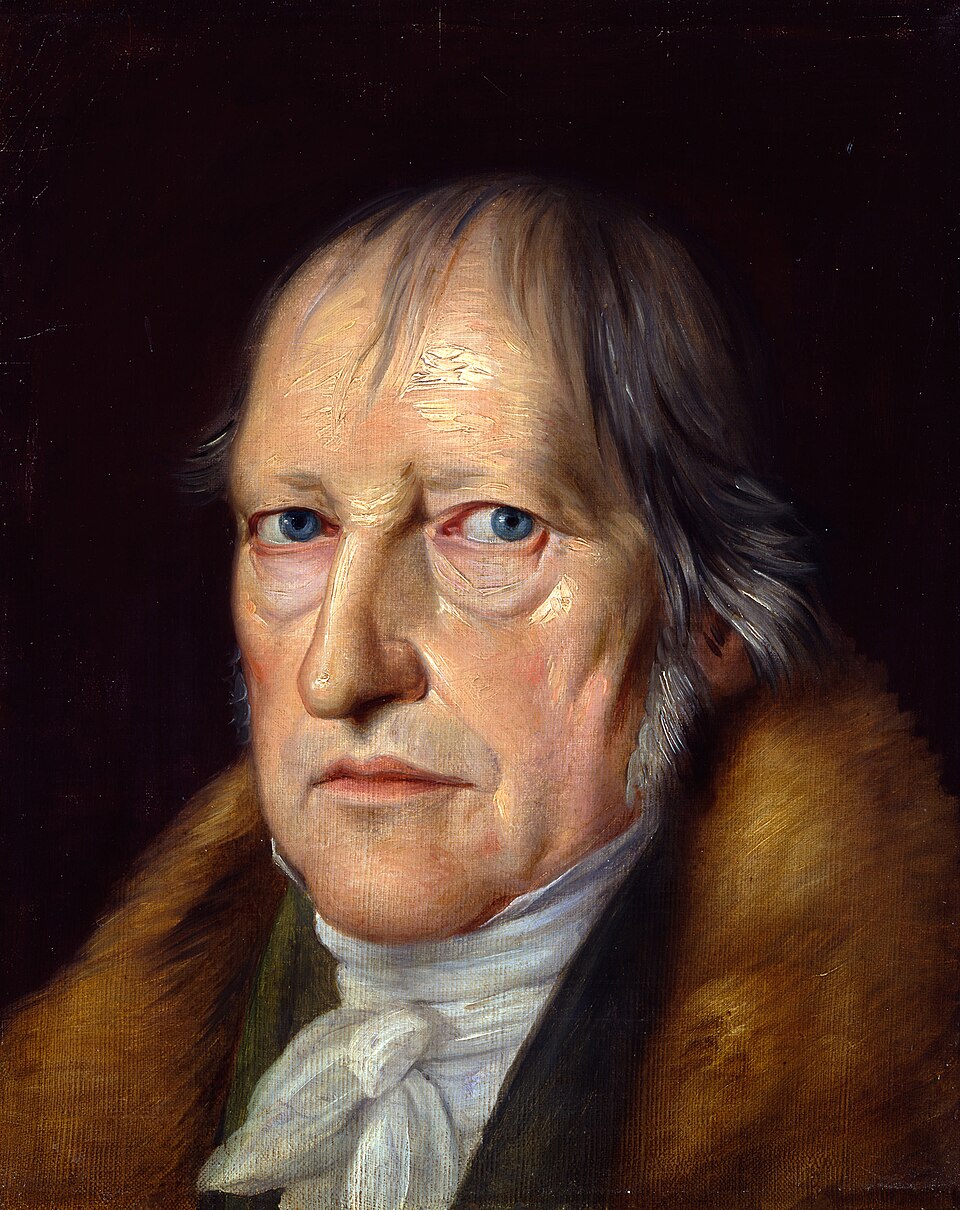 2Hegel1770 – 1831The Philosophy of Right · Introduction (§§1+) · Nisbet (Wood ed., GBWW-adjacent) translation
Elements of the Philosophy of Right
Introduction
§ 1
The subject-matter of the philosophical science of right is the Idea of right – the concept of right and its actualization.1
Philosophy has to do with Ideas and therefore not with what are commonly described as mere concepts. On the contrary, it shows that the latter are one-sided and lacking in truth, and that it is the concept alone (not what is so often called by that name, but which is merely an abstract determination of the understanding) which has actuality, and in such a way that it gives actuality to itself. Everything other than this actuality which is posited by the concept itself is transitory existence [Dasein], external contingency, opinion, appearance without essence, untruth, deception, etc. The shape which the concept assumes in its actualization, and which is essential for cognition of the concept itself, is different from its form of being purely as concept, and is the other essential moment of the Idea.
Addition (H). The concept and its existence [Existenz] are two aspects [of the same thing], separate and united, like soul and body. The body is the same life as the soul, and yet the two can be said to lie outside one another. A soul without a body would not be a living thing, and vice versa. Thus the existence [Dasein] of the concept is its body, just as the latter obeys the soul which produced it. The buds have the tree within them and contain its entire strength, although they are not yet the tree itself. The tree corresponds entirely to the simple image of the bud. If the body does not correspond to the soul, it is a wretched thing indeed. The unity of existence [Dasein] and the concept, of body and soul, is the Idea. It is not just a harmony, but a complete interpenetration. Nothing lives which is not in some way Idea. The Idea of right is freedom, and in order to be truly apprehended, it must be recognizable in its concept and in the concept’s existence [Dasein].
§ 2
The science of right is a part of philosophy. It has therefore to develop the Idea, which is the reason within an object [Gegenstand], out of the concept; or what comes to the same thing, it must observe the proper immanent development of the thing [Sache] itself. As a part [of philosophy], it has a determinate starting point, which is the result and truth of what preceded it, and what preceded it is the so-called proof of that result. Hence the concept of right, so far as its coming into being is concerned, falls outside the science of right; its deduction is presupposed here and is to be taken as given.1
Addition (G). Philosophy forms a circle.2 It has an initial or immediate point – for it must begin somewhere – a point which is not demonstrated and is not a result. But the starting point of philosophy is immediately relative, for it must appear at another end-point as a result. Philosophy is a sequence which is not suspended in mid-air; it does not begin immediately, but is rounded off within itself.
According to the formal, non-philosophical method of the sciences, the first thing which is sought and required, at least for the sake of external scientific form, is the definition. The positive science of right cannot be much concerned with this, however, since its chief aim is to state what is right and legal [Rechtens], i.e. what the particular legal determinations are. This is the reason for the warning: ‘omnis definitio in iure civili periculosa.’a3 And in fact, the more incoherent and internally contradictory the determinations of a [system of] right are, the less possible it will be to make definitions within it; for definitions should contain universal determinations, but in the present context, these would immediately make the contradictory element – in this case, what is unjust [das Unrechtliche] – visible in all its nakedness. Thus, in Roman law [das römische Recht], for example, no definition of a human being would be possible, for the slave could not be subsumed under it; indeed, the status [Stand] of the slave does violence to that concept. The definitions of ‘property’ and ‘proprietor’ would seem equally hazardous in many situations. – But the deduction of the definition may perhaps be reached by means of etymology, or chiefly by abstraction from particular cases, so that it is ultimately based on the feelings and ideas [Vorstellung] of human beings. The correctness of the definition is then made to depend on its agreement with prevailing ideas [Vorstellungen]. This method leaves out of account what is alone essential to science – with regard to content, the necessity of the thing [Sache] in and for itself (in this case, of right), and with regard to form, the nature of the concept. In philosophical cognition, on the other hand, the chief concern is the necessity of a concept, and the route by which it has become a result [is] its proof and deduction. Thus, given that its content is necessary for itself, the second step is to look around for what corresponds to it in our ideas [Vorstellungen] and language. But this concept as it is for itself in its truth may not only be different from our representation [Vorstellung] of it: the two must also differ in their form and shape. If, however, the representation is not also false in its content, the concept may well be shown to be contained in it and present in essence within it; that is, the representation may be raised to the form of the concept. But it is so far from being the measure and criterion of the concept which is necessary and true for itself that it must rather derive its truth from the concept, and recognize and correct itself with the help of the latter. – But if, on the other hand, the former manner of cognition with its formal definitions, inferences, proofs, and the like has now virtually disappeared, the other mode which has replaced it is a bad substitute: that is, Ideas in general, and hence also the Idea of right and its further determinations, are taken up and asserted in immediate fashion as facts of consciousness, and our natural or intensified feelings, our own heart and enthusiasm, are made the source of right.4 If this is the most convenient method of all, it is also the least philosophical – not to mention here other aspects of this view, which has immediate relevance [Beziehung] to action and not just to cognition. Whereas the first – admittedly formal – method does at least require the form of the concept in its definitions and the form of necessary cognition in its proofs, the mode of immediate consciousness and feeling makes the subjectivity, contingency, and arbitrariness of knowledge into its principle. – A familiarity with the nature of scientific procedure in philosophy, as expounded in philosophical logic, is here presupposed.
§ 3
Right is in general positive (a) through its form of having validity within a [particular] state; and this legal authority is the principle which underlies knowledge [Kenntnis] of right, i.e. the positive science of right. (b) In terms of content, this right acquires a positive element (α) through the particular national character of a people, its stage of historical development, and the whole context of relations governed by natural necessity;1 (β) through the necessity whereby a system of legal right must contain the application of the universal concept to the particular and externally given characteristics of objects [Gegenstände] and instances – an application which is no longer [a matter of] speculative thought and the development of the concept, but [of] subsumption by the understanding; (γ) through the final determinations required for making decisions in actuality.
If the feelings of the heart, [personal] inclinations, and arbitrariness are set up in opposition to positive right and laws, philosophy at least cannot recognize such authorities. That force and tyranny may be an element in positive right is contingent to the latter, and has nothing to do with its nature. Later in this work (§§ 211–214), it will be shown at what point right must become positive. The determinations which will be discussed in that context are mentioned here only in order to indicate the limits [Grenze] of philosophical right and at the same time to rule out any possible idea [Vorstellung], let alone expectation, that its systematic development should give rise to a positive code of laws such as is required by an actual state. – Natural law or philosophical right is different from positive right, but it would be a grave misunderstanding to distort this difference into an opposition or antagonism; on the contrary, their relation is like that between Institutes and Pandects.2 – With regard to the historical element in positive right (first referred to in § 3 above), Montesquieu stated the true historical view, the genuinely philosophical viewpoint, that legislation in general and its particular determinations should not be considered in isolation and in the abstract, but rather as a dependent moment within one totality, in the context of all the other determinations which constitute the character of a nation and age; within this context they gain their genuine significance, and hence also their justification.3 – To consider the emergence and development of determinations of right as they appear in time is a purely historical task. This task, like that of recognizing the logical consistency of such determinations by comparing them with previously existing legal relations, is meritorious and praiseworthy within its own sphere, and bears no relation to the philosophical approach – unless, that is to say, development from historical grounds is confused with development from the concept, and the significance of historical explanation and justification is extended to include a justification which is valid in and for itself4. This distinction, which is very important and should be firmly borne in mind, is at the same time a very obvious one; a determination of right may be shown to be entirely grounded in and consistent with the prevailing circumstances and existing legal institutions, yet it may be contrary to right [unrechtlich] and irrational in and for itself, like numerous determinations of Roman civil law [Privatrecht] which followed quite consistently from such institutions as Roman paternal authority and Roman matrimony. But even if the determinations of right are rightful and rational, it is one thing to demonstrate that this is so – and this cannot truly be done except by means of the concept – and another to depict their historical emergence and the circumstances, eventualities, needs, and incidents which led to their introduction. This kind of demonstration and (pragmatic) cognition in terms of proximate or remote historical causes is often called ‘explanation’, or even more commonly ‘comprehension’, in the belief [Meinung] that this kind of historical demonstration is all – or rather, the one essential thing – that needs to be done in order to comprehend the law or a legal institution, whereas in fact the truly essential issue, the concept of the thing [Sache], has not even been mentioned. – Similarly, we often hear talk of Roman or Germanic ‘concepts of right’, or of such ‘concepts of right’ as are defined in this or that legal code, although these codes contain no reference to concepts, but only to general determinations of right, propositions of the understanding, principles, laws, and the like. – By disregarding the difference in question, it becomes possible to shift the point of view and to turn the request for a true justification into a justification by circumstances, a logical deduction from premises which may in themselves [für sich] be as valueless as the conclusions derived from them, etc.; in short, the relative is put in place of the absolute, and the external appearance in place of the nature of the thing [Sache] itself. When a historical justification confuses an origin in external factors with an origin in the concept, it unconsciously achieves the opposite of what it intends. If it can be shown that the origin of an institution was entirely expedient and necessary under the specific circumstances of the time, the requirements of the historical viewpoint are fulfilled. But if this is supposed to amount to a general justification of the thing itself, the result is precisely the opposite; for since the original circumstances are no longer present, the institution has thereby lost its meaning and its right [to exist]. Thus if, for example, the monasteries are justified by an appeal to their services in cultivating and populating areas of wilderness and in preserving scholarship through instruction, copying of manuscripts, etc., and these services are regarded as the reason [Grund] and purpose [Bestimmung] of their continued existence, what in fact follows from these past services is that, since the circumstances have now changed completely, the monasteries have, at least in this respect, become superfluous and inappropriate. – Since it has now been shown that the historical significance of origins, along with their historical demonstration and exposition, belongs to a different sphere from the philosophical view of the same origins and of the concept of the thing, the two approaches can to that extent remain indifferent to one another. But since they do not always maintain such peaceful relations, even in scientific matters, I shall quote something relating to their mutual contact which appears in Herr [Gustav] Hugo’s Textbook of the History of Roman Law [Lehrbuch der Geschichte des römischen Rechts, 1790], and which will also further elucidate their supposed mode of opposition.5 Herr Hugo points out in the passage in question (fifth edition , § 53) ‘that Cicero praises the Twelve Tables, while looking askance at the philosophers’,6 whereas ‘the philosopher Favorinus treats them just as many a great philosopher has subsequently treated positive right’. In the same context, Herr Hugo replies once and for all to such treatment with the explanation that ‘Favorinus understood the Twelve Tables just as little as the philosophers have understood positive right’. – As to the correction of the philosopher Favorinus by the jurist Sextus Caecilius in [Aulus] Gellius’ Noctes Atticae, XX, 1, it is primarily a statement of the true and lasting principle which must underlie the justification of anything whose impact is merely positive.7 ‘Non ignoras’, says Caecilius very aptly to Favorinus, ‘legum opportunitates et medelas pro temporum moribus et pro rerum publicarum generibus ac pro utilitatum praesentium rationibus, proque vitiorum, quibus medendum est, fervoribus, mutari ac flecti, neque uno statu consistere, quin, ut facies coeli et maris, ita rerum atque fortunae tempestatibus varientur. Quid salubrius visum est rogatione illa Stolonis . . . quid utilius plebiscito Voconio . . . quid tam necessarium existimatum est . . . quam lex Licinia . . . ? Omnia tamen haec obliterata et operta sunt civitatis opulentia . . .’a These laws are positive in so far as their significance and appropriateness are circumstantial and their value is therefore entirely historical; they are accordingly of a transient nature. The wisdom of what legislators and governments have done for the circumstances of their time and laid down for the conditions under which they lived is a distinct issue [eine Sache für sich] which should be assessed by history, whose recognition of it will be all the more profound if such an assessment is supported by philosophical insights. I shall, however, cite an example of Caecilius’ further attempts to justify the Twelve Tables against Favorinus, because in so doing, he employs the eternally deceptive method of the understanding and its mode of ratiocination, namely by supplying a good reason [Grund] for a bad thing [Sache] and believing that the latter has thereby been justified. He mentions the abominable law which, after a specified interval had elapsed, gave the creditor the right to kill the debtor or to sell him into slavery, or even, if there were several creditors, to cut pieces off him and so divide him between them that, if anyone had cut off too much or too little, he should incur no consequent legal disadvantagea (a clause which would have benefited Shakespeare’s Shylock in The Merchant of Venice and which he would most gratefully have accepted).11 In support of this law, Caecilius puts forward the good reason that it provided an additional guarantee of good faith and that, given the abominable nature of the law, it was never intended that it should be enforced.12 In his thoughtlessness, he not only fails to reflect that this latter provision [Bestimmung] frustrates the former intention, namely that the law should guarantee good faith, but also overlooks the fact that he himself cites an example immediately afterwards of how the law on false witness was rendered ineffectual by its excessive severity. – But it is not clear what Herr Hugo means when he says that Favorinus did not understand the law; any schoolboy is capable of understanding it, and Shylock would have understood better than anyone else the clause in question, which would have been of so much advantage to him; by ‘understanding’, Herr Hugo must have meant only that degree [Bildung] of understanding which is satisfied if a good reason can be found for such a law. – Incidentally, a further misunderstanding of which Caecilius convicts Favorinus in the same context is one to which a philosopher may readily confess without blushing – namely his failure to realize that iumentum, which the law specified, ‘as distinct from arcera’, as the only mode of transport to be provided to bring a sick man as witness to the court, should be understood to signify not only a horse but also a coach or wagon.13 Caecilius was able to derive from this legal determination a further proof of the excellence and precision of the old laws, for in determining how a sick witness was to be summoned to testify in court, they even went so far as to distinguish not just between a horse and a wagon, but even between different kinds of wagon – between a covered and upholstered wagon, as Caecilius explains, and a less comfortable one. We would thus be left with a choice between the severity of the original law and the triviality of such determinations; but to describe such things, let alone learned expositions of them, as ‘trivial’, would be among the greatest possible affronts to scholarship of this and other kinds.
— Hegel, The Philosophy of Right, Introduction (§§1+)
3Hegel1770 – 1831The Philosophy of History · Part IV: The Germanic World · Sibree (Batoche Books, 1900) translation
Hegel's Philosophy of History
Hegel’s Philosophy of History
Part IV: The German World.
The German Spirit is the Spirit of the new World. Its aim is the realization of absolute Truth as the unlimited self-determination of Freedom – that Freedom which has its own absolute form itself as its purport. The destiny of the German peoples is, to be the bearers of the Christian principle. The principle of Spiritual Freedom – of Reconciliation [of the Objective and Subjective], was introduced into the still simple, unformed minds of those peoples; and the part assigned them in the service of the World- Spirit was that of not merely possessing the Idea of Freedom as the substratum of their religious conceptions, but of producing it in free and spontaneous developments from their subjective self-consciousness. In entering on the task of dividing the German World into its natural periods, we must remark that we have not, as was the case in treating of the Greeks and Romans, a double external relation – backwards to an earlier World-Historical people, and forwards to a later one – to guide us. History shows that the process of development among the peoples now under consideration, was an altogether different one. The Greeks and Romans had reached maturity within, ere they directed their energies outwards. The Germans, on the contrary, began with self- diffusion – deluging the world, and overpowering in their course the inwardly rotten, hollow political fabrics of the civilized nations. Only then did their development begin, kindled by a foreign culture, a foreign religion, polity and legislation. The process of culture they underwent consisted in taking up foreign elements and reductively amalgamating them with their own national life. Thus their history presents an introversion – the attraction of alien forms of life and the bringing these to bear upon their own. In the Crusades, indeed, and in the discovery of America, the Western World directed its energies outwards. But it was not thus brought in contact with a World-Historical people that had preceded it; it did not dispossess a principle that had previously governed the world. The relation to an extraneous principle here only accompanies [does not constitute] the history – does not bring with it essential changes in the nature of those conditions which characterize the peoples in question, but rather wears the aspect of internal evolution. – The relation to other countries and periods is thus entirely different from that sustained by the Greeks and Romans. For the Christian world is the world of completion; the grand principle of being is realized, consequently the end of days is fully come. The Idea can discover in Christianity no point in the aspirations of Spirit that is not satisfied. For its individual members, the Church is, it is true, a preparation for an eternal state as something future; since the units who compose it, in their isolated and several capacity, occupy a position of particularity: but the Church has also the Spirit of God actually present in it, it forgives the sinner and is a present kingdom of heaven. Thus the Christian World has no absolute existence outside its sphere, but only a relative one which is already implicitly vanquished, and in respect to which its only concern is to make it apparent that this conquest has taken place. Hence it follows that an external reference ceases to be the characteristic element determining the epochs of the modern world. We have therefore to look for another principle of division.
The German World took up the Roman culture and religion in their completed form. There was indeed a German and Northern religion, but it had by no means taken deep root in the soul; Tacitus therefore calls the Germans: “Securi adversus Deos.” The Christian Religion which they adopted, had received from Councils and Fathers of the Church, who possessed the whole culture, and in particular, the philosophy of the Greek and Roman World, a perfected dogmatic system; the Church, too, had a completely developed hierarchy. To the native tongue of the Germans, the Church likewise opposed one perfectly developed – the Latin. In art and philosophy a similar alien influence predominated. What of Alexandrian and of formal Aristotelian philosophy was still preserved in the writings of Boethius and elsewhere, became the fixed basis of speculative thought in the West for many centuries. The same principle holds in regard to the form of the secular sovereignty. Gothic and other chiefs gave themselves the name of Roman Patricians, and at a later date the Roman Empire was restored. Thus the German world appears, superficially, to be only a continuation of the Roman. But there lived in it an entirely new Spirit, through which the World was to be regenerated – the free Spirit, viz. which reposes on itself – the absolutely self-determination [Eigensinn] of subjectivity. To this self- involved subjectivity, the corresponding objectivity [Inhalt] stands opposed as absolutely alien. The distinction and antithesis which is evolved from these principles, is that of Church and State. On the one side, the Church develops itself, as the embodiment of absolute Truth; for it is the consciousness of this truth, and at the same time the agency for rendering the Individual harmonious with it. On the other side stands secular consciousness, which, with its aims, occupies the world of Limitation – the State, based on Heart [emotional and thence social affections] or mutual confidence and subjectivity generally. European history is the exhibition of the growth of each of these principles severally, in Church and State; then of an antithesis on the part of both – not only of the one to the other, but appearing within the sphere of each of these bodies themselves (since each of them is itself a totality); lastly, of the harmonizing of the antithesis. The three periods of this world will have to be treated accordingly.
The first begins with the appearance of the German Nations in the Roman Empire – the incipient development of these peoples, converts to Christianity, and now established in the possession of the West. Their barbarous and simple character prevents this initial period from possessing any great interest. The Christian world then presents itself as “Christendom” – one mass, in which the Spiritual and the Secular form only different aspects. This epoch extends to Charlemagne.
The second period develops the two sides of the antithesis to a logically consequential independence and opposition – the Church for itself as a Theocracy, and the State for itself as a Feudal Monarchy. Charlemagne had formed an alliance with the Holy See against the Lombards and the factions of the nobles in Rome. A union thus arose between the spiritual and the secular power, and a kingdom of heaven on earth promised to follow in the wake of this conciliation. But just at this time, instead of a spiritual kingdom of heaven, the inwardness of the Christian principle wears the appearance of being altogether directed outwards and leaving its proper sphere. Christian Freedom is perverted to its very opposite, both in a religious and secular respect; on the one hand to the severest bondage, on the other hand to the most immoral excess – a barbarous intensity of every passion. In this period two aspects of society are to be especially noticed: the first is the formation of states – superior and inferior suzerainties exhibiting a regulated subordination, so that every relation becomes a firmly-fixed private right, excluding a sense of universality. This regulated subordination appears in the Feudal System. The second aspect presents the antithesis of Church and State. This antithesis exists solely because the Church, to whose management the Spiritual was committed, itself sinks down into every kind of worldliness – a worldliness which appears only the more detestable, because all passions assume the sanction of religion.
The time of Charles V’s reign – i.e., the first half of the sixteenth century – forms the end of the second, and likewise the beginning of the third period. Secularity appears now as gaining a consciousness of its intrinsic worth – becomes aware of its having a value of its own in the morality, rectitude, probity and activity of man. The consciousness of independent validity is aroused through the restoration of Christian freedom. The Christian principle has now passed through the terrible discipline of culture, and it first attains truth and reality through the Reformation, This third period of the German World extends from the Reformation to our own times. The principle of Free Spirit is here made the banner of the World, and from this principle are evolved the universal axioms of Reason. Formal Thought – the Understanding – had been already developed; but Thought received its true material first with the Reformation, through the reviviscent concrete consciousness of Free Spirit. From that epoch Thought began to gain a culture properly its own: principles were derived from it which were to be the norm for the constitution of the State. Political life was now to be consciously regulated by Reason. Customary morality, traditional usage lost its validity; the various claims insisted upon, must prove their legitimacy as based on rational principles. Not till this era is the Freedom of Spirit realized. We may distinguish these periods as Kingdoms of the Father, the Son, and the Spirit. The Kingdom of the Father is the consolidated, undistinguished mass, presenting a self-repeating cycle, mere change – like that sovereignty of Chronos engulfing his offspring. The Kingdom of the Son is the manifestation of God merely in a relation to secular existence – shining upon it as upon an alien object. The Kingdom of the Spirit is the harmonizing of the antithesis.
These epochs may be also compared with the earlier empires. In the German aeon, as the realm of Totality, we see the distinct repetition of the earlier epochs. Charlemagne’s time may be compared with the Persian Empire; it is the period of substantial unity – this unity having its foundation in the inner man, the Heart, and both in the Spiritual and the Secular still abiding in its simplicity.
To the Greek world and its merely ideal unity, the time preceding Charles V answers; where real unity no longer exists, because all phases of particularity have become fixed in privileges and peculiar rights. As in the interior of the realms themselves, the different estates of the realm, with their several claims, are isolated, so do the various states in their foreign aspects occupy a merely external relation to each other. A diplomatic policy arises, which in the interest of a European balance of power, unites them with and against each other. It is the time in which the world becomes clear and manifest to itself (Discovery of America). So too does consciousness gain clearness in the supersensuous world and respecting it.
Substantial objective religion brings itself to sensuous clearness in the sensuous element (Christian Art in the age of Pope Leo), and also becomes clear to itself in the element of inmost truth. We may compare this time with that of Pericles. The introversion of Spirit begins (Socrates – Luther), though Pericles is wanting in this epoch. Charles V possesses enormous possibilities in point of outward appliances, and appears absolute in his power; but the inner spirit of Pericles, and therefore the absolute means of establishing a free sovereignty, are not in him. This is the epoch when Spirit becomes clear to itself in separations occurring in the realm of reality; now the distinct elements of the German world manifest their essential nature.
The third epoch may be compared with the Roman World. The unity of a universal principle is here quite as decidedly present, yet not as the unity of abstract universal sovereignty, but as the Hegemony of self-cognizant Thought. The authority of Rational Aim is acknowledged, and privileges and particularities melt away before the common object of the State. Peoples will the Right in and for itself; regard is not had exclusively to particular conventions between nations, but principles enter into the considerations with which diplomacy is occupied. As little can Religion maintain itself apart from Thought, but either advances to the comprehension of the Idea, or, compelled by thought itself, becomes intensive belief – or lastly, from despair of finding itself at home in thought, flees back from it in pious horror, and becomes Superstition.
— Hegel, The Philosophy of History, Part IV: The Germanic World
4Hegel1770 – 1831The Philosophy of History · Part I: The Oriental World · Sibree (Batoche Books, 1900) translation
Hegel's Philosophy of History
Hegel’s Philosophy of History
Part I: The Oriental World
We have to begin with the Oriental World, but not before the period in which we discover States in it. The diffusion of Language and the formation of races lie beyond the limits of History. History is prose, and myths fall short of History. The consciousness of external definite existence only arises in connection with the power to form abstract distinctions and assign abstract predicates; and in proportion as a capacity for expressing Laws (of natural or social life) is acquired, in the same proportion does the ability manifest itself to comprehend objects in an unpoetical form. While the ante-historical is that which precedes political life, it also lies beyond self-cognizant life; though surmises and suppositions may be entertained respecting that period, these do not amount to facts. The Oriental World has as its inherent and distinctive principle the Substantial (the Prescriptive), in Morality. We have the first example of a subjugation of the mere arbitrary will, which is merged in this substantiality. Moral distinctions and requirements are expressed as Laws, but so that the subjective will is governed by these Laws as by an external force. Nothing subjective in the shape of disposition, Conscience, formal Freedom, is recognized. Justice is administered only on the basis of external morality, and Government exists only as the prerogative of compulsion. Our civil law contains indeed some purely compulsory ordinances. I can be compelled to give up another man’s property, or to keep an agreement which I have made; but the Moral is not placed by us in the mere compulsion, but in the disposition of the subjects – their sympathy with the requirements of law. Morality is in the East likewise a subject of positive legislation, and although the moral prescriptions (the substance of their Ethics) may be perfect, what should be internal subjective sentiment is made a matter of external arrangement. There is no want of a will to command moral actions, but of a will to perform them because commanded from within. Since Spirit has not yet attained subjectivity, it wears the appearance of spirituality still involved in the conditions of Nature. Since the external and the internal, Law and Moral Sense, are not yet distinguished – still form an undivided unity – so also do Religion and the State. The Constitution generally is a Theocracy, and the Kingdom of God is to the same extent also a secular Kingdom as the secular Kingdom is also divine. What we call God has not yet in the East been realized in consciousness, for our idea of God involves an elevation of the soul to the supersensual. While we obey, because what we are required to do is confirmed by an internal sanction, there the Law is regarded as inherently and absolutely valid without a sense of the want of this subjective confirmation. In the law men recognize not their own will, but one entirely foreign. Of the several parts of Asia we have already eliminated as unhistorical, Upper Asia (so far and so long as its Nomad population do not appear on the scene of history), and Siberia. The rest of the Asiatic World is divided into four districts: first, the River-Plains, formed by the Yellow and Blue Stream, and the Upland of farther Asia – China and the Mongols. Secondly, the valley of the Ganges and that of the Indus. The third theatre of History comprises the river-plains of the Oxus and Jaxartes, the Upland of Persia, and the other valley-plains of the Euphrates and Tigris, to which Hither-Asia attaches itself. Fourthly, the River-plain of the Nile.
With China and the Mongols – the realm of theocratic despotism – History begins. Both have the patriarchal constitution for their principle – so modified in China, as to admit the development of an organized system of secular polity; while among the Mongols it limits itself to the simple form of a spiritual, religious sovereignty. In China the Monarch is Chief as Patriarch. The laws of the state are partly civil ordinances, partly moral requirements; so that the internal law – the knowledge on the part of the individual of the nature of his volition, as his own inmost self – even this is the subject of external statutory enactment. The sphere of subjectivity does not then, attain to maturity here, since moral laws are treated as legislative enactments, and law on its part has an ethical aspect. All that we call subjectivity is concentrated in the supreme head of the State, who, in all his legislation has an eye to the health, wealth, and benefit of the whole. Contrasted with this secular Empire is the spiritual sovereignty of the Mongols, at the head of which stands the Lama, who is honored as God. In this Spiritual Empire no secular political life can be developed.
In the second phase – the Indian realm – we see the unity of political organization – a perfect civil machinery, such as exists in China – in the first instance, broken up. The several powers of society appear as dissevered and free in relation to each other. The different castes are indeed, fixed; but in view of the religious doctrine that established them, they wear the aspect of natural distinctions. Individuals are thereby still further stripped of proper personality – although it might appear as if they derived gain from the development of the distinctions in question. For though we find the organization of the State no longer, as in China, determined and arranged by the one all-absorbing personality (the head of the State) the distinctions that exist are attributed to Nature, and so become differences of Caste. The unity in which these divisions must finally meet, is a religious one; and thus arises Theocratic Aristocracy and its despotism. Here begins, therefore, the distinction between the spiritual consciousness and secular conditions; but as the separation implied in the above mentioned distinctions is the cardinal consideration, so also we find in the religion the principle of the isolation of the constituent elements of the Idea; – a principle which posits the harshest antithesis – the conception of the purely abstract unity of God, and of the purely sensual Powers of Nature. The connection of the two is only a constant change – a restless hurrying from one extreme to the other – a wild chaos of fruitless variation, which must appear as madness to a duly regulated, intelligent consciousness.
The third important form – presenting a contrast to the immovable unity of China and to the wild and turbulent unrest of India – is the Persian Realm. China is quite peculiarly Oriental ; India we might compare with Greece; Persia on the other hand with Rome. In Persia namely, the Theocratic power appears as a Monarchy. Now Monarchy is that kind of constitution which does indeed unite the members of the body politic in the head of the government as in a point; but regards that head neither as the absolute director nor the arbitrary ruler, but as a power whose will is regulated by the same principle of law as the obedience of the subject. We have thus a general principle, a Law, lying at the basis of the whole, but which, still regarded as a dictum of mere Nature (not as free and absolute Truth) is clogged by an antithesis (that of formal freedom on the part of man as commanded to obey positive alien requirements). The representation, therefore, which Spirit makes of itself is, at this grade of progress, of a purely natural kind – Light. This Universal principle is as much a regulative one for the monarch as for each of his subjects, and the Persian Spirit is accordingly clear, illuminated – the idea of a people living in pure morality, as in a sacred community. But this has on the one hand as a merely natural Ecclesia, the above antithesis still unreconciled; and its sanctity displays the characteristics of a compulsory, external one. On the other hand this antithesis is exhibited in Persia in its being the Empire of hostile peoples, and the union of the most widely differing nations. The Persian Unity is not that abstract one of the Chinese Empire; it is adapted to rule over many and various nationalities, which it unites under the mild power of Universality as a beneficial Sun shining over all – waking them into life and cherishing their growth. This Universal principle – occupying the position of a root only – allows the several members a free growth for unrestrained expansion and ramification. In the organization of these several peoples, the various principles and forms of life have full play and continue to exist together. We find in this multitude of nations, roving Nomades; then we see in Babylonia and Syria commerce and industrial pursuits in full vigor, the wildest sensuality, the most uncontrolled turbulence. The coasts mediate a connection with foreign lands. In the midst of this confusion the spiritual God of the Jews arrests our attention – like Brahm, existing only for Thought, yet jealous and excluding from his being and abolishing all distinct speciality of manifestations [avatars], such as are freely allowed in other religions. This Persian Empire, then – since it can tolerate these several principles, exhibits the Antithesis in a lively active form, and is not shut up within itself, abstract and calm, as are China and India – makes a real transition in the History of the World. If Persia forms the external transition to Greek life, the internal, mental transition is mediated by Egypt. Here the antitheses in their abstract form are broken through; a breaking through which effects their nullification. This undeveloped reconciliation exhibits the struggle of the most contradictory principles, which are not yet capable of harmonizing themselves, but, setting up the birth of this harmony as the problem to be solved, make themselves a riddle for themselves and for others, the solution of which is only to be found in the Greek World. If we compare these kingdoms in the light of their various fates, we find the empire of the two Chinese rivers the only durable kingdom in the World. Conquests cannot affect such an empire. The world of the Ganges and the Indus has also been preserved. A state of things so destitute of (distinct) thought is likewise imperishable, but it is in its very nature destined to be mixed with other races – to be conquered and subjugated. While these two realms have remained to the present day, of the empires of the Tigris and Euphrates on the contrary nothing remains, except, at most, a heap of bricks; for the Persian Kingdom, as that of Transition, is by nature perishable, and the Kingdoms of the Caspian Sea are given up to the ancient struggle of Iran and Turan. The Empire of the solitary Nile is only present beneath the ground, in its speechless Dead, ever and anon stolen away to all quarters of the globe, and in their majestic habitations; – for what remains above ground is nothing else but such splendid tombs.
Section I: China
With the Empire of China History has to begin, for it is the oldest, as far as history gives us any information ; and its principle has such substantiality, that for the empire in question it is at once the oldest and the newest. Early do we see China advancing to the condition in which it is found at this day ; for as the contrast between objective existence and subjective freedom of movement in it, is still wanting, every change is excluded, and the fixedness of a character which recurs perpetually, takes the place of what we should call the truly historical. China and India lie, as it were, still outside the World’s History, as the mere presupposition of elements whose combination must be waited for to constitute their vital progress. The unity of substantiality and subjective freedom so entirely excludes the distinction and contrast of the two elements, that by this very fact, substance cannot arrive at reflection on itself – at subjectivity. The Substantial [Positive] in its moral aspect, rules therefore, not as the moral disposition of the Subject, but as the despotism of the Sovereign.
— Hegel, The Philosophy of History, Part I: The Oriental World
5Hegel1770 – 1831The Philosophy of Right · Part I — Abstract Right (Property §§41+) · Nisbet (Wood ed., GBWW-adjacent) translation
Elements of the Philosophy of Right
SECTION 1
Property
§ 41
The person must give himself an external sphere of freedom in order to have being as Idea.1 The person is the infinite will, the will which has being in and for itself, in this first and as yet wholly abstract determination. Consequently, this sphere distinct from the will, which may constitute the sphere of its freedom, is likewise determined as immediately different and separable from it.
Addition (H). The rational aspect of property is to be found not in the satisfaction of needs but in the superseding of mere subjectivity of personality. Not until he has property does the person exist as reason. Even if this first reality of my freedom is in an external thing [Sache] and is thus a poor kind of reality, the abstract personality in its very immediacy can have no other existence [Dasein] than in the determination of immediacy.
§ 42
What is immediately different from the free spirit is, for the latter and in itself, the external in general – a thing [Sache], something unfree, impersonal, and without rights.
The word ‘thing’ [Sache], like the word ‘objective’, has two opposite meanings.1 On the one hand, when we say ‘that’s the thing’, or ‘the thing, not the person, is what matters’, it signifies what is substantial. On the other hand, when contrasted with the person (as distinct from the particular subject), the thing is the opposite of the substantial: it is that which, by definition [seiner Bestimmung nach], is purely external. – What is external for the free spirit (which must be clearly distinguished from mere consciousness) is external in and for itself; and for this reason, the definition [Begriffsbestimmung] of the concept of nature is that it is the external in itself.
Addition (H). Since a thing [Sache] has no subjectivity, it is external not only to the subject, but also to itself. Space and time are external in this way. As an object of the senses, I am myself external, spatial, and temporal. In so far as I have sensuous intuitions, I have them of something which is external to itself. An animal can intuit, but the soul of the animal does not have the soul, or itself, as its object [Gegenstand], but something external.
§ 43
As the immediate concept and hence also [as] essentially individual, a person has a natural existence [Existenz] partly within himself and partly as something to which he relates as to an external world. – It is only these things [Sachen] in their immediate quality, not those determinations they are capable of taking on through the mediation of the will, which are at issue here in connection with personality, which is itself still in its initial immediacy.
Intellectual [geistige] accomplishments, sciences, arts, even religious observances (such as sermons, masses, prayers, and blessings at consecrations), inventions, and the like, become objects [Gegenstände] of contract; in the way in which they are bought and sold, etc., they are treated as equivalent to acknowledged things. It may be asked whether the artist, scholar, etc. is in legal possession of his art, science, ability to preach a sermon, hold a mass, etc. – that is, whether such objects are things. We hesitate to call such accomplishments, knowledge [Kenntnisse], abilities, etc. things; for on the one hand, such possessions are the object of commercial negotiations and agreements, yet on the other, they are of an inward and spiritual nature. Consequently, the understanding may find it difficult to define their legal status, for it thinks only in terms of the alternative that something is either a thing or not a thing (just as it must be either infinite or finite).1 Knowledge, sciences, talents, etc. are of course attributes of the free spirit, and are internal rather than external to it; but the spirit is equally capable, through expressing them, of giving them an external existence [Dasein] and disposing of them (see below), so that they come under the definition [Bestimmung] of things. Thus, they are not primarily immediate in character, but become so only through the mediation of the spirit, which reduces its inner attributes to immediacy and externality. – In accordance with the unjust [unrechtlichen] and unethical determination of Roman law, children were, from the father’s point of view, things. The father was consequently in legal possession of his children, although he also stood in the ethical relation of love to them (which must, of course, have been greatly weakened by the wrong referred to above). Thus, there was in this case a union – albeit a totally unjust one – of the two determinations of being a thing and not being a thing. – Abstract right is concerned only with the person as such, and hence also with the particular, which belongs to the existence [Dasein] and sphere of the person’s freedom. But it is concerned with the particular only in so far as it is separable and immediately different from the person – whether this separation constitutes its essential determination, or whether it receives it only by means of the subjective will. Thus, intellectual accomplishments, sciences, etc. are relevant here only in their character as legal possessions; that possession of body and spirit which is acquired through education, study, habituation, etc. and which constitutes an inner property of the spirit will not be dealt with here. But the transition of such intellectual property into externality, in which it falls within the definition [Bestimmung] of legal and rightful property, will be discussed only when we come to the disposal of property.
§ 44
A person has the right to place his will in any thing [Sache]. The thing thereby becomes mine and acquires my will as its substantial end (since it has no such end within itself), its determination, and its soul – the absolute right of appropriation which human beings have over all things [Sachen].
That so-called philosophy which ascribes reality – in the sense of self-sufficiency and genuine being-for-and-in-itself – to immediate individual things [Dingen], to the non-personal realm, as well as that philosophy which assures us that spirit cannot recognize truth or know what the thing-in-itself is,1 is immediately refuted by the attitude of the free will towards these things [Dinge]. If so-called external things have a semblance of self-sufficiency for consciousness, for intuition and representational thought, the free will, in contrast, is the idealism and truth of such actuality.
Addition (H). All things [Dinge] can become the property of human beings, because the human being is free will and, as such, exists in and for himself, whereas that which confronts him does not have this quality. Hence everyone has the right to make his will a thing [Sache] or to make the thing his will, or, in other words, to supersede the thing and transform it into his own; for the thing, as externality, has no end in itself, and is not infinite self-reference but something external to itself. A living creature (the animal) is also external in this way and is to that extent itself a thing [Sache]. The will alone is infinite, absolute in relation to everything else, whereas the other, for its part, is merely relative. Thus to appropriate something means basically only to manifest the supremacy of my will in relation to the thing [Sache] and to demonstrate that the latter does not have being in and for itself and is not an end in itself. This manifestation occurs through my conferring upon the thing an end other than that which it immediately possessed; I give the living creature, as my property, a soul other than that which it previously had; I give it my soul. The free will is consequently that idealism which does not consider things [Dinge], as they are, to be in and for themselves, whereas realism declares them to be absolute, even if they are found only in the form of finitude. Even the animal has gone beyond this realist philosophy, for it consumes things [Dinge] and thereby proves that they are not absolutely self-sufficient.2
§ 45
To have even external power over something constitutes possession, just as the particular circumstance that I make something my own out of natural need, drive, and arbitrary will is the particular interest of possession. But the circumstance that I, as free will, am an object [gegenständlich] to myself in what I possess and only become an actual will by this means constitutes the genuine and rightful element in possession, the determination of property.1
In relation to needs – if these are taken as primary – the possession of property appears as a means; but the true position is that, from the point of view of freedom, property, as the first existence [Dasein] of freedom, is an essential end for itself.
§ 46
Since my will, as personal and hence as the will of an individual [des Einzelnen], becomes objective in property, the latter takes on the character of private property; and common property, which may by its nature be owned by separate individuals, takes on the determination of an inherently [an sich] dissolvable community in which it is in itself [für sich] a matter [Sache] for the arbitrary will whether or not I retain my share in it.
The utilization of elementary objects is, by its nature, incapable of being particularized in the form of private possession. – The agrarian laws of Rome embody a conflict between community and private ownership of land; the latter, as the more rational moment, had to retain its supremacy, albeit at the expense of other rights.1 – Entailed family property contains a moment which is opposed to the right of personality and hence of private property.2 But those determinations which concern private property may have to be subordinated to higher spheres of right, such as a community or the state, as is the case with private property when it becomes the property of a so-called corporate person [moralische Person] or property in mortmain. Nevertheless, such exceptions cannot be grounded in contingency, private arbitrariness, or private utility, but only in the rational organism of the state. – The Idea of Plato’s republic contains as a universal principle a wrong against the person, inasmuch as the person is forbidden to own private property.3 The idea [Vorstellung] of a pious or friendly or even compulsory brotherhood of men with communal property and a ban on the principle of private property may easily suggest itself to that disposition which misjudges the nature of the freedom of spirit and right and does not comprehend it in its determinate moments. As for the moral or religious dimension, when Epicurus’ friends planned to establish such an association with communal property, he prevented them from doing so for the simple reason [Grund] that their plan displayed distrust, and that those who distrust one another are not friends (Diogenes Laertius, I.X.6).
Addition (H). In property, my will is personal, but the person is a specific entity [ein Dieses]; thus, property becomes the personal aspect of this specific will. Since I give my will existence [Dasein] through property, property must also have the determination of being this specific entity, of being mine. This is the important doctrine of the necessity of private property. Even if exceptions may be made by the state, it is nevertheless the state alone which can make them; but frequently, especially in our own times, private property has been restored by the state. Thus, for example, many states have rightly dissolved [aufgehoben] the monasteries, because a community does not ultimately have the same right to property as a person does.
§ 47
As a person, I am myself an immediate individual [Einzelner]; in its further determination, this means in the first place that I am alive in this organic body, which is my undivided external existence [Dasein], universal in content, the real potentiality of all further-determined existence. But as a person, I at the same time possess my life and body, like other things [Sachen], only in so far as I so will it.
— Hegel, The Philosophy of Right, Part I — Abstract Right (Property §§41+)
6Hegel1770 – 1831The Philosophy of Right · Part II — Morality (The Good and Conscience §§129+) · Nisbet (Wood ed., GBWW-adjacent) translation
Elements of the Philosophy of Right
SECTION 3
The Good and the Conscience
§ 129
The good is the Idea, as the unity of the concept of the will and the particular will, in which abstract right, welfare, the subjectivity of knowing, and the contingency of external existence [Dasein], as self-sufficient for themselves, are superseded; but they are at the same time essentially contained and preserved within it. – [The good is] realized freedom, the absolute and ultimate end of the world.
Addition (H). Every stage is in fact the Idea, but the earlier stages contain it only in more abstract form. For example, even the ‘I’ as personality is already the Idea, but in its most abstract shape. The good is therefore the Idea as further determined, the unity of the concept of the will and the particular will. It does not belong to abstract right, but has a complete content whose import encompasses both right and welfare.
§ 130
Within this idea, welfare has no validity for itself as the existence [Dasein] of the individual and particular will, but only as universal welfare and essentially as universal in itself, i.e. in accordance with freedom; welfare is not a good without right. Similarly, right is not the good without welfare (fiat iustitia should not have pereat mundusa1 as its consequence). Thus, since the good must necessarily be actualized through the particular will, and since it is at the same time the latter’s substance, it has an absolute right as distinct from the abstract right of property and the particular ends of welfare. In so far as either of the latter moments is distinguished from the good, it has validity only in so far as it is in conformity with it and subordinate to it.
§ 131
For the subjective will, the good is likewise absolutely essential, and the subjective will has worth and dignity only in so far as its insight and intention are in conformity with the good. In so far as the good is still at this point this abstract Idea of the good, the subjective will is not yet posited as assimilated to it and in conformity with it. It thus stands in a relationship to the good, a relationship whereby the good ought to be its substantial character, whereby it ought to make the good its end and fulfil it – just as it is only in the subjective will that the good for its part has the means of entering into actuality.
Addition (H). The good is the truth of the particular will, but the will is only what it commits itself to; it is not by nature good, but can become what it is only by its own efforts. On the other hand, the good itself, without the subjective will, is only an abstraction, devoid of that reality which it is destined to achieve only through the subjective will. The development of the good accordingly has three stages: (1) the good must be a particular will for me – since I am a will myself – and I must know it; (2) the nature of the good must be stated, and the particular determinations of the good must be developed; (3) and lastly, the good must be determined for itself and particularized as infinite subjectivity which has being for itself. This inward determination is conscience.
§ 132
The right of the subjective will is that whatever it is to recognize as valid should be perceived by it as good, and that it should be held responsible for an action – as its aim translated into external objectivity – as right or wrong, good or evil, legal or illegal, according to its cognizance [Kenntnis] of the value which that action has in this objectivity.
The good is in general the essence of the will in its substantiality and universality – the will in its truth; the good therefore exists without exception only in thought and through thought. Consequently, the assertion that human beings cannot know [erkennen] the truth, but have to do only with appearances, or that thought is harmful to the good will, and other similar notions [Vorstellungen], deprive the spirit both of intellectual and of all ethical worth and dignity. – The right to recognize nothing that I do not perceive as rational is the highest right of the subject, but by virtue of its subjective determination, it is at the same time formal; on the other hand, the right of the rational – as the objective – over the subject remains firmly established. – Because of its formal determination, insight is equally capable of being true and of being mere opinion and error. From the point of view of what is still the sphere of morality, the individual’s attainment of this right of insight depends upon his particular subjective education. I may require of myself and regard it as an inner subjective right that my insight into an obligation should be based on good reasons and that I should be convinced by it, and in addition, that I should recognize it in terms of its concept and nature. But whatever I may require in order to satisfy my conviction that an action is good, permissible, or impermissible – and hence that the agent is in this respect responsible for it – in no way detracts from the right of objectivity. – This right of insight into the good is distinct from the right of insight with regard to action as such (see § 117). As far as the latter is concerned, the right of objectivity takes the following shape: since action is an alteration which must exist in an actual world and thus seeks recognition in it, it must in general conform to what is recognized as valid in that world. Whoever wills an action in the actual world has, in so doing, submitted himself to its laws and recognized the right of objectivity. – Similarly, in the state, as the objectivity of the concept of reason, legal responsibility [die gerichtliche Zurechnung] must not stop at what the individual considers to be in conformity with his reason or otherwise, or at his subjective insight into rightness or wrongness, good or evil, or at what he may require in order to satisfy his conviction. In this objective field, the right of insight applies to insight into legality or illegality, i.e. into what is recognized as right, and is confined to its primary meaning, namely cognizance [Kenntnis] in the sense of familiarity with what is legal and to that extent obligatory. Through the public nature of the laws and the universality of customs, the state takes away from the right of insight its formal aspect and that contingency which this right still has for the subject within the prevailing viewpoint [of morality]. The right of the subject to know [kennen] action in its determination of good or evil, legal or illegal, has the effect, in the case of children, imbeciles, and lunatics, of diminishing or annulling [aufzuheben] their responsibility in this respect, too; but it is impossible to impose a definite limit [bestimmte Grenze] on these conditions and the level of responsibility associated with them. But to make momentary blindness, the excitement of passion, intoxication, or in general what is described as the strength of sensuous motives [Triebfedern] (but excluding anything which gives grounds for a right of necessity – see § 127)a into grounds for attributing responsibility or determining the [nature of the] crime itself and its culpability, and to consider such circumstances as taking away the criminal’s guilt [Schuld], is once again (cf. § 100 and Remarks to § 120)b to deny the criminal the right and dignity [Ehre] of a human being; for the nature of a human being consists precisely in the fact that he is essentially universal in character, not an abstraction of the moment and a single fragment of knowledge. – Just as what the arsonist sets on fire is not the isolated area of wood an inch wide to which he applies the flame, but the universal within it – i.e. the entire house – so, too, is the arsonist himself, as a subject, not just the individual aspect of this moment or this isolated passion for revenge. If he were so, he would be an animal which should be hit on the head because of its dangerousness and proneness to unpredictable fits of rage. – It is said that the criminal, at the moment of his action, must have a clear representation [sich … müsse vorgestellt haben] of its wrongfulness and culpability before he can be made responsible for it as a crime. This requirement, which appears to uphold his right of moral subjectivity, in fact denies his inherent nature as an intelligent being; for this nature, in its active presence, is not confined to the shape it assumes in Wolff’s psychology – namely that of clear representations [Vorstellungen] – and only in cases of madness is it so deranged as to be divorced from the knowledge and performance of individual things [Dinge].1 – The sphere in which the above circumstances come into consideration as grounds for relaxing the punishment is not the sphere of right, but the sphere of clemency.
§ 133
The relation of the good to the particular subject is that the good is the essential character of the subject’s will, which thus has an unqualified obligation in this connection. Because particularity is distinct from the good and falls within the subjective will, the good is initially determined only as universal abstract essentiality – i.e. as duty. In view of this determination, duty should be done for the sake of duty.1
Addition (H). The essential element of the will for me is duty. Now if I know nothing apart from the fact that the good is my duty, I do not go beyond duty in the abstract. I should do my duty for its own sake, and it is in the true sense my own objectivity that I bring to fulfilment in doing so. In doing my duty, I am with myself [bei mir selbst] and free. The merit and exalted viewpoint of Kant’s moral philosophy are that it has emphasized this significance of duty.
§ 134
Since action for itself requires a particular content and a determinate end, whereas duty in the abstract contains nothing of the kind, the question arises: what is duty? For this definition [Bestimmung], all that is available so far is this: to do right, and to promote welfare, one’s own welfare and welfare in its universal determination, the welfare of others (see § 119).
Addition (H). This is the very question which was put to Jesus when someone wished to know what to do in order to gain eternal life.1 For the universal aspect of good, or good in the abstract, cannot be fulfilled as an abstraction; it must first acquire the further determination of particularity.
§ 135
These determinations, however, are not contained in the determination of duty itself. But since both of them are conditional and limited, they give rise to the transition to the higher sphere of the unconditional, the sphere of duty. Hence all that is left for duty itself, in so far as it is the essential or universal element in the moral self-consciousness as it is related within itself to itself alone, is abstract universality, whose determination is identity without content or the abstractly positive, i.e. the indeterminate.
— Hegel, The Philosophy of Right, Part II — Morality (The Good and Conscience §§129+)
7Hegel1770 – 1831The Philosophy of History · Introduction · Sibree (Batoche Books, 1900) translation
Hegel's Philosophy of History
Hegel
Philosophy of History.
Introduction.
The subject of this course of Lectures is the Philosophical History of the World. And by this must be understood, not a collection of general observations respecting it, suggested by the study of its records, and proposed to be illustrated by its facts, but Universal History itself. To gain a clear idea, at the outset, of the nature of our task, it seems necessary to begin with an examination of the other methods of treating History. The various methods may be ranged under three heads:
I. Original History.
II. Reflective History.
III. Philosophical History.
I. Of the first kind, the mention of one or two distinguished names will furnish a definite type. To this category belong Herodotus, Thucydides, and other historians of the same order, whose descriptions are for the most part limited to deeds, events, and states of society, which they had before their eyes, and whose spirit they shared. They simply transferred what was passing in the world around them, to the realm of representative intellect. An external phenomenon is thus translated into an internal conception. In the same way the poet operates upon the material supplied him by his emotions; projecting it into an image for the conceptive faculty. These original historians did, it is true, find statements and narratives of other men ready to hand. One person cannot be an eye or ear witness of everything. But they make use of such aids only as the poet does of that heritage of an already-formed language, to which he owes so much: merely as an ingredient. Historiographers bind together the fleeting elements of story, and treasure them up for immortality in the Temple of Mnemosyne. Legends, Balladstories, Traditions, must be excluded from such original history. These are but dim and hazy forms of historical apprehension, and therefore belong to nations whose intelligence is but half awakened. Here, on the contrary, we have to do with people fully conscious of what they were and what they were about. The domain of reality – actually seen, or capable of being so – affords a very different basis in point of firmness from that fugitive and shadowy element, in which were engendered those legends and poetic dreams whose historical prestige vanishes, as soon as nations have attained a mature individuality.
Such original historians, then, change the events, the deeds, and the states of society with which they are conversant, into an object for the conceptive faculty. The narratives they leave us cannot, therefore, be very comprehensive in their range. Herodotus, Thucydides, Guicciardini, may be taken as fair samples of the class in this respect. What is present and living in their environment is their proper material. The influences that have formed the writer are identical with those which have moulded the events that constitute the matter of his story. The author’s spirit, and that of the actions he narrates, is one and the same. He describes scenes in which he himself has been an actor, or at any rate an interested spectator. It is short periods of time, individual shapes of persons and occurrences, single, unreflected traits, of which he makes his picture. And his aim is nothing more than the presentation to posterity of an image of events as clear as that which he himself possessed in virtue of personal observation, or life-like descriptions. Reflections are none of his business, for he lives in the spirit of his subject; he has not attained an elevation above it. If, as in Caesar’s case, he belongs to the exalted rank of generals or statesmen, it is the prosecution of his own aims that constitutes the history.
Such speeches as we find in Thucydides (for example) of which we can positively assert that they are not bona fide reports, would seem to make against out statement that a historian of his class presents us no reflected picture; that persons and people appear in his works in propria persona. Speeches, it must be allowed, are veritable transactions in the human commonwealth; in fact, very gravely influential transactions. It is indeed, often said, “Such and such things are only talk;” by way of demonstrating their harmlessness. That for which this excuse is brought may be mere “talk”; and talk enjoys the important privilege of being harmless. But addresses of peoples to peoples, or orations directed to nations and to princes, are integrant constituents of history. Granted that such orations as those of Pericles – that most profoundly accomplished, genuine, noble statesman – were elaborated by Thucydides, it must yet be maintained that they were not foreign to the character of the speaker. In the orations in question, these men proclaim the maxims adopted by their countrymen, and which formed their own character; they record their views of their political relations, and of their moral and spiritual nature; and the principles of their designs and conduct. What the historian puts into their mouths is no supposititious system of ideas, but an uncorrupted transcript of their intellectual and moral habitudes.
Of these historians, whom we must make thoroughly our own, with whom we must linger long, if we would live with their respective nations, and enter deeply into their spirit: of these historians, to whose pages we may turn not for the purposes of erudition merely, but with a view to deep and genuine enjoyment, there are fewer than might be imagined. Herodotus the Father, i.e., the Founder of History, and Thucydides have been already mentioned. Xenophon’s Retreat of the Ten Thousand, is a work equally original. Caesar’s Commentaries are the simple masterpiece of a mighty spirit. Among the ancients, these annalists were necessarily great captains and statesmen. In the Middle Ages, if we except the Bishops, who were placed in the very centre of the political world, the Monks monopolize this category as naive chroniclers who were as decidedly isolated from active life as those elder annalists had been connected with it. In modern times the relations are entirely altered. Our culture is essentially comprehensive, and immediately changes all events into historical representations. Belonging to the class in question, we have vivid, simple, clear narrations – especially of military transactions – which might fairly take their place with those of Caesar. In richness of matter and fulness of detail as regards strategic appliances, and attendant circumstances, they are even more instructive. The French “Mémoires,” also, fall under this category. In many cases these are written by men of mark, though relating to affairs of little note. They not unfrequently contain a large proportion of anecdotal matter, so that the ground they occupy is narrow and trivial. Yet they are often veritable masterpieces in history; as those of Cardinal de Retz, which in fact trench on a larger historical field. In Germany such masters are rare. Frederick the Great (“Histoire de Mon Temps”) is an illustrious exception. Writers of this order must occupy an elevated position. Only from such a position is it possible to take an extensive view of affairs – to see everything. This is out of the question for him, who from below merely gets a glimpse of the great world through a miserable cranny.
II. The second kind of history we may call the reflective. It is history whose mode of representation is not really confined by the limits of the time to which it relates, but whose spirit transcends the present. In this second order a strongly marked variety of species may be distinguished.
1. It is the aim of the investigator to gain a view of the entire history of a people or a country, or of the world, in short, what we call Universal History. In this case the working up of the historical material is the main point. The workman approaches his task with his own spirit; a spirit distinct from that of the element he is to manipulate. Here a very important consideration will be the principles to which the author refers the bearing and motives of the actions and events which he describes, and those which determine the form of his narrative. Among us Germans this reflective treatment and the display of ingenuity which it occasions assume a manifold variety of phases. Every writer of history proposes to himself an original method. The English and French confess to general principles of historical composition. Their standpoint is more that of cosmopolitan or of national culture. Among us each labors to invent a purely individual point of view. Instead of writing history, we are always beating our brains to discover how history ought to be written. This first kind of Reflective History is most nearly akin to the preceding, when it has no farther aim than to present the annals of a country complete. Such compilations (among which may be reckoned the works of Livy, Diodorus Siculus, Johannes von Müller’s History of Switzerland) are, if well performed, highly meritorious.
Among the best of the kind may be reckoned such annalists as approach those of the first class; who give so vivid a transcript of events that the reader may well fancy himself listening to contemporaries and eye- witnesses. But it often happens that the individuality of tone which must characterize a writer belonging to a different culture is not modified in accordance with the periods such a record must traverse. The spirit of the writer is quite other than that of the times of which he treats. Thus Livy puts into the mouths of the old Roman kings, consuls, and generals such orations as would be delivered by an accomplished advocate of the Livian era, and which strikingly contrast with the genuine traditions of Roman antiquity (e.g., the fable of Menenius Agrippa). In the same way he gives us descriptions of battles, as if he had been an actual spectator; but whose features would serve well enough for battles in any period, and whose distinctness contrasts on the other hand with the want of connection and the inconsistency that prevail elsewhere, even in his treatment of chief points of interest. The difference between such a compiler and an original historian may be best seen by comparing Polybius himself with the style in which Livy uses, expands, and abridges his annals in those periods of which Polybius’s account has been preserved. Johannes von Müller has given a stiff, formal, pedantic aspect to his history, in the endeavor to remain faithful in his portraiture to the times he describes. We much prefer the narratives we find in old Tschudy. All is more naive and natural than it appears in the garb of a fictitious and affected archaism.
A history which aspires to traverse long periods of time, or to be universal, must indeed forego the attempt to give individual representations of the past as it actually existed. It must foreshorten its pictures by abstractions; and this includes not merely the omission of events and deeds, but whatever is involved in the fact that Thought is, after all, the most trenchant epitomist. A battle, a great victory, a siege, no longer maintains its original proportions, but is put off with a bare mention. When Livy, e.g., tells us of the wars with the Volsci, we sometimes have the brief announcement: “This year war was carried on with the Volsci.”
— Hegel, The Philosophy of History, Introduction
Join the Great Conversation
Add your reading notes, a question, or a response. Others in this lesson will see your contribution — and the editor will read every submission before it goes live.