Does God Exist?
Aquinas vs Hume
Thomas Aquinas was not trying to win a debate. He was trying to order, rigorously, what he already believed — to show that reason and revelation could walk together without either having to apologize for the other. The Five Ways in the Summa are not five versions of one argument; they are five distinct movements from observed features of the world (motion, causation, contingency, gradation, purpose) to a first principle that makes those features intelligible.
Five centuries later, David Hume sets out to show — through the voices of his Dialogues Concerning Natural Religion — that the whole genre of argument Aquinas is working in cannot do what it promises. Hume does not refute the Five Ways one by one. He examines the kind of inference they all depend on, and shows it to be weaker than it looks. The rhetorical form is Socratic; the rhetorical aim is demolition, carried out with Hume's characteristic politeness.
In the passages that follow you will encounter both men at full strength. Both are dense; both reward slow reading. Aquinas assumes the reader will take his starting points as a matter of course and asks her to follow the logic. Hume assumes the reader will take nothing as a matter of course and asks him to notice when the argument stops being argument and starts being habit. The reader's job is not to choose a side — it is to see what each philosopher is answering, and what each is answering to.
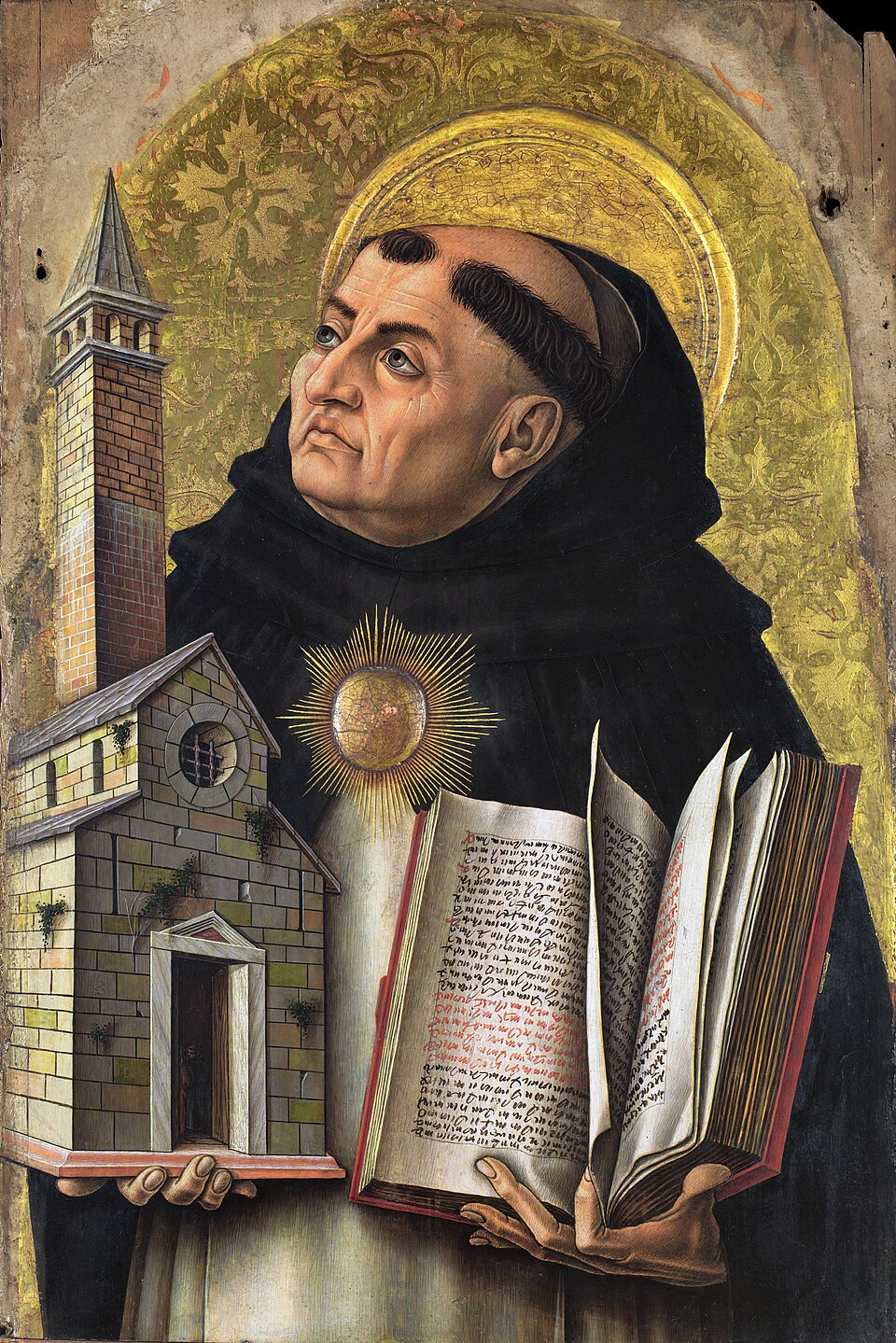 1Aquinasc. 1225 – 1274Summa Theologica · Part I-II, Q. 102, Art. 5 · English Dominican Fathers (GBWW) translation
Whether There Can Be Any Suitable Cause for the Sacraments of the Old
Law?
Objection 1: It would seem that there can be no suitable cause for the sacraments of the Old Law. Because those things that are done for the purpose of divine worship should not be like the observances of idolaters: since it is written (Deut. 12:31): "Thou shalt not do in like manner to the Lord thy God: for they have done to their gods all the abominations which the Lord abhorreth." Now worshippers of idols used to knive themselves to the shedding of blood: for it is related (3 Kings 18:28) that they "cut themselves after their manner with knives and lancets, till they were all covered with blood." For this reason the Lord commanded (Deut. 14:1): "You shall not cut yourselves nor make any baldness for the dead." Therefore it was unfitting for circumcision to be prescribed by the Law (Lev. 12:3).
Obj. 2: Further, those things which are done for the worship of God should be marked with decorum and gravity; according to Ps. 34:18: "I will praise Thee in a grave [Douay: 'strong'] people." But it seems to savor of levity for a man to eat with haste. Therefore it was unfittingly commanded (Ex. 12:11) that they should eat the Paschal lamb "in haste." Other things too relative to the eating of the lamb were prescribed, which seem altogether unreasonable.
Obj. 3: Further, the sacraments of the Old Law were figures of the sacraments of the New Law. Now the Paschal lamb signified the sacrament of the Eucharist, according to 1 Cor. 5:7: "Christ our Pasch is sacrificed." Therefore there should also have been some sacraments of the Old Law to foreshadow the other sacraments of the New Law, such as Confirmation, Extreme Unction, and Matrimony, and so forth.
Obj. 4: Further, purification can scarcely be done except by removing something impure. But as far as God is concerned, no bodily thing is reputed impure, because all bodies are God's creatures; and "every creature of God is good, and nothing to be rejected that is received with thanksgiving" (1 Tim. 4:4). It was therefore unfitting for them to be purified after contact with a corpse, or any similar corporeal infection.
Obj. 5: Further, it is written (Ecclus. 34:4): "What can be made clean by the unclean?" But the ashes of the red heifer [*Cf. Heb. 9:13] which was burnt, were unclean, since they made a man unclean: for it is stated (Num. 19:7, seqq.) that the priest who immolated her was rendered unclean "until the evening"; likewise he that burnt her; and he that gathered up her ashes. Therefore it was unfittingly prescribed there that the unclean should be purified by being sprinkled with those cinders.
Obj. 6: Further, sins are not something corporeal that can be carried from one place to another: nor can man be cleansed from sin by means of something unclean. It was therefore unfitting for the purpose of expiating the sins of the people that the priest should confess the sins of the children of Israel on one of the buck-goats, that it might carry them away into the wilderness: while they were rendered unclean by the other, which they used for the purpose of purification, by burning it together with the calf outside the camp; so that they had to wash their clothes and their bodies with water (Lev. 16).
Obj. 7: Further, what is already cleansed should not be cleansed again. It was therefore unfitting to apply a second purification to a man cleansed from leprosy, or to a house; as laid down in Lev. 14.
Obj. 8: Further, spiritual uncleanness cannot be cleansed by material water or by shaving the hair. Therefore it seems unreasonable that the Lord ordered (Ex. 30:18, seqq.) the making of a brazen laver with its foot, that the priests might wash their hands and feet before entering the temple; and that He commanded (Num. 8:7) the Levites to be sprinkled with the water of purification, and to shave all the hairs of their flesh.
Objection 9: Further, that which is greater cannot be cleansed by that which is less. Therefore it was unfitting that, in the Law, the higher and lower priests, as stated in Lev. 8 [*Cf. Ex. 29], and the Levites, according to Num. 8, should be consecrated with any bodily anointing, bodily sacrifices, and bodily oblations.
Objection 10: Further, as stated in 1 Kings 16:7, "Man seeth those things that appear, but the Lord beholdeth the heart." But those things that appear outwardly in man are the dispositions of his body and his clothes. Therefore it was unfitting for certain special garments to be appointed to the higher and lower priests, as related in Ex. 28 [*Cf. Lev. 8:7, seqq.]. It seems, moreover, unreasonable that anyone should be debarred from the priesthood on account of defects in the body, as stated in Lev. 21:17, seqq.: "Whosoever of thy seed throughout their families, hath a blemish, he shall not offer bread to his God . . . if he be blind, if he be lame," etc. It seems, therefore, that the sacraments of the Old Law were unreasonable.
On the contrary, It is written (Lev. 20:8): "I am the Lord that sanctify you." But nothing unreasonable is done by God, for it is written (Ps. 103:24): "Thou hast made all things in wisdom." Therefore there was nothing without a reasonable cause in the sacraments of the Old Law, which were ordained to the sanctification of man.
I answer that, As stated above (Q. 101, A. 4), the sacraments are, properly speaking, things applied to the worshippers of God for their consecration so as, in some way, to depute them to the worship of God. Now the worship of God belonged in a general way to the whole people; but in a special way, it belonged to the priests and Levites, who were the ministers of divine worship. Consequently, in these sacraments of the Old Law, certain things concerned the whole people in general; while others belonged to the ministers.
In regard to both, three things were necessary. The first was to be established in the state of worshipping God: and this institution was brought about—for all in general, by circumcision, without which no one was admitted to any of the legal observances—and for the priests, by their consecration. The second thing required was the use of those things that pertain to divine worship. And thus, as to the people, there was the partaking of the paschal banquet, to which no uncircumcised man was admitted, as is clear from Ex. 12:43, seqq.: and, as to the priests, the offering of the victims, and the eating of the loaves of proposition and of other things that were allotted to the use of the priests. The third thing required was the removal of all impediments to divine worship, viz. of uncleannesses. And then, as to the people, certain purifications were instituted for the removal of certain external uncleannesses; and also expiations from sins; while, as to the priests and Levites, the washing of hands and feet and the shaving of the hair were instituted.
And all these things had reasonable causes, both literal, in so far as they were ordained to the worship of God for the time being, and figurative, in so far as they were ordained to foreshadow Christ: as we shall see by taking them one by one.
Reply Obj. 1: The chief literal reason for circumcision was in order that man might profess his belief in one God. And because Abraham was the first to sever himself from the infidels, by going out from his house and kindred, for this reason he was the first to receive circumcision. This reason is set forth by the Apostle (Rom. 4:9, seqq.) thus: "He received the sign of circumcision, a seal of the justice of the faith which he had, being uncircumcised"; because, to wit, we are told that "unto Abraham faith was reputed to justice," for the reason that "against hope he believed in hope," i.e. against the hope that is of nature he believed in the hope that is of grace, "that he might be made the father of many nations," when he was an old man, and his wife an old and barren woman. And in order that this declaration, and imitation of Abraham's faith, might be fixed firmly in the hearts of the Jews, they received in their flesh such a sign as they could not forget, wherefore it is written (Gen. 17:13): "My covenant shall be in your flesh for a perpetual covenant." This was done on the eighth day, because until then a child is very tender, and so might be seriously injured; and is considered as something not yet consolidated: wherefore neither are animals offered before the eighth day. And it was not delayed after that time, lest some might refuse the sign of circumcision on account of the pain: and also lest the parents, whose love for their children increases as they become used to their presence and as they grow older, should withdraw their children from circumcision. A second reason may have been the weakening of concupiscence in that member. A third motive may have been to revile the worship of Venus and Priapus, which gave honor to that part of the body. The Lord's prohibition extended only to the cutting of oneself in honor of idols: and such was not the circumcision of which we have been speaking.
The figurative reason for circumcision was that it foreshadowed the removal of corruption, which was to be brought about by Christ, and will be perfectly fulfilled in the eighth age, which is the age of those who rise from the dead. And since all corruption of guilt and punishment comes to us through our carnal origin, from the sin of our first parent, therefore circumcision was applied to the generative member. Hence the Apostle says (Col. 2:11): "You are circumcised" in Christ "with circumcision not made by hand in despoiling of the body of the flesh, but in the circumcision of" Our Lord Jesus "Christ."
Reply Obj. 2: The literal reason of the paschal banquet was to commemorate the blessing of being led by God out of Egypt. Hence by celebrating this banquet they declared that they belonged to that people which God had taken to Himself out of Egypt. For when they were delivered from Egypt, they were commanded to sprinkle the lamb's blood on the transoms of their house doors, as though declaring that they were averse to the rites of the Egyptians who worshipped the ram. Wherefore they were delivered by the sprinkling or rubbing of the blood of the lamb on the door-posts, from the danger of extermination which threatened the Egyptians.
Now two things are to be observed in their departure from Egypt: namely, their haste in going, for the Egyptians pressed them to go forth speedily, as related in Ex. 12:33; and there was danger that anyone who did not hasten to go with the crowd might be slain by the Egyptians. Their haste was shown in two ways. First by what they ate. For they were commanded to eat unleavened bread, as a sign "that it could not be leavened, the Egyptians pressing them to depart"; and to eat roast meat, for this took less time to prepare; and that they should not break a bone thereof, because in their haste there was no time to break bones. Secondly, as to the manner of eating. For it is written: "You shall gird your reins, and you shall have shoes on your feet, holding staves in your hands, and you shall eat in haste": which clearly designates men at the point of starting on a journey. To this also is to be referred the command: "In one house shall it be eaten, neither shall you carry forth of the flesh thereof out of the house": because, to wit, on account of their haste, they could not send any gifts of it.
— Aquinas, Summa Theologica, Part I-II, Q. 102, Art. 5
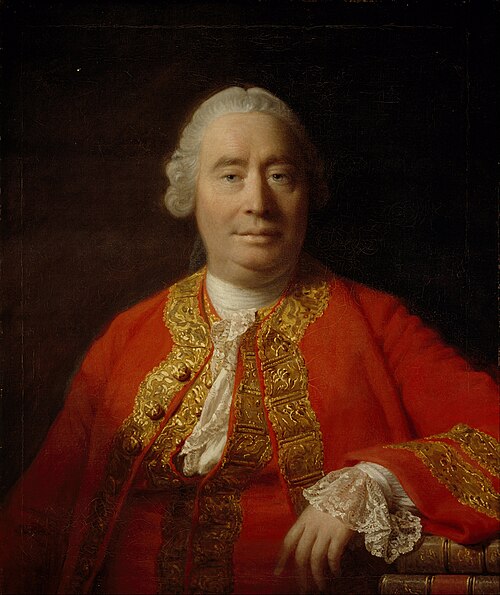 2Hume1711 – 1776An Enquiry Concerning Human Understanding · Section 10
THERE is, in Dr. Tillotson's writings, an argument against the real presence, which is as concise, and elegant, and strong as any argument can possibly be supposed against a doctrine, so little worthy of a serious refutation. It is acknowledged on all hands, says that learned prelate, that the authority, either of the scripture or of tradition, is founded merely in the testimony of the Apostles, who were eye-witnesses to those miracles of our Saviour, by which he proved his divine mission. Our evidence, then, for, the truth of the Christian religion is less than the evidence for the truth of our senses; because, even in the first authors of our religion, it was no greater; and it is evident it must diminish in passing from them to their disciples; nor can any one rest such confidence in their testimony, as in the immediate object of his senses. But a weaker evidence can never destroy a stronger; and therefore, were the doctrine of the real presence ever so clearly revealed in scripture, it were directly contrary to the rules of just reasoning to give our assent to it. It contradicts sense, though both the scripture and tradition, on which it is supposed to be built, carry not such evidence with them as sense; when they are considered merely as external evidences, and are not brought home to every one's breast, by the immediate operation of the Holy Spirit.
Nothing is so convenient as a decisive argument of this kind, which must at least silence the most arrogant bigotry and superstition, and free us from their impertinent solicitations. I flatter myself, that I have discovered an argument of a like nature, which, if just, will, with the wise and learned, be an everlasting check to all kinds of superstitious delusion, and consequently, will be useful as long as the world endures. For so long, I presume, will the accounts of miracles and prodigies be found in all history, sacred and profane.
Though experience be our only guide in reasoning concerning matters of fact; it must be acknowledged, that this guide is not altogether infallible, but in some cases is apt to lead us into errors. One, who in our climate, should expect better weather in any week of June than in one of December, would reason justly, and conformably to experience; but it is certain, that he may happen, in the event, to find himself mistaken. However, we may observe, that, in such a case, he would have no cause to complain of experience; because it commonly informs us beforehand of the uncertainty, by that contrariety of events, which we may learn from a diligent observation. All effects follow not with like certainty from their supposed causes. Some events are found, in all countries and all ages, to have been constantly conjoined together: Others are found to have been more variable, and sometimes to disappoint our expectations; so that, in our reasonings concerning matter of fact, there are all imaginable degrees of assurance, from the highest certainty to the lowest species of moral evidence.
A wise man, therefore, proportions his belief to the evidence. In such conclusions as are founded on an infallible experience, he expects the event with the last degree of assurance, and regards his past experience as a full proof of the future existence of that event. In other cases, he proceeds with more caution: he weighs the opposite experiments: he considers which side is supported by the greater number of experiments: to that side he inclines, with doubt and hesitation; and when at last he fixes his judgement, the evidence exceeds not what we properly call probability. All probability, then, supposes an opposition of experiments and observations, where the one side is found to overbalance the other, and to produce a degree of evidence, proportioned to the superiority. A hundred instances or experiments on one side, and fifty on another, afford a doubtful expectation of any event; though a hundred uniform experiments, with only one that is contradictory, reasonably beget a pretty strong degree of assurance. In all cases, we must balance the opposite experiments, where they are opposite, and deduct the smaller number from the greater, in order to know the exact force of the superior evidence.
To apply these principles to a particular instance; we may observe, that there is no species of reasoning more common, more useful, and even necessary to human life, than that which is derived from the testimony of men, and the reports of eye-witnesses and spectators. This species of reasoning, perhaps, one may deny to be founded on the relation of cause and effect. I shall not dispute about a word. It will be sufficient to observe that our assurance in any argument of this kind is derived from no other principle than our observation of the veracity of human testimony, and of the usual conformity of facts to the reports of witnesses. It being a general maxim, that no objects have any discoverable connexion together, and that all the inferences, which we can draw from one to another, are founded merely on our experience of their constant and regular conjunction; it is evident, that we ought not to make an exception to this maxim in favour of human testimony, whose connexion with any event seems, in itself, as little necessary as any other. Were not the memory tenacious to a certain degree; had not men commonly an inclination to truth and a principle of probity; were they not sensible to shame, when detected in a falsehood: were not these, I say, discovered by experience to be qualities, inherent in human nature, we should never repose the least confidence in human testimony. A man delirious, or noted for falsehood and villainy, has no manner of authority with us.
And as the evidence, derived from witnesses and human testimony, is founded on past experience, so it varies with the experience, and is regarded either as a proof or a probability, according as the conjunction between any particular kind of report and any kind of object has been found to be constant or variable. There are a number of circumstances to be taken into consideration in all judgements of this kind; and the ultimate standard, by which we determine all disputes, that may arise concerning them, is always derived from experience and observation. Where this experience is not entirely uniform on any side, it is attended with an unavoidable contrariety in our judgements, and with the same opposition and mutual destruction of argument as in every other kind of evidence. We frequently hesitate concerning the reports of others. We balance the opposite circumstances, which cause any doubt or uncertainty; and when we discover a superiority on any side, we incline to it; but still with a diminution of assurance, in proportion to the force of its antagonist.
This contrariety of evidence, in the present case, may be derived from several different causes; from the opposition of contrary testimony; from the character or number of the witnesses; from the manner of their delivering their testimony; or from the union of all these circumstances. We entertain a suspicion concerning any matter of fact, when the witnesses contradict each other; when they are but few, or of a doubtful character; when they have an interest in what they affirm; when they deliver their testimony with hesitation, or on the contrary, with too violent asseverations. There are many other particulars of the same kind, which may diminish or destroy the force of any argument, derived from human testimony.
Suppose, for instance, that the fact, which the testimony endeavours to establish, partakes of the extraordinary and the marvellous; in that case, the evidence, resulting from the testimony, admits of a diminution, greater or less, in proportion as the fact is more or less unusual. The reason why we place any credit in witnesses and historians, is not derived from any connexion, which we perceive a priori, between testimony and reality, but because we are accustomed to find a conformity between them. But when the fact attested is such a one as has seldom fallen under our observation, here is a contest of two opposite experiences; of which the one destroys the other, as far as its force goes, and the superior can only operate on the mind by the force, which remains. The very same principle of experience, which gives us a certain degree of assurance in the testimony of witnesses, gives us also, in this case, another degree of assurance against the fact, which they endeavour to establish; from which contradiction there necessarily arises a counterpoize, and mutual destruction of belief and authority.
I should not believe such a story were it told me by Cato, was a proverbial saying in Rome, even during the lifetime of that philosophical patriot.20 The incredibility of a fact, it was allowed, might invalidate so great an authority.
The Indian prince, who refused to believe the first relations concerning the effects of frost, reasoned justly; and it naturally required very strong testimony to engage his assent to facts, that arose from a state of nature, with which he was unacquainted, and which bore so little analogy to those events, of which he had had constant and uniform experience. Though they were not contrary to his experience, they were not conformable to it.21
But in order to encrease the probability against the testimony of witnesses, let us suppose, that the fact, which they affirm, instead of being only marvellous, is really miraculous; and suppose also, that the testimony considered apart and in itself, amounts to an entire proof; in that case, there is proof against proof, of which the strongest must prevail, but still with a diminution of its force, in proportion to that of its antagonist.
A miracle is a violation of the laws of nature; and as a firm and unalterable experience has established these laws, the proof against a miracle, from the very nature of the fact, is as entire as any argument from experience can possibly be imagined. Why is it more than probable, that all men must die; that lead cannot, of itself, remain suspended in the air; that fire consumes wood, and is extinguished by water; unless it be, that these events are found agreeable to the laws of nature, and there is required a violation of these laws, or in other words, a miracle to prevent them? Nothing is esteemed a miracle, if it ever happen in the common course of nature. It is no miracle that a man, seemingly in good health, should die on a sudden: because such a kind of death, though more unusual than any other, has yet been frequently observed to happen. But it is a miracle, that a dead man should come to life; because that has never been observed in any age or country. There must, therefore, be a uniform experience against every miraculous event, otherwise the event would not merit that appellation. And as a uniform experience amounts to a proof, there is here a direct and full proof, from the nature of the fact, against the existence of any miracle; nor can such a proof be destroyed, or the miracle rendered credible, but by an opposite proof, which is superior.22
The plain consequence is (and it is a general maxim worthy of our attention), 'that no testimony is sufficient to establish a miracle, unless the testimony be of such a kind, that its falsehood would be more miraculous, than the fact, which it endeavors to establish; and even in that case there is a mutual destruction of arguments, and the superior only gives us an assurance suitable to that degree of force, which remains, after deducting the inferior.' When anyone tells me, that he saw a dead man restored to life, I immediately consider with myself, whether it be more probable, that this person should either deceive or be deceived, or that the fact, which he relates, should really have happened. I weigh the one miracle against the other; and according to the superiority, which I discover, I pronounce my decision, and always reject the greater miracle. If the falsehood of his testimony would be more miraculous, than the event which he relates; then, and not till then, can he pretend to command my belief or opinion.
— Hume, An Enquiry Concerning Human Understanding, Section 10
3Aquinasc. 1225 – 1274Summa Theologica · Supplement, Q. 77, Art. 2 · English Dominican Fathers (1920) translation
Article 2. Whether the time of our resurrection is hidden?
Objection 1. It would seem that this time is not hidden. Because when we know exactly the beginning of a thing, we can know its end exactly, since "all things are measured by a certain period" (De Generat. ii). Now the beginning of the world is known exactly. Therefore its end can also be known exactly. But this will be the time of the resurrection and judgment. Therefore that time is not hidden.
Objection 2. Further, it is stated (Apocalypse 12:6) that "the woman who represents the Church had a place prepared by God, that there she might feed [Vulgate: 'they should feed her'] a thousand two hundred sixty days." Again (Daniel 12:11), a certain fixed number of days is mentioned, which apparently signify years, according to Ezekiel 4:6: "A day for a year, yea a day for a year I have appointed to thee." Therefore the time of the end of the world and of the resurrection can be known exactly from Holy Writ.
Objection 3. Further, the state of the New Testament was foreshadowed in the Old Testament. Now we know exactly the time wherein the state of the Old Testament endured. Therefore we can also know exactly the time wherein the state of the New Testament will endure. But the state of the New Testament will last to the end of the world, wherefore it is said (Matthew 28:20): "Behold I am with you . . . to the consummation of the world." Therefore the time of the end of the world and of the resurrection can be known exactly.
On the contrary, That which is unknown to the angels will be much more unknown to men: because those things to which men attain by natural reason are much more clearly and certainly known to the angels by their natural knowledge. Moreover revelations are not made to men save by means of the angels as Dionysius asserts (Coel. Hier. iv). Now the angels have no exact knowledge of that time, as appears from Matthew 24:36: "Of that day and hour no one knoweth, no not the angels of heaven." Therefore that time is hidden from men.
Further, the apostles were more cognizant of God's secrets than others who followed them, because they had "the first-fruits of the spirit" (Romans 8:23)—" before others in point of time and more abundantly," as a gloss observes. And yet when they questioned our Lord about this very matter, He answered them (Acts 1:7): "It is not for you to know the times or moments which the Father hath put in His own power." Much more, therefore, is it hidden from others.
I answer that, As Augustine says (Qq. lxxxiii, qu. 58) "as to the last age of the human race, which begins from our Lord's coming and lasts until the end of the world, it is uncertain of how many generations it will consist: even so old age, which is man's last age, has no fixed time according to the measure of the other ages, since sometimes alone it lasts as long a time as all the others." The reason of this is because the exact length of future time cannot be known except either by revelation or by natural reason: and the time until the resurrection cannot be reckoned by natural reason, because the resurrection and the end of the heavenly movement will be simultaneous as stated above (Article 1). And all things that are foreseen by natural reason to happen at a fixed time are reckoned by movement: and it is impossible from the movement of the heaven to reckon its end, for since it is circular, it is for this very reason able by its nature to endure for ever: and consequently the time between this and the resurrection cannot be reckoned by natural reason. Again it cannot be known by revelation, so that all may be on the watch and ready to meet Christ: and for this reason when the apostles asked Him about this, Christ answered (Acts 1:7): "It is not for you to know the times or moments which the Father hath put in His own power," whereby, as Augustine says (De Civ. Dei xviii, 53): "He scatters the fingers of all calculators and bids them be still." For what He refused to tell the apostles, He will not reveal to others: wherefore all those who have been misled to reckon the aforesaid time have so far proved to be untruthful; for some, as Augustine says (De Civ. Dei xviii, 53), stated that from our Lord's Ascension to His last coming 400 years would elapse, others 500, others 1,000. The falseness of these calculators is evident, as will likewise be the falseness of those who even now cease not to calculate.
Reply to Objection 1. When we know a thing's beginning and also its end it follows that its measure is known to us: wherefore if we know the beginning of a thing the duration of which is measured by the movement of the heaven, we are able to know its end, since the movement of heaven is known to us. But the measure of the duration of the heavenly movement is God's ordinance alone, which is unknown to us. Wherefore however much we may know its beginning, we are unable to know its end.
Reply to Objection 2. The thousand two hundred sixty days mentioned in the Apocalypse (12:6) denote all the time during which the Church endures, and not any definite number of years. The reason whereof is because the preaching of Christ on which the Church is built lasted three years and a half, which time contains almost an equal number of days as the aforesaid number. Again the number of days appointed by Daniel does not refer to a number of years to elapse before the end of the world or until the preaching of Antichrist, but to the time of Antichrist's preaching and the duration of his persecution.
Reply to Objection 3. Although the state of the New Testament in general is foreshadowed by the state of the Old Testament it does not follow that individuals correspond to individuals: especially since all the figures of the Old Testament were fulfilled in Christ. Hence Augustine (De Civ. Dei xviii, 52) answers certain persons who wished to liken the number of persecutions suffered by the Church to the number of the plagues of Egypt, in these words: "I do not think that the occurrences in Egypt were in their signification prophetic of these persecutions, although those who think so have shown nicety and ingenuity in adapting them severally the one to the other, not indeed by a prophetic spirit, but by the guess-work of the human mind, which sometimes reaches the truth and sometimes not." The same remarks would seem applicable to the statements of Abbot Joachim, who by means of such conjectures about the future foretold some things that were true, and in others was deceived.
Article 3. Whether the resurrection will take place at night-time?
Objection 1. It would seem that the resurrection will not be at night-time. For the resurrection will not be "till the heavens be broken" (Job 14:12). Now when the heavenly movement ceases, which is signified by its breaking, there will be no time, neither night nor day. Therefore the resurrection will not be at night-time.
Objection 2. Further, the end of a thing ought to be most perfect. Now the end of time will be then: wherefore it is said (Apocalypse 10:6) that "time shall be no longer." Therefore time ought to be then in its most perfect disposition and consequently it should be the daytime.
Objection 3. Further, the time should be such as to be adapted to what is done therein: wherefore (John 13:30) the night is mentioned as being the time when Judas went out from the fellowship of the light. Now, all things that are hidden at the present time will then be made most manifest, because when the Lord shall come He "will bring to light the hidden things of darkness, and will make manifest the counsels of the hearts" (1 Corinthians 4:5). Therefore it ought to be during the day.
On the contrary, Christ's resurrection is the exemplar of ours. Now Christ's resurrection was at night, as Gregory says in a homily for Easter (xxi in Evang.). Therefore our resurrection will also be at night-time.
Further, the coming of our Lord is compared to the coming of a thief into the house (Luke 12:39-40). But the thief comes to the house at night-time. Therefore our Lord will also come in the night. Now, when He comes the resurrection will take place, as stated above (Supplement:76:2). Therefore the resurrection will be at night-time.
I answer that, The exact time and hour at which the resurrection will be cannot be known for certain, as stated in the text (Sent. iv, D, 43). Nevertheless some assert with sufficient probability that it will be towards the twilight, the moon being in the east and the sun in the west; because the sun and moon are believed to have been created in these positions, and thus their revolutions will be altogether completed by their return to the same point. Wherefore it is said that Christ arose at such an hour.
Reply to Objection 1. When the resurrection occurs, it will not be time but the end of time; because at the very instant that the heavens will cease to move the dead will rise again. Nevertheless the stars will be in the same position as they occupy now at any fixed hour: and accordingly it is said that the resurrection will be at this or that hour.
Reply to Objection 2. The most perfect disposition of time is said to be midday, on account of the light given by the sun. But then the city of God will need neither sun nor moon, because the glory of God will enlighten it (Apocalypse 22:5). Wherefore in this respect it matters not whether the resurrection be in the day or in the night.
Reply to Objection 3. That time should be adapted to manifestation as regards the things that will happen then, and to secrecy as regards the fixing of the time. Hence either may happen fittingly, namely that the resurrection be in the day or in the night.
Article 4. Whether the resurrection will happen suddenly or by degrees?
Objection 1. It would seem that the resurrection will not happen suddenly but by degrees. For the resurrection of the dead is foretold (Ezekiel 37:7-8) where it is written: "The bones came together . . . and I saw and behold the sinews and the flesh came up upon them, and the skin was stretched out over them, but there was no spirit in them." Therefore the restoration of the bodies will precede in time their reunion with the souls, and thus the resurrection will not be sudden.
Objection 2. Further, a thing does not happen suddenly if it require several actions following one another. Now the resurrection requires several actions following one another, namely the gathering of the ashes, the refashioning of the body, the infusion of the soul. Therefore the resurrection will not be sudden.
Objection 3. Further, all sound is measured by time. Now the sound of the trumpet will be the cause of the resurrection, as stated above (Supplement:76:2). Therefore the resurrection will take time and will not happen suddenly.
Objection 4. Further, no local movement can be sudden as stated in De Sensu et Sensato vii. Now the resurrection requires local movement in the gathering of the ashes. Therefore it will not happen suddenly.
On the contrary, It is written (1 Corinthians 15:51-52): "We shall all indeed rise again . . . in a moment, in the twinkling of an eye." Therefore the resurrection will be sudden.
— Aquinas, Summa Theologica, Supplement, Q. 77, Art. 2
4Hume1711 – 1776An Enquiry Concerning Human Understanding · Section 7
THE great advantage of the mathematical sciences above the moral consists in this, that the ideas of the former, being sensible, are always clear and determinate, the smallest distinction between them is immediately perceptible, and the same terms are still expressive of the same ideas, without ambiguity or variation. An oval is never mistaken for a circle, nor an hyperbola for an ellipsis. The isosceles and scalenum are distinguished by boundaries more exact than vice and virtue, right and wrong. If any term be defined in geometry, the mind readily, of itself, substitutes, on all occasions, the definition for the term defined: or even when no definition is employed, the object itself may be presented to the senses, and by that means be steadily and clearly apprehended. But the finer sentiments of the mind, the operations of the understanding, the various agitations of the passions, though really in themselves distinct, easily escape us, when surveyed by reflection; nor is it in our power to recall the original object, as often as we have occasion to contemplate it. Ambiguity, by this means, is gradually introduced into our reasonings: similar objects are readily taken to be the same: and the conclusion becomes at last very wide of the premises.
One may safely, however, affirm, that, if we consider these sciences in a proper light, their advantages and disadvantages nearly compensate each other, and reduce both of them to a state of equality. If the mind, with greater facility, retains the ideas of geometry clear and determinate, it must carry on a much longer and more intricate chain of reasoning, and compare ideas much wider of each other, in order to reach the abstruser truths of that science. And if moral ideas are apt, without extreme care, to fall into obscurity and confusion, the inferences are always much shorter in these disquisitions, and the intermediate steps, which lead to the conclusion, much fewer than in the sciences which treat of quantity and number. In reality, there is scarcely a proposition in Euclid so simple, as not to consist of more parts, than are to be found in any moral reasoning which runs not into chimera and conceit. Where we trace the principles of the human mind through a few steps, we may be very well satisfied with our progress; considering how soon nature throws a bar to all our enquiries concerning causes, and reduces us to an acknowledgment of our ignorance. The chief obstacle, therefore, to our improvement in the moral or metaphysical sciences is the obscurity of the ideas, and ambiguity of the terms. The principal difficulty in the mathematics is the length of inferences and compass of thought, requisite to the forming of any conclusion. And, perhaps, our progress in natural philosophy is chiefly retarded by the want of proper experiments and phaenomena, which are often discovered by chance, and cannot always be found, when requisite, even by the most diligent and prudent enquiry. As moral philosophy seems hitherto to have received less improvement than either geometry or physics, we may conclude, that, if there be any difference in this respect among these sciences, the difficulties, which obstruct the progress of the former, require superior care and capacity to be surmounted.
There are no ideas, which occur in metaphysics, more obscure and uncertain, than those of power, force, energy or necessary connexion, of which it is every moment necessary for us to treat in all our disquisitions. We shall, therefore, endeavour, in this section, to fix, if possible, the precise meaning of these terms, and thereby remove some part of that obscurity, which is so much complained of in this species of philosophy.
It seems a proposition, which will not admit of much dispute, that all our ideas are nothing but copies of our impressions, or, in other words, that it is impossible for us to think of anything, which we have not antecedently felt, either by our external or internal senses. I have endeavoured10 to explain and prove this proposition, and have expressed my hopes, that, by a proper application of it, men may reach a greater clearness and precision in philosophical reasonings, than what they have hitherto been able to attain. Complex ideas, may, perhaps, be well known by definition, which is nothing but an enumeration of those parts or simple ideas, that compose them. But when we have pushed up definitions to the most simple ideas, and find still more ambiguity and obscurity; what resource are we then possessed of? By what invention can we throw light upon these ideas, and render them altogether precise and determinate to our intellectual view? Produce the impressions or original sentiments, from which the ideas are copied. These impressions are all strong and sensible. They admit not of ambiguity. They are not only placed in a full light themselves, but may throw light on their correspondent ideas, which lie in obscurity. And by this means, we may, perhaps, attain a new microscope or species of optics, by which, in the moral sciences, the most minute, and most simple ideas may be so enlarged as to fall readily under our apprehension, and be equally known with the grossest and most sensible ideas, that can be the object of our enquiry.
To be fully acquainted, therefore, with the idea of power or necessary connexion, let us examine its impression; and in order to find the impression with greater certainty, let us search for it in all the sources, from which it may possibly be derived.
When we look about us towards external objects, and consider the operation of causes, we are never able, in a single instance, to discover any power or necessary connexion; any quality, which binds the effect to the cause, and renders the one an infallible consequence of the other. We only find, that the one does actually, in fact, follow the other. The impulse of one billiard-ball is attended with motion in the second. This is the whole that appears to the outward senses. The mind feels no sentiment or inward impression from this succession of objects: consequently, there is not, in any single, particular instance of cause and effect, any thing which can suggest the idea of power or necessary connexion.
From the first appearance of an object, we never can conjecture what effect will result from it. But were the power or energy of any cause discoverable by the mind, we could foresee the effect, even without experience; and might, at first, pronounce with certainty concerning it, by mere dint of thought and reasoning.
In reality, there is no part of matter, that does ever, by its sensible qualities, discover any power or energy, or give us ground to imagine, that it could produce any thing, or be followed by any other object, which we could denominate its effect. Solidity, extension, motion; these qualities are all complete in themselves, and never point out any other event which may result from them. The scenes of the universe are continually shifting, and one object follows another in an uninterrupted succession; but the power of force, which actuates the whole machine, is entirely concealed from us, and never discovers itself in any of the sensible qualities of body. We know that, in fact, heat is a constant attendant of flame; but what is the connexion between them, we have no room so much as to conjecture or imagine. It is impossible, therefore, that the idea of power can be derived from the contemplation of bodies, in single instances of their operation; because no bodies ever discover any power, which can be the original of this idea.11
Since, therefore, external objects as they appear to the senses, give us no idea of power or necessary connexion, by their operation in particular instances, let us see, whether this idea be derived from reflection on the operations of our own minds, and be copied from any internal impression. It may be said, that we are every moment conscious of internal power; while we feel, that, by the simple command of our will, we can move the organs of our body, or direct the faculties of our mind. An act of volition produces motion in our limbs, or raises a new idea in our imagination. This influence of the will we know by consciousness. Hence we acquire the idea of power or energy; and are certain, that we ourselves and all other intelligent beings are possessed of power. This idea, then, is an idea of reflection, since it arises from reflecting on the operations of our own mind, and on the command which is exercised by will, both over the organs of the body and faculties of the soul.
We shall proceed to examine this pretension; and first with regard to the influence of volition over the organs of the body. This influence, we may observe, is a fact, which, like all other natural events, can be known only by experience, and can never be foreseen from any apparent energy or power in the cause, which connects it with the effect, and renders the one an infallible consequence of the other. The motion of our body follows upon the command of our will. Of this we are every moment conscious. But the means, by which this is effected; the energy, by which the will performs so extraordinary an operation; of this we are so far from being immediately conscious, that it must for ever escape our most diligent enquiry.
For first: Is there any principle in all nature more mysterious than the union of soul with body; by which a supposed spiritual substance acquires such an influence over a material one, that the most refined thought is able to actuate the grossest matter? Were we empowered, by a secret wish, to remove mountains, or control the planets in their orbit; this extensive authority would not be more extraordinary, nor more beyond our comprehension. But if by consciousness we perceived any power or energy in the will, we must know this power; we must know its connexion with the effect; we must know the secret union of soul and body, and the nature of both these substances; by which the one is able to operate, in so many instances, upon the other.
Secondly, We are not able to move all the organs of the body with a like authority; though we cannot assign any reason besides experience, for so remarkable a difference between one and the other. Why has the will an influence over the tongue and fingers, not over the heart or liver? This question would never embarrass us, were we conscious of a power in the former case, not in the latter. We should then perceive, independent of experience, why the authority of will over the organs of the body is circumscribed within such particular limits. Being in that case fully acquainted with the power or force, by which it operates, we should also know, why its influence reaches precisely to such boundaries, and no farther.
A man, suddenly struck with palsy in the leg or arm, or who had newly lost those members, frequently endeavours, at first to move them, and employ them, in their usual offices. Here he is as much conscious of power to command such limbs, as a man in perfect health is conscious of power to actuate any member which remains in its natural state and condition. But consciousness never deceives. Consequently, neither in the one case nor in the other, are we ever conscious of any power. We learn the influence of our will from experience alone. And experience only teaches us, how one event constantly follows another; without instructing us in the secret connexion, which binds them together, and renders them inseparable.
— Hume, An Enquiry Concerning Human Understanding, Section 7
5Aquinasc. 1225 – 1274Summa Theologica · Supplement, Q. 93, Art. 1 · English Dominican Fathers (1920) translation
Article 1. Whether the happiness of the saints will be greater after the judgment than before?
Objection 1. It would seem that the happiness of the saints will not be greater after the judgment than before. For the nearer a thing approaches to the Divine likeness, the more perfectly does it participate happiness. Now the soul is more like God when separated from the body than when united to it. Therefore its happiness is greater before being reunited to the body than after.
Objection 2. Further, power is more effective when it is united than when divided. Now the soul is more united when separated from the body than when it is joined to the body. Therefore it has then greater power for operation, and consequently has a more perfect share of happiness, since this consists in action [Cf. I-II:3:2].
Objection 3. Further, beatitude consists in an act of the speculative intellect. Now the intellect, in its act, makes no use of a bodily organ; and consequently by being reunited to the body the soul does not become capable of more perfect understanding. Therefore the soul's happiness is not greater after than before the judgment.
Objection 4. Further, nothing can be greater than the infinite, and so the addition of the finite to the infinite does not result in something greater than the infinite by itself. Now the beatified soul before its reunion with the body is rendered happy by rejoicing in the infinite good, namely God; and after the resurrection of the body it will rejoice in nothing else except perhaps the glory of the body, and this is a finite good. Therefore their joy after the resumption of the body will not be greater than before.
On the contrary, A gloss on Apocalypse 6:9, "I saw under the altar the souls of them that were slain," says: "At present the souls of the saints are under the altar, i.e. less exalted than they will be." Therefore their happiness will be greater after the resurrection than after their death.
Further, just as happiness is bestowed on the good as a reward, so is unhappiness awarded to the wicked. But the unhappiness of the wicked after reunion with their bodies will be greater than before, since they will be punished not only in the soul but also in the body. Therefore the happiness of the saints will be greater after the resurrection of the body than before.
I answer that, It is manifest that the happiness of the saints will increase in extent after the resurrection, because their happiness will then be not only in the soul but also in the body. Moreover, the soul's happiness also will increase in extent, seeing that the soul will rejoice not only in its own good, but also in that of the body. We may also say that the soul's happiness will increase in intensity [Cf. I-II:4:5, ad 5, where St. Thomas retracts this statement]. For man's body may be considered in two ways: first, as being dependent on the soul for its completion; secondly, as containing something that hampers the soul in its operations, through the soul not perfectly completing the body. As regards the first way of considering the body, its union with the soul adds a certain perfection to the soul, since every part is imperfect, and is completed in its whole; wherefore the whole is to the part as form to matter. Consequently the soul is more perfect in its natural being, when it is in the whole—namely, man who results from the union of soul and body—than when it is a separate part. But as regards the second consideration the union of the body hampers the perfection of the soul, wherefore it is written (Wisdom 9:15) that "the corruptible body is a load upon the soul." If, then, there be removed from the body all those things wherein it hampers the soul's action, the soul will be simply more perfect while existing in such a body than when separated therefrom. Now the more perfect a thing is in being, the more perfectly is it able to operate: wherefore the operation of the soul united to such a body will be more perfect than the operation of the separated soul. But the glorified body will be a body of this description, being altogether subject to the spirit. Therefore, since beatitude consists in an operation [Cf. I-II:3:2, seqq.], the soul's happiness after its reunion with the body will be more perfect than before. For just as the soul separated from a corruptible body is able to operate more perfectly than when united thereto, so after it has been united to a glorified body, its operation will be more perfect than while it was separated. Now every imperfect thing desires its perfection. Hence the separated soul naturally desires reunion with the body and on account of this desire which proceeds from the soul's imperfection its operation whereby it is borne towards God is less intense. This agrees with the saying of Augustine (Gen. ad lit. xii, 35) that "on account of the body's desire it is held back from tending with all its might to that sovereign good."
Reply to Objection 1. The soul united to a glorified body is more like to God than when separated therefrom, in so far as when united it has more perfect being. For the more perfect a thing is the more it is like to God: even so the heart, the perfection of whose life consists in movement, is more like to God while in movement than while at rest, although God is never moved.
Reply to Objection 2. A power which by its own nature is capable of being in matter is more effective when subjected in matter than when separated from matter, although absolutely speaking a power separate from matter is more effective.
Reply to Objection 3. Although in the act of understanding the soul does not make use of the body, the perfection of the body will somewhat conduce to the perfection of the intellectual operation in so far as through being united to a glorified body, the soul will be more perfect in its nature, and consequently more effective in its operation, and accordingly the good itself of the body will conduce instrumentally, as it were, to the operation wherein happiness consists: thus the Philosopher asserts (Ethic. i, 8,10) that external goods conduce instrumentally to the happiness of life.
Reply to Objection 4. Although finite added to infinite does not make a greater thing, it makes more things, since finite and infinite are two things, while infinite taken by itself is one. Now the greater extent of joy regards not a greater thing but more things. Wherefore joy is increased in extent, through referring to God and to the body's glory, in comparison with the joy which referred to God. Moreover, the body's glory will conduce to the intensity of the joy that refers to God, in so far as it will conduce to the more perfect operation whereby the soul tends to God: since the more perfect is a becoming operation, the greater the delight [Cf. I-II:32:1], as stated in Ethic. x, 8.
Article 2. Whether the degrees of beatitude should be called mansions?
Objection 1. It would seem that the degrees of beatitude should not be called mansions. For beatitude implies the notion of a reward: whereas mansion denotes nothing pertaining to a reward. Therefore the various degrees of beatitude should not be called mansions.
Objection 2. Further, mansion seemingly denotes a place. Now the place where the saint will be beatified is not corporeal but spiritual, namely God Who is one. Therefore there is but one mansion: and consequently the various degrees of beatitude should not be called mansions.
Objection 3. Further, as in heaven there will be men of various merits, so are there now in purgatory, and were in the limbo of the fathers. But various mansions are not distinguished in purgatory and limbo. Therefore in like manner neither should they be distinguished in heaven.
On the contrary, It is written (John 14:2): "In My Father's house there are many mansions": and Augustine expounds this in reference to the different degrees of rewards (Tract. lxvii in Joan.).
Further, in every well-ordered city there is a distinction of mansions. Now the heavenly kingdom is compared to a city (Apocalypse 21:2). Therefore we should distinguish various mansions there according to the various degrees of beatitude.
I answer that, Since local movement precedes all other movements, terms of movement, distance and the like are derived from local movement to all other movements according to the Philosopher (Phys., liber viii, 7). Now the end of local movement is a place, and when a thing has arrived at that place it remains there at rest and is maintained therein. Hence in every movement this very rest at the end of the movement is called an establishment [collocatio] or mansion. Wherefore since the term movement is transferred to the actions of the appetite and will, the attainment of the end of an appetitive movement is called a mansion or establishment: so that the unity of a house corresponds to the unity of beatitude which unity is on the part of the object, and the plurality of mansions corresponds to the differences of beatitude on the part of the blessed: even so we observe in natural things that there is one same place above to which all light objects tend, whereas each one reaches it more closely, according as it is lighter, so that they have various mansions corresponding to their various lightness.
Reply to Objection 1. Mansion implies the notion of end and consequently of reward which is the end of merit.
Reply to Objection 2. Though there is one spiritual place, there are different degrees of approaching thereto: and the various mansions correspond to these.
Reply to Objection 3. Those who were in limbo or are now in purgatory have not yet attained to their end. Wherefore various mansions are not distinguished in purgatory or limbo, but only in heaven and hell, wherein is the end of the good and of the wicked.
Article 3. Whether the various mansions are distinguished according to the various degrees of charity?
Objection 1. It would seem that the various mansions are not distinguished according to the various degrees of charity. For it is written (Matthew 25:15): "He gave to every one according to his proper virtue [Douay: 'ability']." Now the proper ability of a thing is its natural power. Therefore the gifts also of grace and glory are distributed according to the different degrees of natural power.
Objection 2. Further, it is written (Psalm 61:12): "Thou wilt render to every man according to his works." Now that which is rendered is the measure of beatitude. Therefore the degrees of beatitude are distinguished according to the diversity of works and not according to the diversity of charity.
Objection 3. Further, reward is due to act and not to habit: hence "it is not the strongest who are crowned but those who engage in the conflict" (Ethic. i, 8) and "he . . . shall not be [Vulgate: 'is not'] crowned except he strive lawfully." Now beatitude is a reward. Therefore the various degrees of beatitude will be according to the various degrees of works and not according to the various degrees of charity.
On the contrary, The more one will be united to God the happier will one be. Now the measure of charity is the measure of one's union with God. Therefore the diversity of beatitude will be according to the difference of charity.
Further, "if one thing simply follows from another thing simply, the increase of the former follows from the increase of the latter." Now to have beatitude follows from having charity. Therefore to have greater beatitude follows from having greater charity.
— Aquinas, Summa Theologica, Supplement, Q. 93, Art. 1
6Hume1711 – 1776An Enquiry Concerning Human Understanding · Section 11
WAS lately engaged in conversation with a friend who loves sceptical paradoxes; where, though he advanced many principles, of which I can by no means approve, yet as they seem to be curious, and to bear some relation to the chain of reasoning carried on throughout this enquiry, I shall here copy them from my memory as accurately as I can, in order to submit them to the judgement of the reader.
Our conversation began with my admiring the singular good fortune of philosophy, which, as it requires entire liberty above all other privileges, and chiefly flourishes from the free opposition of sentiments and argumentation, received its first birth in an age and country of freedom and toleration, and was never cramped, even in its most extravagant principles, by any creeds, concessions, or penal statutes. For, except the banishment of Protagoras, and the death of Socrates, which last event proceeded partly from other motives, there are scarcely any instances to be met with, in ancient history, of this bigoted jealousy, with which the present age is so much infested. Epicurus lived at Athens to an advanced age, in peace and tranquillity: Epicureans27 were even admitted to receive the sacerdotal character, and to officiate at the altar, in the most sacred rites of the established religion: and the public encouragement28 of pensions and salaries was afforded equally, by the wisest of all the Roman emperors29, to the professors of every sect of philosophy. How requisite such kind of treatment was to philosophy, in her early youth, will easily be conceived, if we reflect, that, even at present, when she may be supposed more hardy and robust, she bears with much difficulty the inclemency of the seasons, and those harsh winds of calumny and persecution, which blow upon her.
You admire, says my friend, as the singular good fortune of philosophy, what seems to result from the natural course of things, and to be unavoidable in every age and nation. This pertinacious bigotry, of which you complain, as so fatal to philosophy, is really her offspring, who, after allying with superstition, separates himself entirely from the interest of his parent, and becomes her most inveterate enemy and persecutor. Speculative dogmas of religion, the present occasions of such furious dispute, could not possibly be conceived or admitted in the early ages of the world; when mankind, being wholly illiterate, formed an idea of religion more suitable to their weak apprehension, and composed their sacred tenets of such tales chiefly as were the objects of traditional belief, more than of argument or disputation. After the first alarm, therefore, was over, which arose from the new paradoxes and principles of the philosophers; these teachers seem ever after, during the ages of antiquity, to have lived in great harmony with the established superstition, and to have made a fair partition of mankind between them; the former claiming all the learned and wise, the latter possessing all the vulgar and illiterate.
It seems then, say I, that you leave politics entirely out of the question, and never suppose, that a wise magistrate can justly be jealous of certain tenets of philosophy, such as those of Epicurus, which, denying a divine existence, and consequently a providence and a future state, seem to loosen, in a great measure the ties of morality, and may be supposed, for that reason, pernicious to the peace of civil society.
I know, replied he, that in fact these persecutions never, in any age, proceeded from calm reason, or from experience of the pernicious consequences of philosophy; but arose entirely from passion and prejudice. But what if I should advance farther, and assert, that if Epicurus had been accused before the people, by any of the sycophants or informers of those days, he could easily have defended his cause, and proved his principles of philosophy to be as salutary as those of his adversaries, who endeavoured, with such zeal, to expose him to the public hatred and jealousy?
I wish, said I, you would try your eloquence upon so extraordinary a topic, and make a speech for Epicurus, which might satisfy, not the mob of Athens, if you will allow that ancient and polite city to have contained any mob, but the more philosophical part of his audience, such as might be supposed capable of comprehending his arguments.
The matter would not be difficult, upon such conditions, replied he: and if you please, I shall suppose myself Epicurus for a moment, and make you stand for the Athenian people, and shall deliver you such an harangue as will fill all the urn with white beans, and leave not a black one to gratify the malice of my adversaries.
Very well: pray proceed upon these suppositions.
I come hither, O ye Athenians, to justify in your assembly what I maintain in my school, and I find myself impeached by furious antagonists, instead of reasoning with calm and dispassionate enquirers. Your deliberations, which of right should be directed to questions of public good, and the interest of the commonwealth, are diverted to the disquisitions of speculative philosophy; and these magnificent, but perhaps fruitless enquiries, take place of your more familiar but more useful occupations. But so far as in me lies, I will prevent this abuse. We shall not here dispute concerning the origin and government of worlds. We shall only enquire how far such questions concern the public interest. And if I can persuade you, that they are entirely indifferent to the peace of society and security of government, I hope that you will presently send us back to our schools, there to examine, at leisure, the question the most sublime, but, at the same time, the most speculative of all philosophy.
The religious philosophers, not satisfied with the tradition of your forefathers, and doctrine of your priests (in which I willingly acquiesce), indulge a rash curiosity, in trying how far they can establish religion upon the principles of reason; and they thereby excite, instead of satisfying, the doubts, which naturally arise from a diligent and scrutinous enquiry. They paint, in the most magnificent colours, the order, beauty, and wise arrangement of the universe; and then ask, if such a glorious display of intelligence could proceed from the fortuitous concourse of atoms, or if chance could produce what the greatest genius can never sufficiently admire. I shall not examine the justness of this argument. I shall allow it to be as solid as my antagonists and accusers can desire. It is sufficient, if I can prove, from this very reasoning, that the question is entirely speculative, and that, when, in my philosophical disquisitions, I deny a providence and a future state, I undermine not the foundations of society, but advance principles, which they themselves, upon their own topics, if they argue consistently, must allow to be solid and satisfactory.
You then, who are my accusers, have acknowledged, that the chief or sole argument for a divine existence (which I never questioned) is derived from the order of nature; where there appear such marks of intelligence and design, that you think it extravagant to assign for its cause, either chance, or the blind and unguided force of matter. You allow, that this is an argument drawn from effects to causes. From the order of the work, you infer, that there must have been project and forethought in the workman. If you cannot make out this point, you allow, that your conclusion fails; and you pretend not to establish the conclusion in a greater latitude than the phenomena of nature will justify. These are your concessions. I desire you to mark the consequences.
When we infer any particular cause from an effect, we must proportion the one to the other, and can never be allowed to ascribe to the cause any qualities, but what are exactly sufficient to produce the effect. A body of ten ounces raised in any scale may serve as a proof, that the counterbalancing weight exceeds ten ounces; but can never afford a reason that it exceeds a hundred. If the cause, assigned for any effect, be not sufficient to produce it, we must either reject that cause, or add to it such qualities as will give it a just proportion to the effect. But if we ascribe to it farther qualities, or affirm it capable of producing other effects, we can only indulge the licence of conjecture, and arbitrarily suppose the existence of qualities and energies, without reason or authority.
The same rule holds, whether the cause assigned be brute unconscious matter, or a rational intelligent being. If the cause be known only by the effect, we never ought to ascribe to it any qualities, beyond what are precisely requisite to produce the effect: nor can we, by any rules of just reasoning, return back from the cause, and infer other effects from it, beyond those by which alone it is known to us. No one, merely from the sight of one of Zeuxis's pictures, could know, that he was also a statuary or architect, and was an artist no less skilful in stone and marble than in colours. The talents and taste, displayed in the particular work before us; these we may safely conclude the workman to be possessed of. The cause must be proportioned to the effect; and if we exactly and precisely proportion it, we shall never find in it any qualities, that point farther, or afford an inference concerning any other design or performance. Such qualities must be somewhat beyond what is merely requisite for producing the effect, which we examine.
Allowing, therefore, the gods to be the authors of the existence or order of the universe; it follows, that they possess that precise degree of power, intelligence, and benevolence, which appears in their workmanship; but nothing farther can ever be proved, except we call in the assistance of exaggeration and flattery to supply the defects of argument and reasoning. So far as the traces of any attributes, at present, appear, so far may we conclude these attributes to exist. The supposition of farther attributes is mere hypothesis; much more the supposition, that, in distant regions of space or periods of time, there has been, or will be, a more magnificent display of these attributes, and a scheme of administration more suitable to such imaginary virtues. We can never be allowed to mount up from the universe, the effect, to Jupiter, the cause; and then descend downwards, to infer any new effect from that cause; as if the present effects alone were not entirely worthy of the glorious attributes, which we ascribe to that deity. The knowledge of the cause being derived solely from the effect, they must be exactly adjusted to each other; and the one can never refer to anything farther, or be the foundation of any new inference and conclusion.
You find certain phenomena in nature. You seek a cause or author. You imagine that you have found him. You afterwards become so enamoured of this offspring of your brain, that you imagine it impossible, but he must produce something greater and more perfect than the present scene of things, which is so full of ill and disorder. You forget, that this superlative intelligence and benevolence are entirely imaginary, or, at least, without any foundation in reason; and that you have no ground to ascribe to him any qualities, but what you see he has actually exerted and displayed in his productions. Let your gods, therefore, O philosophers, be suited to the present appearances of nature: and presume not to alter these appearances by arbitrary suppositions, in order to suit them to the attributes, which you so fondly ascribe to your deities.
— Hume, An Enquiry Concerning Human Understanding, Section 11
7Aquinasc. 1225 – 1274Summa Theologica · Part I, Q. 2, Art. 3 · English Dominican Fathers (GBWW) translation
Whether God Exists?
Objection 1: It seems that God does not exist; because if one of two contraries be infinite, the other would be altogether destroyed. But the word "God" means that He is infinite goodness. If, therefore, God existed, there would be no evil discoverable; but there is evil in the world. Therefore God does not exist.
Obj. 2: Further, it is superfluous to suppose that what can be accounted for by a few principles has been produced by many. But it seems that everything we see in the world can be accounted for by other principles, supposing God did not exist. For all natural things can be reduced to one principle which is nature; and all voluntary things can be reduced to one principle which is human reason, or will. Therefore there is no need to suppose God's existence.
On the contrary, It is said in the person of God: "I am Who am." (Ex. 3:14)
I answer that, The existence of God can be proved in five ways.
The first and more manifest way is the argument from motion. It is certain, and evident to our senses, that in the world some things are in motion. Now whatever is in motion is put in motion by another, for nothing can be in motion except it is in potentiality to that towards which it is in motion; whereas a thing moves inasmuch as it is in act. For motion is nothing else than the reduction of something from potentiality to actuality. But nothing can be reduced from potentiality to actuality, except by something in a state of actuality. Thus that which is actually hot, as fire, makes wood, which is potentially hot, to be actually hot, and thereby moves and changes it. Now it is not possible that the same thing should be at once in actuality and potentiality in the same respect, but only in different respects. For what is actually hot cannot simultaneously be potentially hot; but it is simultaneously potentially cold. It is therefore impossible that in the same respect and in the same way a thing should be both mover and moved, i.e. that it should move itself. Therefore, whatever is in motion must be put in motion by another. If that by which it is put in motion be itself put in motion, then this also must needs be put in motion by another, and that by another again. But this cannot go on to infinity, because then there would be no first mover, and, consequently, no other mover; seeing that subsequent movers move only inasmuch as they are put in motion by the first mover; as the staff moves only because it is put in motion by the hand. Therefore it is necessary to arrive at a first mover, put in motion by no other; and this everyone understands to be God.
The second way is from the nature of the efficient cause. In the world of sense we find there is an order of efficient causes. There is no case known (neither is it, indeed, possible) in which a thing is found to be the efficient cause of itself; for so it would be prior to itself, which is impossible. Now in efficient causes it is not possible to go on to infinity, because in all efficient causes following in order, the first is the cause of the intermediate cause, and the intermediate is the cause of the ultimate cause, whether the intermediate cause be several, or only one. Now to take away the cause is to take away the effect. Therefore, if there be no first cause among efficient causes, there will be no ultimate, nor any intermediate cause. But if in efficient causes it is possible to go on to infinity, there will be no first efficient cause, neither will there be an ultimate effect, nor any intermediate efficient causes; all of which is plainly false. Therefore it is necessary to admit a first efficient cause, to which everyone gives the name of God.
The third way is taken from possibility and necessity, and runs thus. We find in nature things that are possible to be and not to be, since they are found to be generated, and to corrupt, and consequently, they are possible to be and not to be. But it is impossible for these always to exist, for that which is possible not to be at some time is not. Therefore, if everything is possible not to be, then at one time there could have been nothing in existence. Now if this were true, even now there would be nothing in existence, because that which does not exist only begins to exist by something already existing. Therefore, if at one time nothing was in existence, it would have been impossible for anything to have begun to exist; and thus even now nothing would be in existence—which is absurd. Therefore, not all beings are merely possible, but there must exist something the existence of which is necessary. But every necessary thing either has its necessity caused by another, or not. Now it is impossible to go on to infinity in necessary things which have their necessity caused by another, as has been already proved in regard to efficient causes. Therefore we cannot but postulate the existence of some being having of itself its own necessity, and not receiving it from another, but rather causing in others their necessity. This all men speak of as God.
The fourth way is taken from the gradation to be found in things. Among beings there are some more and some less good, true, noble and the like. But more and less are predicated of different things, according as they resemble in their different ways something which is the maximum, as a thing is said to be hotter according as it more nearly resembles that which is hottest; so that there is something which is truest, something best, something noblest and, consequently, something which is uttermost being; for those things that are greatest in truth are greatest in being, as it is written in Metaph. ii. Now the maximum in any genus is the cause of all in that genus; as fire, which is the maximum heat, is the cause of all hot things. Therefore there must also be something which is to all beings the cause of their being, goodness, and every other perfection; and this we call God.
The fifth way is taken from the governance of the world. We see that things which lack intelligence, such as natural bodies, act for an end, and this is evident from their acting always, or nearly always, in the same way, so as to obtain the best result. Hence it is plain that not fortuitously, but designedly, do they achieve their end. Now whatever lacks intelligence cannot move towards an end, unless it be directed by some being endowed with knowledge and intelligence; as the arrow is shot to its mark by the archer. Therefore some intelligent being exists by whom all natural things are directed to their end; and this being we call God.
Reply Obj. 1: As Augustine says (Enchiridion xi): "Since God is the highest good, He would not allow any evil to exist in His works, unless His omnipotence and goodness were such as to bring good even out of evil." This is part of the infinite goodness of God, that He should allow evil to exist, and out of it produce good.
Reply Obj. 2: Since nature works for a determinate end under the direction of a higher agent, whatever is done by nature must needs be traced back to God, as to its first cause. So also whatever is done voluntarily must also be traced back to some higher cause other than human reason or will, since these can change or fail; for all things that are changeable and capable of defect must be traced back to an immovable and self-necessary first principle, as was shown in the body of the Article.
— Aquinas, Summa Theologica, Part I, Q. 2, Art. 3
8Hume1711 – 1776An Enquiry Concerning Human Understanding · Section 1
MORAL philosophy, or the science of human nature, may be treated after two different manners; each of which has its peculiar merit, and may contribute to the entertainment, instruction, and reformation of mankind. The one considers man chiefly as born for action; and as influenced in his measures by taste and sentiment; pursuing one object, and avoiding another, according to the value which these objects seem to possess, and according to the light in which they present themselves. As virtue, of all objects, is allowed to be the most valuable, this species of philosophers paint her in the most amiable colours; borrowing all helps from poetry and eloquence, and treating their subject in an easy and obvious manner, and such as is best fitted to please the imagination, and engage the affections. They select the most striking observations and instances from common life; place opposite characters in a proper contrast; and alluring us into the paths of virtue by the views of glory and happiness, direct our steps in these paths by the soundest precepts and most illustrious examples. They make us feel the difference between vice and virtue; they excite and regulate our sentiments; and so they can but bend our hearts to the love of probity and true honour, they think, that they have fully attained the end of all their labours.
The other species of philosophers consider man in the light of a reasonable rather than an active being, and endeavour to form his understanding more than cultivate his manners. They regard human nature as a subject of speculation; and with a narrow scrutiny examine it, in order to find those principles, which regulate our understanding, excite our sentiments, and make us approve or blame any particular object, action, or behaviour. They think it a reproach to all literature, that philosophy should not yet have fixed, beyond controversy, the foundation of morals, reasoning, and criticism; and should for ever talk of truth and falsehood, vice and virtue, beauty and deformity, without being able to determine the source of these distinctions. While they attempt this arduous task, they are deterred by no difficulties; but proceeding from particular instances to general principles, they still push on their enquiries to principles more general, and rest not satisfied till they arrive at those original principles, by which, in every science, all human curiosity must be bounded. Though their speculations seem abstract, and even unintelligible to common readers, they aim at the approbation of the learned and the wise; and think themselves sufficiently compensated for the labour of their whole lives, if they can discover some hidden truths, which may contribute to the instruction of posterity.
It is certain that the easy and obvious philosophy will always, with the generality of mankind, have the preference above the accurate and abstruse; and by many will be recommended, not only as more agreeable, but more useful than the other. It enters more into common life; moulds the heart and affections; and, by touching those principles which actuate men, reforms their conduct, and brings them nearer to that model of perfection which it describes. On the contrary, the abstruse philosophy, being founded on a turn of mind, which cannot enter into business and action, vanishes when the philosopher leaves the shade, and comes into open day; nor can its principles easily retain any influence over our conduct and behaviour. The feelings of our heart, the agitation of our passions, the vehemence of our affections, dissipate all its conclusions, and reduce the profound philosopher to a mere plebeian.
This also must be confessed, that the most durable, as well as justest fame, has been acquired by the easy philosophy, and that abstract reasoners seem hitherto to have enjoyed only a momentary reputation, from the caprice or ignorance of their own age, but have not been able to support their renown with more equitable posterity. It is easy for a profound philosopher to commit a mistake in his subtile reasonings; and one mistake is the necessary parent of another, while he pushes on his consequences, and is not deterred from embracing any conclusion, by its unusual appearance, or its contradiction to popular opinion. But a philosopher, who purposes only to represent the common sense of mankind in more beautiful and more engaging colours, if by accident he falls into error, goes no farther; but renewing his appeal to common sense, and the natural sentiments of the mind, returns into the right path, and secures himself from any dangerous illusions. The fame of Cicero flourishes at present; but that of Aristotle is utterly decayed. La Bruyere passes the seas, and still maintains his reputation: but the glory of Malebranche is confined to his own nation, and to his own age. And Addison, perhaps, will be read with pleasure, when Locke shall be entirely forgotten.
The mere philosopher is a character, which is commonly but little acceptable in the world, as being supposed to contribute nothing either to the advantage or pleasure of society; while he lives remote from communication with mankind, and is wrapped up in principles and notions equally remote from their comprehension. On the other hand, the mere ignorant is still more despised; nor is any thing deemed a surer sign of an illiberal genius in an age and nation where the sciences flourish, than to be entirely destitute of all relish for those noble entertainments. The most perfect character is supposed to lie between those extremes; retaining an equal ability and taste for books, company, and business; preserving in conversation that discernment and delicacy which arise from polite letters; and in business, that probity and accuracy which are the natural result of a just philosophy. In order to diffuse and cultivate so accomplished a character, nothing can be more useful than compositions of the easy style and manner, which draw not too much from life, require no deep application or retreat to be comprehended, and send back the student among mankind full of noble sentiments and wise precepts, applicable to every exigence of human life. By means of such compositions, virtue becomes amiable, science agreeable, company instructive, and retirement entertaining.
Man is a reasonable being; and as such, receives from science his proper food and nourishment: But so narrow are the bounds of human understanding, that little satisfaction can be hoped for in this particular, either from the extent of security or his acquisitions. Man is a sociable, no less than a reasonable being: but neither can he always enjoy company agreeable and amusing, or preserve the proper relish for them. Man is also an active being; and from that disposition, as well as from the various necessities of human life, must submit to business and occupation: but the mind requires some relaxation, and cannot always support its bent to care and industry. It seems, then, that nature has pointed out a mixed kind of life as most suitable to the human race, and secretly admonished them to allow none of these biases to draw too much, so as to incapacitate them for other occupations and entertainments. Indulge your passion for science, says she, but let your science be human, and such as may have a direct reference to action and society. Abstruse thought and profound researches I prohibit, and will severely punish, by the pensive melancholy which they introduce, by the endless uncertainty in which they involve you, and by the cold reception which your pretended discoveries shall meet with, when communicated. Be a philosopher; but, amidst all your philosophy, be still a man.
Were the generality of mankind contented to prefer the easy philosophy to the abstract and profound, without throwing any blame or contempt on the latter, it might not be improper, perhaps, to comply with this general opinion, and allow every man to enjoy, without opposition, his own taste and sentiment. But as the matter is often carried farther, even to the absolute rejecting of all profound reasonings, or what is commonly called metaphysics, we shall now proceed to consider what can reasonably be pleaded in their behalf.
We may begin with observing, that one considerable advantage, which results from the accurate and abstract philosophy, is, its subserviency to the easy and humane; which, without the former, can never attain a sufficient degree of exactness in its sentiments, precepts, or reasonings. All polite letters are nothing but pictures of human life in various attitudes and situations; and inspire us with different sentiments, of praise or blame, admiration or ridicule, according to the qualities of the object, which they set before us. An artist must be better qualified to succeed in this undertaking, who, besides a delicate taste and a quick apprehension, possesses an accurate knowledge of the internal fabric, the operations of the understanding, the workings of the passions, and the various species of sentiment which discriminate vice and virtue. How painful soever this inward search or enquiry may appear, it becomes, in some measure, requisite to those, who would describe with success the obvious and outward appearances of life and manners. The anatomist presents to the eye the most hideous and disagreeable objects; but his science is useful to the painter in delineating even a Venus or an Helen. While the latter employs all the richest colours of his art, and gives his figures the most graceful and engaging airs; he must still carry his attention to the inward structure of the human body, the position of the muscles, the fabric of the bones, and the use and figure of every part or organ. Accuracy is, in every case, advantageous to beauty, and just reasoning to delicate sentiment. In vain would we exalt the one by depreciating the other.
Besides, we may observe, in every art or profession, even those which most concern life or action, that a spirit of accuracy, however acquired, carries all of them nearer their perfection, and renders them more subservient to the interests of society. And though a philosopher may live remote from business, the genius of philosophy, if carefully cultivated by several, must gradually diffuse itself throughout the whole society, and bestow a similar correctness on every art and calling. The politician will acquire greater foresight and subtility, in the subdividing and balancing of power; the lawyer more method and finer principles in his reasonings; and the general more regularity in his discipline, and more caution in his plans and operations. The stability of modern governments above the ancient, and the accuracy of modern philosophy, have improved, and probably will still improve, by similar gradations.
Were there no advantage to be reaped from these studies, beyond the gratification of an innocent curiosity, yet ought not even this to be despised; as being one accession to those few safe and harmless pleasures, which are bestowed on the human race. The sweetest and most inoffensive path of life leads through the avenues of science and learning; and whoever can either remove any obstructions in this way, or open up any new prospect, ought so far to be esteemed a benefactor to mankind. And though these researches may appear painful and fatiguing, it is with some minds as with some bodies, which being endowed with vigorous and florid health, require severe exercise, and reap a pleasure from what, to the generality of mankind, may seem burdensome and laborious. Obscurity, indeed, is painful to the mind as well as to the eye; but to bring light from obscurity, by whatever labour, must needs be delightful and rejoicing.
— Hume, An Enquiry Concerning Human Understanding, Section 1
Join the Great Conversation
Add your reading notes, a question, or a response. Others in this lesson will see your contribution — and the editor will read every submission before it goes live.